This page is Metadata over Dogma’s summary of published scholarship. It is not the show’s work and has not been reviewed by the Hosts. The Episode quotes below prompted the page; they are not its sources.
Prompted by 4 Episodes · not the show’s work
“And this is something that developed long ago as early Jewish readers of the Jewish Scriptures and early Christian readers of the Christian and the Jewish Scriptures were wrestling with how to make sense of the different passages that seem to be saying a lot of different things.”
“And I have a big concern with univocality because nowhere in the text, nowhere in the text of the Bible is it asserted or promoted. This is something that must be imposed upon the Bible from outside the Bible and really is only a possibility once the Bible comes together as a single collection of texts.”
“And the biggest problem I have with univocality is that it silences the biblical authors because we are imposing this expectation from the outside. This is not something that the biblical authors have signed off on.”
“So even the concept of hell is not presented univocally in any single Gospel, much less in all the Gospels, much less across the entire New Testament. It is entirely inconsistent.”
“The Bible is— is not a consistent, unified, univocal text.”
“The text is not univocal. I mean, just between Genesis 1:28 and 2:24, you've got two entirely distinct creation accounts.”
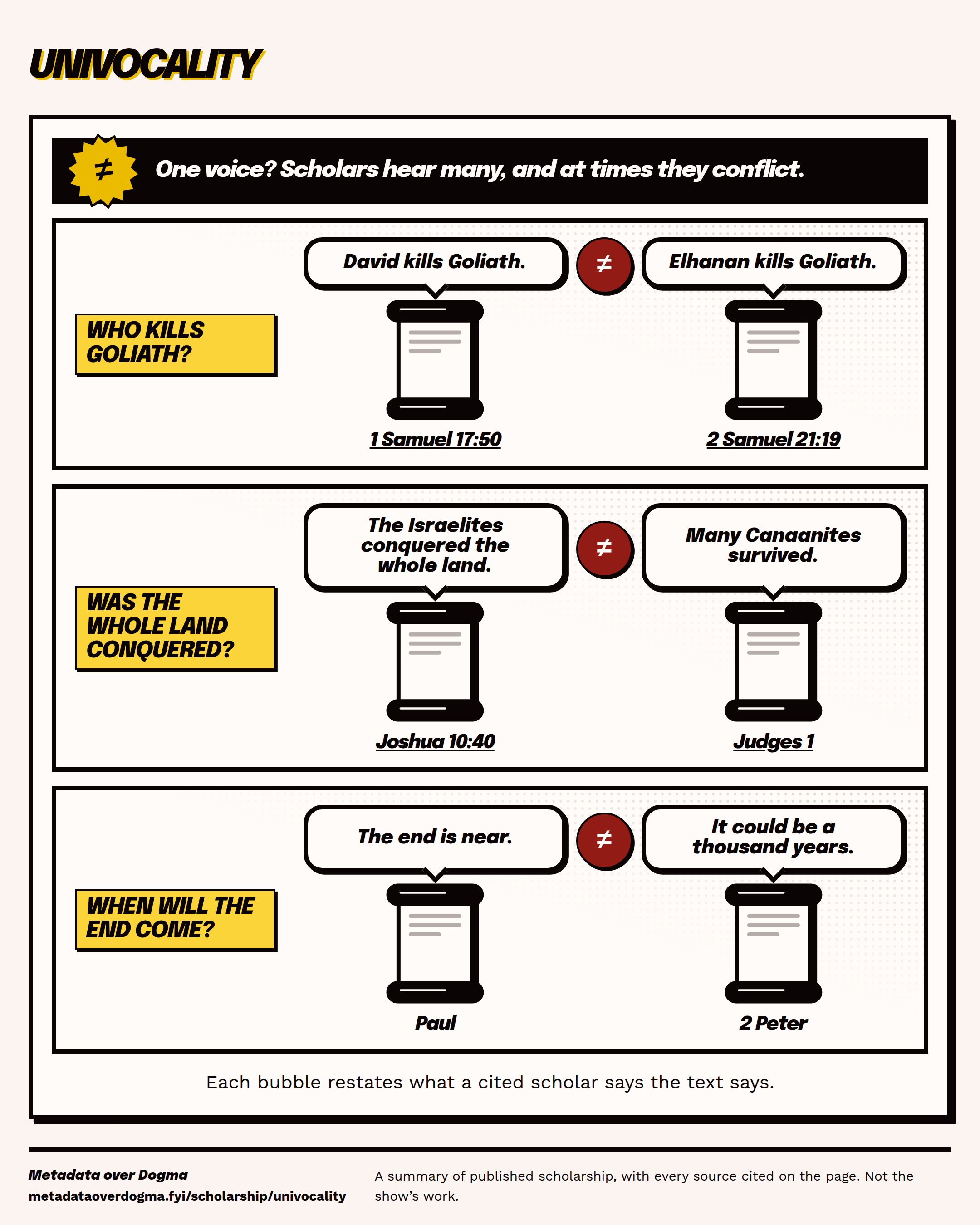
One voice?
Does the Bible speak with one voice? No. Scholars describe its books as many voices, whose views differ and at times conflict.
Christine Hayes's Yale lectures on the Hebrew Bible call it an anthology of diverse works, not an ideological monolith, and say that its legal materials do not speak with one voice: they contain provisions that contradict one another. The chapter summary for Coogan and Chapman's introductory textbook says Job and Ecclesiastes show the range of voices in the Bible, disagreeing with a theme found in the Deuteronomistic Historians and the prophets: that Israel's fate was based on divine judgment. For the New Testament, Dale Martin's Yale lectures describe 27 books with different points of view and different theologies, and the chapter summary for Ehrman's introductory textbook says its books embody different points of view. Hayes adds that the Hebrew Bible's books share some basic points of agreement, though even some of the most basic do not go uncontested.
“I don't want to leave you with the impression that the biblical materials speak with one voice — they don't.”
“Biblical legal materials contain provisions that contradict one another.”
“it follows from the fact that it's not a book but an anthology of diverse works, that it's not an ideological monolith.”
“The books of Job and Ecclesiastes demonstrate the range of voices contained in the Bible as they disagree with the overarching theme found in the Deuteronomistic Historians and the prophets that Israel’s fate was based on divine judgment.”
“27 different books, written anywhere from the year 50 to the year 150. So a hundred-year period of time that these books were probably written in. They have different points of view, different situations, different theologies, different genres.”
“Not originally composed as part of a collection, the books of the New Testament embody different points of view.”
“And certainly there are some basic points of agreement, but even some of the most basic points of agreement do not pass without some contestation.”
Is the Bible a single book? Not in origin. It is a collection of books by many authors, written and edited over many centuries.
Hayes's first lecture says the Bible is not a book but a library: an anthology of writings written and edited over an extensive period of time by people in very different situations. The chapter summary for Coogan and Chapman's textbook says the books of the Hebrew Bible are an anthology written and collected over a thousand years. Brennan Breed's Bible Odyssey article notes that the word Bible comes from the Greek biblia, “books”, and says many authors in very different places and times wrote and edited the books of the Hebrew Bible and the New Testament over a thousand-year period. Dietmar Neufeld's Bible Odyssey article says the New Testament did not begin as a unified collection: its 27 books were written by different authors between about 50 and 120 C.E. and circulated independently.
“The first is the idea that the Bible's a book. It's not a book.”
“It's a library. It's an anthology of writings or books written and edited over an extensive period of time by people in very different situations responding to very different issues and stimuli, some political, some historical, some philosophical, some religious, some moral.”
“As a starting point, it is important to note that the books of the Hebrew Bible are an anthology that was written and collected over a thousand years.”
“This is a more accurate description of what the Bible is—a collection of many books, like a library.”
“Many authors in very different places and times wrote and edited the books that constitute the Hebrew Bible and the New Testament; all told, this process extended over a thousand-year period.”
“The New Testament, however, did not begin as a unified collection of books that were divinely inspired, sacred, and authoritative.”
“While we might think of the New Testament as a single work, its 27 books were written by different authors between approximately 50 C.E. and 120 C.E. and circulated from place to place independently in the ancient Roman world within the first three centuries of early Christianity.”
Where the texts differ
Where do the books of the Hebrew Bible differ? In many places: repeated stories that contradict each other, and later books that retell earlier ones differently.
Carol Meyers's Bible Odyssey article says close study revealed biblical narratives to be replete with inconsistencies and even outright contradictions: in 1 Samuel 17:50 David kills Goliath, but in 2 Samuel 21:19 Elhanan does, and Joshua says the Israelites conquered the whole land while Judges describes the survival of many Canaanites; Hayes's lecture on Joshua and Judges adds that Judges 1 gives a long list of the places from which the Canaanites were not expelled. Hayes's lectures say the Bible contains a lot of repetition and contradiction, and that its legal materials contradict one another. The chapter summary for Coogan and Chapman's textbook says almost all biblical scholars explain the Pentateuch's repetitions, inconsistencies and contradictions by distinct sources from different historical periods. Chronicles retells Samuel and Kings: Hayes calls it the Bible interpreting itself, the textbook summary says its David has several substantive differences from the earlier account, and Jesse Ainslie and Joseph Lam's Bible Odyssey article says Kings and Chronicles tell two very different stories about King Manasseh.
“Close study of biblical narratives revealed that they are replete with inconsistencies and even outright contradictions.”
“Or in 1Sam 17:50, David kills Goliath, whereas in 2Sam 21:19, Elhanan does.”
“On a larger scale, the book of Joshua proclaims that the Israelites conquered “the whole land” (e.g., Josh 10:40), but the book of Judges describes the survival of many Canaanites and other peoples.”
“The Bible contains a lot of repetition and contradiction.”
“Biblical legal materials contain provisions that contradict one another.”
“Although the evidence does not fit as neatly into the classical formulation of the hypothesis as scholars at one time thought, almost all biblical scholars recognize that the repetitions, inconsistencies, and contradictions in the Pentateuch are best explained by the existence of distinct sources dating to different historical periods.”
“So Chronicles is already an interpretation. It's an inner-biblical interpretation. It is the Bible interpreting itself.”
“Moreover, the Chronicler’s depiction of David has several substantive differences from the Deuteronomistic Historians’ account of his life.”
“The book of Kings and the book of Chronicles tell two very different stories about King Manasseh of Judah.”
“Judges 1 gives a long list of the places from which the Canaanites were not expelled.”
Do the four Gospels tell the same story? Not in every detail. Matthew and Luke, for example, tell different stories of Jesus' birth.
The chapter summaries for Ehrman's textbook say the Synoptic Gospels also disagree, as in the different timing of Jesus' death in Mark and John, and that although Matthew and Luke share the basic narrative of Jesus' birth, none of their specific stories are the same. Helen Bond's Bible Odyssey article calls the two birth stories quite different: if historical, Luke's account would contradict Matthew's indication that Jesus was born shortly before Herod I died, and attempts to read Luke's census as an earlier one have not been successful. Dale Martin's Yale lectures list the Matthew and Luke birth narratives among accounts that are very difficult to harmonize. The HarperCollins Bible Dictionary says John presents a rather different picture of Jesus' life and ministry than the other three Gospels.
“The Gospels also, however, disagree, and scholars must account for this as well.”
“The creation of stories is made evident by variations in the Gospel narratives, such as the different timing of Jesus’ death in Mark and John.”
“Although the basic narrative is the same in both Matthew and Luke—Jesus is born in Bethlehem to a virgin named Mary who is betrothed to Joseph—none of the specific stories are the same.”
“So it can come as a surprise to realize that it only appears in two Gospels, Matthew and Luke. And their stories are quite different.”
“Furthermore, if historical, Luke’s account would contradict Matthew’s clear indication that Jesus was born shortly before the death of Herod I (that is, around a decade earlier, in 6 B.C.E.). Attempts to suggest that Luke’s reference to the “first registration” (Luke 2:2) was an earlier census carried out by Quirinius have not been successful.”
“We've also got a lot of other situations where this would be very difficult. I mentioned the differences between Matthew and Luke as far as the birth narratives.”
“The Gospel of John presents a rather different picture of Jesus’s life and ministry than do the other three Gospels.”
Do James and Paul disagree about faith and works? Scholars differ. James argues against a teaching like Paul's, but the sources read part ways on whether he targets Paul himself or a distortion of his message.
Dale Martin's Yale lectures describe a debate among scholars. In his reading, James clearly thinks he is disagreeing with a version of Christianity that looks a lot like Paul's letters, and may even think he is disagreeing with Paul, though it is hard to say; but some scholars answer that the two do not really disagree, because they work with different definitions of faith and of works. Martin leaves it open: “Maybe yes, maybe no, maybe it's a little bit of both.” The chapter summary for Ehrman's textbook says James argued against Christians who had distorted Paul's message of justification by faith. John Painter's Bible Odyssey article says the letter, which does not name Paul, confronts the challenge he presents, and that the evidence suggests the historical James and Paul were not enemies, though their relationship involved tensions.
“And here's the debate among scholars, some people have given this answer of why James and Paul don't really disagree. Because, as some of you already picked up, they're working with what seem to be different definitions of both faith and works.”
“Clearly, James thinks he's disagreeing with some kind of version of Christianity that looks an awful lot like Paul's letters. James may think he's disagreeing with Paul even, it's hard to say, he doesn't ever mention him by name.”
“So does he disagree with Paul? Maybe yes, maybe no, maybe it's a little bit of both.”
“The author of the epistle of James argued that some Christians had distorted Paul’s message of justification by faith by teaching that only a person’s beliefs, not actions, mattered for salvation.”
“Nor does it mention Paul by name: instead, it confronts the challenge he presents—most seriously in his law-free gospel that emphasizes faith in a way that seems to ignore works, hearing, and believing without doing (Jas 1:22-25, Jas 2:14-26).”
“Historically, however, the evidence suggests that though the relationship involved tensions, the two were not enemies.”
Do the New Testament writers agree on when the end will come? No. Some expect it soon; others allow for a delay before it comes.
The chapter summary on Revelation for Ehrman's textbook says Jesus and the earliest Christians, including Paul, claimed that the end of the world was near. The summary on Luke says Luke's Jesus does not preach the imminent end, which will come after the mission to the gentiles, and the summary on the Deutero-Pauline letters notes that the interim period with an antichrist in 2 Thessalonians appears nowhere else in Paul. Dale Martin's Yale lectures say 2 Peter has no franticness: it says the end could happen in a thousand years. The HarperCollins Bible Dictionary notes that some passages point to signs that the end is near, while others say it will come without warning.
“Jesus and the earliest Christians, including Paul, claimed that the end of the world was near.”
“In Luke, Jesus does not preach the imminent end. Rather, the end will occur after the mission to the gentiles is completed.”
“Nowhere else does Paul expect an interim period in which an antichrist will appear.”
“There's no franticness here, there's no idea that it's going to happen right now. In fact he says it could happen in a thousand years.”
“A number of passages suggest that certain “signs” or preliminary phenomena may indicate that Jesus’s parousia or other parousia events are imminent (Matt 24:4-34; Mark 13:5-20; Luke 21:8-28; 2Thess 2:1-12; 1John 2:18). Other texts call on readers to be ready because such events will take place without warning (see, e.g., Matt 24:43-44).”
Reading them as one
Does reading the books as one Bible hide their differences? It can. Scholars warn that a unified reading can smooth over differences that stand out when each book is read on its own.
The chapter summary for Ehrman's textbook says that when the New Testament books are read separately their differences stand out, but that canonization homogenizes them: placed in one book, their distinctive emphases are minimized. Dale Martin's Yale lectures say that much of the history of early Christianity, and the New Testament itself, was an attempt to pull diverse groups into one unified movement, and set his course against that historical tendency to make unity out of diversity. Hayes urges readers not to force the Hebrew Bible into one model: “Don't homogenize it all.” She also says the later Jewish communities that gathered these books chose to include dissonant voices together and did not strive to reconcile the conflicts, and that the final redactors wanted their woven sources read as a unity, so that the Bible can be read both analytically and synthetically.
“When the New Testament books are read separately, the differences between them stand out. The process of canonization, however, works to homogenize the texts. By placing these disparate texts into one book, the New Testament, their distinctive emphases are minimized.”
“In fact, a good bit of the history of early Christianity, and the New Testament itself, was to take what was a diverse group of different people, all somehow being loyal to this guy they called Jesus. But they weren't all the same, and they were in different geographical situations, they had different beliefs. And early Christianity was an attempt to pull all these things into one unified movement, in some way, to get some kind of uniformity of belief and practice.”
“So this course is actually going to run counter to that historical tendency to make unity out of diversity.”
“so that we can allow the biblical text to speak to us in all its polyphony. And not try to force it all into one model”
“Let the text be contradictory and inconsistent and difficult. Let it be difficult. Don't homogenize it all.”
“They chose to include all of these dissonant voices together. They didn't strive to reconcile the conflicts, nor should we.”
“whatever sources were woven together, they were woven together with great skill and care by a final redactor, or redactors, who wanted them to be read as a unity, and surely that must mean something. It must mean they can be read as a unity and that that's a challenge that's been issued to us. So the Bible can be read both analytically and synthetically.”
How did early readers handle the differences? Some reconciled them. In the second century Tatian wove the four Gospels into a single account, resolving their conflicts.
William Petersen's entry in the Gorgias Encyclopedic Dictionary of the Syriac Heritage says a Gospel harmony conflates parallel accounts so that conflicts are resolved. It suggests that the Gospels did not present the unity that was, for Tatian, the hallmark of truth, and that critics such as Celsus had ridiculed Christianity over their contradictions; it adds that none of the suggested motives is convincing on its own. Brennan Breed's Bible Odyssey article says Tatian rewrote the Gospels so that they would not conflict, and Dale Martin's Yale lectures describe his Diatessaron as one gospel made out of four. Rabbinic interpretation reconciled verses too: the Encyclopaedia Judaica entry on hermeneutics says the rabbis saw the Pentateuch as unified and consistent in all its parts, and gives a rule for two verses that contradict one another until a third reconciles them. Hayes argues that the Hebrew Bible's authority for Israel did not rest on its consistency: grounding authority in consistency or univocality, she says, is a modern notion based on Hellenistic ideals of truth as singular.
“A Gospel harmony is a complicated creation. It seeks, by acute literary skill, to conflate parallel accounts. Duplications are excised, conflicts are resolved, and nothing of importance is lost.”
“Four canonical Gospels as well as numerous extra-canonical Gospels do not present a ‘unity’ which, for Tatian, was the hallmark of truth. Here, then, one can discern a motive for creating a single, harmonized account. Second, the contradictions and inconsistencies in the Gospels had led critics such as Celsus to ridicule Christianity.”
“Various reasons for Tatian’s efforts have been suggested; none, on its own, is convincing, and the reality probably lies in a combination of motives.”
“In the second century C.E., a Christian named Tatian decided to harmonize all four canonical Greek Gospels and, at the same time, translate them into Syriac. Because the four Gospels seem to exhibit some discrepancies, Tatian rewrote them so that they would not conflict.”
“He decided to take the four gospels and do an edition that would string all the stuff from the different four gospels into one book. So he made what we call the Diatessaron, which is a Greek word that means through four. He took four books and created one gospel out of it.”
“The rabbis saw the Pentateuch as a unified, divinely communicated text, consistent in all its parts.”
“two verses contradict one another until a third verse reconciles them.”
“But this kind of polyphony didn't impinge upon the authority of the Hebrew Bible for the nation of Israel, because the Bible's authority doesn't arise from some supposed consistency or univocality. That's a modern notion and it's based on Hellenistic ideals of truth as singular.”
How do scholars read the differences today? Historical critics read each text on its own terms rather than harmonizing them; canonical criticism reads the final form as a whole.
Dale Martin's Yale lectures call it one of the fundamental rules of historical criticism not to harmonize different texts in the Bible but to take each individually, and distinguish that from a theological reading. The chapter summary for Ehrman's textbook says a historical study should read each book independently and understand its message on its own terms. Sarah Shectman's Bible Odyssey article describes canonical criticism, which takes the final form of the text as its starting point and asks how the text as a whole functions as Scripture, and says most scholars use a combination of methods. Hayes says the Bible can be read both analytically and synthetically.
“We're going to read Mark as Mark by itself, and that's one of the fundamental rules of historical criticism is don't harmonize different texts in the Bible. Take them each individually.”
“But a theological reading of the text is not the same thing as a historical critical reading of the text.”
“For a historical study of the New Testament literature, it will help to read each book independently and understand its message on its own terms.”
“Unlike the other methods discussed above, canonical criticism takes the final form of the text as its starting point and focuses on how the text as a whole functions as sacred Scripture.”
“Most scholars use a combination of these methods, as each reveals different aspects of the text”
“So the Bible can be read both analytically and synthetically.”
What do religious traditions hold about the Bible's unity? The Catholic Church teaches that Scripture is a unity by reason of God's plan, different as its books may be.
The Catechism of the Catholic Church asks readers to be especially attentive to the content and unity of the whole Scripture, and says that, different as the books which compose it may be, Scripture is a unity by reason of the unity of God's plan, of which Christ is the center. Got Questions Ministries, an evangelical ministry, grants that some verses appear to contradict each other, but holds that a difference is not a contradiction and that there are plausible answers to every supposed contradiction.
“Be especially attentive "to the content and unity of the whole Scripture". Different as the books which compose it may be, Scripture is a unity by reason of the unity of God's plan, of which Christ Jesus is the center and heart, open since his Passover.”
“Yes, there are difficult passages. Yes, there are verses that appear to contradict each other.”
“However, a difference is not a contradiction.”
“However, it is our contention that there are viable and intellectually plausible answers to every supposed Bible contradiction and error.”
Sources used
| Source | Class | Where read | Date read |
|---|---|---|---|
| Hayes 2006a Christine Hayes, Introduction to the Old Testament (Hebrew Bible), lecture 10 transcript, Open Yale Courses RLST 145 (2006) | Reference | University courseware, open | 24 Nov 2026 |
| Hayes 2006b Christine Hayes, Introduction to the Old Testament (Hebrew Bible), lecture 1 transcript, Open Yale Courses RLST 145 (2006) | Reference | University courseware, open | 24 Nov 2026 |
| Coogan and Chapman 2019a Michael D. Coogan and Cynthia R. Chapman, Student chapter 24 summary of A Brief Introduction to the Old Testament: The Hebrew Bible in Its Context, OUP Learning Link, 4th ed. (Oxford University Press, 2019) | Reference | Publisher companion page, open | 24 Nov 2026 |
| Martin 2009a Dale B. Martin, Introduction to New Testament History and Literature, lecture 1 transcript: Introduction: Why Study the New Testament?, Open Yale Courses RLST 152 (2009) | Reference | University courseware, open | 24 Nov 2026 |
| Ehrman 2020a Bart D. Ehrman, Student chapter 1 summary of A Brief Introduction to the New Testament, OUP Learning Link, 5th ed. (Oxford University Press, 2020) | Reference | Publisher companion page, open | 24 Nov 2026 |
| Hayes 2006c Christine Hayes, Introduction to the Old Testament (Hebrew Bible), lecture 19 transcript, Open Yale Courses RLST 145 (2006) | Reference | University courseware, open | 24 Nov 2026 |
| Coogan and Chapman 2019b Michael D. Coogan and Cynthia R. Chapman, Student chapter 1 summary of A Brief Introduction to the Old Testament: The Hebrew Bible in Its Context, OUP Learning Link, 4th ed. (Oxford University Press, 2019) | Reference | Publisher companion page, open | 24 Nov 2026 |
| Breeda Brennan Breed, How Was the Bible Written and Transmitted?, Bible Odyssey (Society of Biblical Literature) | Reference | Scholarly society website, open | 24 Nov 2026 |
| Neufeld Dietmar Neufeld, In What Ways Is the New Testament a “Religious Text”?, Bible Odyssey (Society of Biblical Literature) | Reference | Scholarly society website, open | 24 Nov 2026 |
| Meyers Carol Meyers, How Does the Hebrew Bible Relate to History?, Bible Odyssey (Society of Biblical Literature) | Reference | Scholarly society website, open | 24 Nov 2026 |
| Hayes 2006d Christine Hayes, Introduction to the Old Testament (Hebrew Bible), lecture 4 transcript, Open Yale Courses RLST 145 (2006) | Reference | University courseware, open | 24 Nov 2026 |
| Coogan and Chapman 2019c Michael D. Coogan and Cynthia R. Chapman, Student chapter 4 summary of A Brief Introduction to the Old Testament: The Hebrew Bible in Its Context, OUP Learning Link, 4th ed. (Oxford University Press, 2019) | Reference | Publisher companion page, open | 24 Nov 2026 |
| Hayes 2006e Christine Hayes, Introduction to the Old Testament (Hebrew Bible), lecture 22 transcript, Open Yale Courses RLST 145 (2006) | Reference | University courseware, open | 24 Nov 2026 |
| Coogan and Chapman 2019d Michael D. Coogan and Cynthia R. Chapman, Student chapter 23 summary of A Brief Introduction to the Old Testament: The Hebrew Bible in Its Context, OUP Learning Link, 4th ed. (Oxford University Press, 2019) | Reference | Publisher companion page, open | 24 Nov 2026 |
| Ainslie and Lam 2021 Jesse Ainslie and Joseph Lam, Manasseh, Bible Odyssey (Society of Biblical Literature, 2021) | Reference | Society of Biblical Literature website, open | 24 Nov 2026 |
| Hayes 2006f Christine Hayes, Introduction to the Old Testament (Hebrew Bible), lecture 12 transcript, Open Yale Courses RLST 145 (2006) | Reference | University courseware, open | 24 Nov 2026 |
| Ehrman 2020b Bart D. Ehrman, Student chapter 5 summary of A Brief Introduction to the New Testament, OUP Learning Link, 5th ed. (Oxford University Press, 2020) | Reference | Publisher companion page, open | 24 Nov 2026 |
| Ehrman 2020c Bart D. Ehrman, Student chapter 4 summary of A Brief Introduction to the New Testament, OUP Learning Link, 5th ed. (Oxford University Press, 2020) | Reference | Publisher companion page, open | 24 Nov 2026 |
| Ehrman 2020d Bart D. Ehrman, Student chapter 7 summary of A Brief Introduction to the New Testament, OUP Learning Link, 5th ed. (Oxford University Press, 2020) | Reference | Publisher companion page, open | 24 Nov 2026 |
| Bond 2018 Helen K. Bond, The Nativity, Bible Odyssey (Society of Biblical Literature, 2018) | Reference | Society of Biblical Literature website, open | 24 Nov 2026 |
| Martin 2009b Dale B. Martin, Introduction to New Testament History and Literature, lecture 13 transcript: The Historical Jesus, Open Yale Courses RLST 152 (2009) | Reference | University courseware, open | 24 Nov 2026 |
| Powell 2009 Mark Allan Powell (ed.), HarperCollins Bible Dictionary, Abridged ed. (HarperOne, 2009) | Reference | Entries reproduced on the Society of Biblical Literature's Bible Odyssey, open | 24 Nov 2026 |
| Martin 2009c Dale B. Martin, Introduction to New Testament History and Literature, lecture 18 transcript: Arguing with Paul?, Open Yale Courses RLST 152 (2009) | Reference | University courseware, open | 24 Nov 2026 |
| Ehrman 2020e Bart D. Ehrman, Student chapter 18 summary of A Brief Introduction to the New Testament, OUP Learning Link, 5th ed. (Oxford University Press, 2020) | Reference | Publisher companion page, open | 24 Nov 2026 |
| Painter 2014 John Painter, James and Paul, Bible Odyssey (Society of Biblical Literature, 2014) | Reference | Society of Biblical Literature website, open | 24 Nov 2026 |
| Ehrman 2020f Bart D. Ehrman, Student chapter 19 summary of A Brief Introduction to the New Testament, OUP Learning Link, 5th ed. (Oxford University Press, 2020) | Reference | Publisher companion page, open | 24 Nov 2026 |
| Ehrman 2020g Bart D. Ehrman, Student chapter 16 summary of A Brief Introduction to the New Testament, OUP Learning Link, 5th ed. (Oxford University Press, 2020) | Reference | Publisher companion page, open | 24 Nov 2026 |
| Martin 2009d Dale B. Martin, Introduction to New Testament History and Literature, lecture 24 transcript: Apocalyptic and Accommodation, Open Yale Courses RLST 152 (2009) | Reference | University courseware, open | 24 Nov 2026 |
| Ehrman 2020h Bart D. Ehrman, Student chapter 9 summary of A Brief Introduction to the New Testament, OUP Learning Link, 5th ed. (Oxford University Press, 2020) | Reference | Publisher companion page, open | 24 Nov 2026 |
| Hayes 2006g Christine Hayes, Introduction to the Old Testament (Hebrew Bible), lecture 2 transcript, Open Yale Courses RLST 145 (2006) | Reference | University courseware, open | 24 Nov 2026 |
| Hayes 2006h Christine Hayes, Introduction to the Old Testament (Hebrew Bible), lecture 5 transcript, Open Yale Courses RLST 145 (2006) | Reference | University courseware, open | 24 Nov 2026 |
| Petersen 2011 William L. Petersen, Diatessaron, Gorgias Encyclopedic Dictionary of the Syriac Heritage, Print ed. 2011; electronic ed., Beth Mardutho (Gorgias Press, 2011) | Reference | Online edition, open | 24 Nov 2026 |
| Breedb Brennan Breed, What Are the Earliest Versions and Translations of the Bible?, Bible Odyssey (Society of Biblical Literature) | Reference | Scholarly society website, open | 24 Nov 2026 |
| Martin 2009e Dale B. Martin, Introduction to New Testament History and Literature, lecture 2 transcript: From Stories to Canon, Open Yale Courses RLST 152 (2009) | Reference | University courseware, open | 24 Nov 2026 |
| Jacobs and Derovan Louis Jacobs and David Derovan, Hermeneutics, Encyclopaedia Judaica, 2nd ed. (entry credit line) | Reference | Entry reproduced on Encyclopedia.com, open | 24 Nov 2026 |
| Martin 2009f Dale B. Martin, Introduction to New Testament History and Literature, lecture 6 transcript: The Gospel of Mark, Open Yale Courses RLST 152 (2009) | Reference | University courseware, open | 24 Nov 2026 |
| Shectman Sarah Shectman, How Do Biblical Scholars Read the Hebrew Bible?, Bible Odyssey (Society of Biblical Literature) | Reference | Scholarly society website, open | 24 Nov 2026 |
| Catechism of the Catholic Church, §112 Catechism of the Catholic Church, §112 (Libreria Editrice Vaticana) | Tradition | vatican.va, open | 24 Nov 2026 |
| Does the Bible contain errors, contradictions, or discrepancies? Does the Bible contain errors, contradictions, or discrepancies? (Got Questions Ministries) | Tradition | Ministry website, open | 24 Nov 2026 |