This page is Metadata over Dogma’s summary of published scholarship. It is not the show’s work and has not been reviewed by the Hosts. The Episode quotes below prompted the page; they are not its sources.
Prompted by 2 Episodes · not the show’s work
“But I just want to briefly cover the origins of the Shroud of Turin, because the first time it pops up in the historical record is in 1356 in a town in France where our first records of it are all rejections of its authenticity.”
“And according to this letter that was written to Pope Clement VII, after a thorough investigation, they found the artist who created it and he admitted to having painted it, what, 1389.”
“They all come up with roughly the same result. This dates to the mid-1200s to the late 1300s CE.”
“And immediately afterwards, of course, you have a bunch of people crying foul that they did it all wrong and that, oh, and there was one person who published a study suggesting that the radiocarbon dating had actually come from a patch that had been sewn into the Shroud that was of medieval production.”
“And, and they claim that the results from the Shroud of Turin are consistent with 2000 year old fabric. Although, and here's the part that baffles me, they suggest that the results only work if the Shroud has been kept in an environment with a temperature that averages between 68 and 72.5 degrees Fahrenheit.”
“They looked at the blood. So there's supposed to be some blood stains on the, on the shroud showed that. Tested how blood would drip and flow with the arms in various orientations and showed that whoever this was here, that blood could not have flowed the way it did with them laying down.”
“I find it hilarious that the first time the Shroud of Turin explicitly shows up in any historical documentation is from the bishop who says some people conjured up this fake shroud and tried to pass it off as authentic, but we caught the guy.”
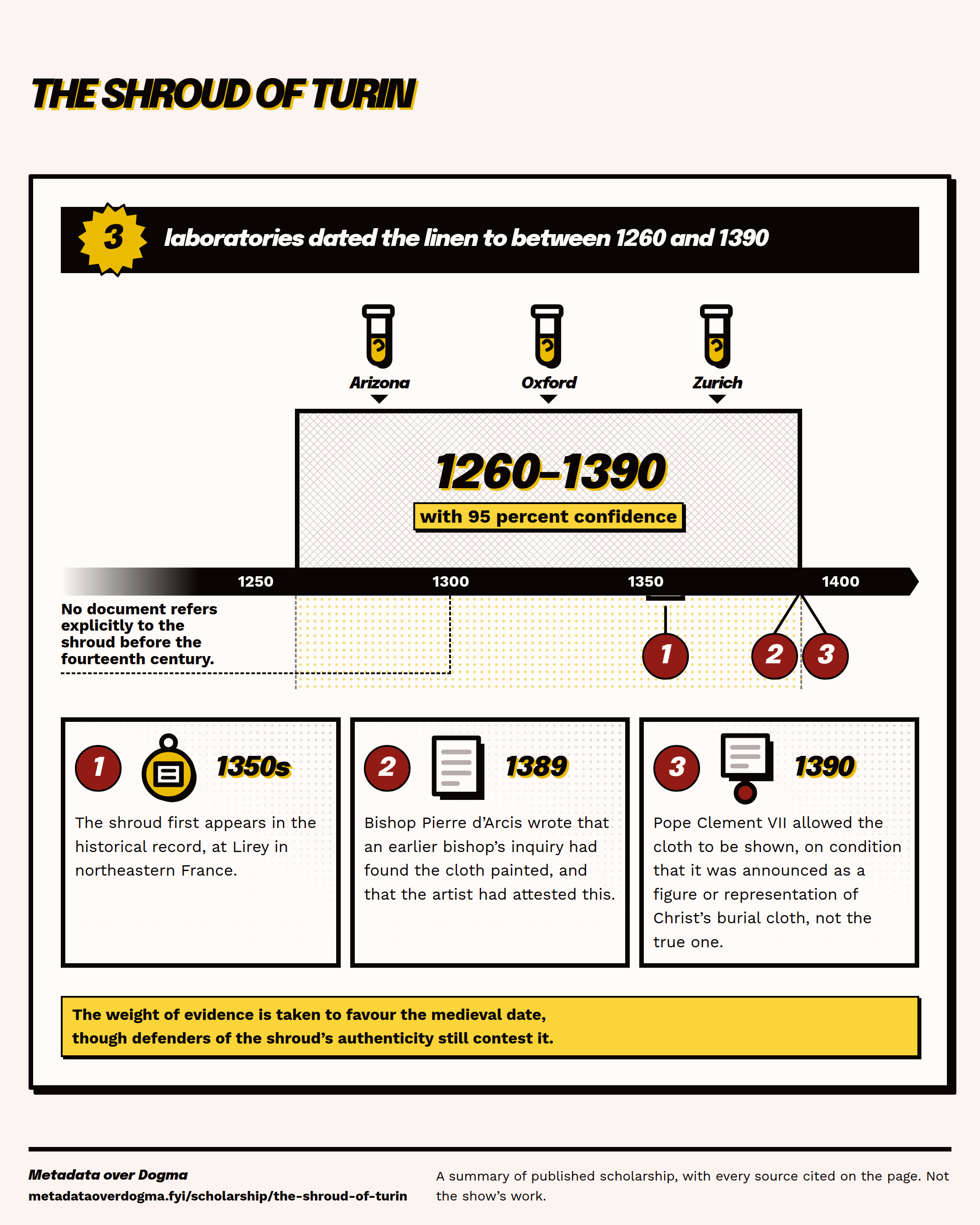
The fourteenth-century record
When does the shroud first appear in the historical record? At Lirey, a village in northeastern France, in the 1350s.
The New Catholic Encyclopedia entry says the shroud's whereabouts are well attested back to the mid-14th century but not earlier, and that about 1357 it was exhibited at Lirey, a village near Troyes in northeastern France. A pilgrim's medallion from that exhibition, preserved at the Musée de Cluny in Paris, shows that it was then owned by Geoffrey de Charny and his wife, Jeanne de Vergy. Andrea Nicolotti dates its appearance at Lirey to approximately 1355, in a collegiate church built with funds from the nobleman Geoffroi de Charny and completed in 1353. Britannica places the first historical account in 1354, when it was recorded in the hands of Geoffroi de Charnay, seigneur de Lirey, and says there is no record of how he came by it.
“The whereabouts of this object is well attested back to the mid-14th century but not earlier.”
“There is clear evidence, however, that about 1357 the shroud was exhibited in Lirey, a village near Troyes in northeastern France.”
“The Musée de Cluny in Paris still preserves a pilgrim's medallion from this exhibition, and this object attests that the shroud was then in possession of Geoffrey de Charny and his wife, Jeanne de Vergy.”
“In approximately 1355 it appeared at Lirey, a village in Champagne, inside a collegiate church built with funds provided by the nobleman Geoffroi de Charny, completed in 1353 and dedicated to the Trinity and the Annunciation of Mary.”
“The first historical account of the shroud occurs in 1354, when it is recorded that it wound up in the hands of a famed knight, Geoffroi de Charnay, seigneur de Lirey. There is no record of how he came into possession of it.”
Is the shroud attested before the fourteenth century? No document refers explicitly to it before the fourteenth century, and theories of its earlier history, such as Ian Wilson's identification of it with the Mandylion of Edessa, have not won universal scholarly support.
The New Catholic Encyclopedia entry says that Ian Wilson and other investigators have proposed theories about the shroud's history before the mid-14th century, but that for lack of hard evidence they have not enjoyed universal scholarly support. Wilson's own theory identifies the shroud with the Mandylion of Edessa, the legendary towel bearing Jesus's face. Andrea Nicolotti, author of a book-length study of the Mandylion, writes that the theory, which Wilson devised in the 1970s, has convinced no one, except perhaps sindonologists. Reviewing that book, Anna Russakoff of the American University of Paris notes that the shroud is a burial linen almost 4.5 metres long, while the Edessa image was by most accounts the size of a hand towel and showed Jesus's face alive with his eyes open. She judges that Nicolotti has convincingly shown the two are distinct objects, and notes that no documents referring explicitly to the shroud date from before the fourteenth century.
“While Ian Wilson and other investigators have proposed various theories about the shroud's history prior to that date, these, because of the lack of hard evidence, have not enjoyed universal scholarly support.”
“Ian Wilson insists on positing that the Shroud is the so-called Mandylion—that is, the legendary “hand-kerchief” or “towel”—of Edessa. This is a theory he himself invented in the 1970s and which has succeeded in convincing no one, except perhaps sindonologists.”
“For one thing, the Shroud, unattested before the fourteenth century, is a burial linen, almost 4.5m long and more than 1.1m wide”
“The Edessean image, on the other hand, was by most accounts the size of a hand towel, and featured the face of Jesus in color and alive with his eyes open.”
“Yet there are no documents that refer explicitly to the Shroud that date prior to the fourteenth century, and radiocarbon dating places it between 1260 and 1390. In any case, Nicolotti has convincingly and methodically shown that throughout the textual and visual accounts, the Shroud and the Mandylion are two distinct objects.”
What did the bishop of Troyes say about it? In 1389 Bishop Pierre d'Arcis wrote that an earlier bishop's inquiry had found the cloth painted, and that the artist who painted it had attested this.
In 1389 Pierre d'Arcis, bishop of Troyes, wrote to Pope Clement VII asking him to stop the cloth's public display. The New Catholic Encyclopedia entry says d'Arcis agreed with his predecessor, Henry of Poitiers, who had objected when the de Charny family displayed it, claiming it was a fraudulent invention; d'Arcis called it a product of human handicraft (manufactus) and an artificial painting or depiction (artificialiter depictus). Nicolotti's translation of d'Arcis's account reports that Henri de Poitiers's inquiry discovered the fraud and how the cloth had been artificially portrayed, and that the artist who had portrayed it proved it was made by human skill, not miraculously. Britannica gives the bishop's words as “cunningly painted, the truth being attested by the artist who painted it.” Nicolotti infers that the image had been made in the middle of the century or a few years before, at the earliest, and that the maker was most likely still alive around 1355.
“When the de Charny family displayed the shroud at Lirey in 1357, the bishop of Troyes, Henry of Poitiers, objected strongly, claiming that the shroud was a fraudulent invention. In 1389 a later bishop of Troyes, Pierre d'Arcis, wrote a letter to Pope Clement VII at Avignon in which he expressed strong agreement with his predecessor's concerns.”
“Because the shroud, said Bishop D'Arcis, is "a product of human handicraft" (manufactus ) and "an artificial painting or depiction" (artificialiter depictus ), the pope should act to put an end to its public display.”
“According to the 1389 account by Pierre d’Arcis, the bishop of Troyes, an investigation carried out by one of his predecessors, Henri de Poitiers, revealed that”
“At length, after diligent efforts and from information taken, at last was discovered the fraud and how that cloth had been artificially portrayed. It was even proved by the artist who had portrayed it that it was made by human skill, and was not made or bestowed miraculously”
“In 1389, when it went on exhibition, the shroud was denounced as false by the local bishop of Troyes, who declared it “cunningly painted, the truth being attested by the artist who painted it.””
“This investigation, therefore, reveals that the image of Christ imprinted on the cloth had been made in the middle of the century or a few years before, at the earliest (the maker was most likely still alive around 1355)”
How did Pope Clement VII respond? He allowed the cloth to be shown, on condition that it was announced as a figure or representation of Christ's burial cloth, not the true one.
Clement VII, the pope at Avignon (Britannica calls him the Avignon antipope), did not ban the showings. Nicolotti writes that in 1390 Clement issued a bull licensing the canons of Lirey to display the cloth, on condition that they announce in a loud and intelligible voice that they were showing it not as the true shroud of Jesus but as a figure or representation of it. The New Catholic Encyclopedia entry quotes the order in a form that calls the cloth only a kind of painting or picture made as a representation of the burial cloth, and adds that Clement forbade any liturgical ceremony or pomp at the showings. Britannica says he refrained from giving his own opinion on its authenticity but sanctioned its use as an object of devotion if it was exhibited as an image or representation of the true shroud.
“The conflict was resolved in 1390 when Pope Clement VII issued a bull in which he granted the canons of Lirey a license to display the Shroud to the faithful, with the obligation, however, that they abide by a specific rule”
“during the ostensions they had to announce “in a loud and intelligible voice, all fraud ceasing” that they did not intend to display the Shroud “as the true shroud of our Lord Jesus Christ, but as a figure or representation of the shroud that is said to have belonged to our Lord Jesus Christ””
“While the pope in his response chose a more cautious route, he did insist that when the shroud was displayed, there should be no liturgical ceremony or pomp.”
“that the aforesaid representation [the shroud] is not the true burial cloth (sudarium ) of our Lord Jesus Christ but only a kind of painting or picture made as a form or representation (in figuram seu representationem ) of the burial cloth.”
“The Avignon antipope Clement VII (reigned 1378–94) refrained from expressing his opinion on the shroud’s authenticity but sanctioned its use as an object of devotion provided that it be exhibited as an “image or representation” of the true shroud.”
The radiocarbon date
What did the 1988 radiocarbon dating find? Three laboratories dated the linen to between 1260 and 1390, with 95 percent confidence.
In 1988 samples from a single portion of the shroud were dated by accelerator mass spectrometry at the University of Arizona, the University of Oxford and the Federal Institute of Technology (ETH) in Zurich. Lloyd Currie, writing in the journal of the US National Institute of Standards and Technology, says the shroud samples were distributed blind to the three laboratories along with three control samples of known age. The results were published in Nature in 1989, and the paper's abstract says they provide conclusive evidence that the linen is mediaeval. The New Catholic Encyclopedia entry says the British Museum's Research Laboratory analysed the results statistically and reported that, within 95 percent confidence limits, the linen dated between 1260 and 1390 AD, not earlier; Ioannis Karapanagiotis's 2025 review of the scientific studies gives the same range. Currie gives the unrounded figure, 1262 to 1384 AD, and Paolo Di Lazzaro and colleagues, who question the result, explain that 1260–1390 is that range rounded to the decade.
“Very small samples from the Shroud of Turin have been dated by accelerator mass spectrometry in laboratories at Arizona, Oxford and Zurich.”
“The results provide conclusive evidence that the linen of the Shroud of Turin is mediaeval.”
“Three highly competent laboratories were selected: the University of Arizona, Oxford University, and the Swiss Federal Institute of Technology [ETH] in Zürich. Samples of the Shroud, plus three control samples of known age, were distributed blind to the three laboratories.”
“Radiocarbon dating of the cloth, however, yielded a result of 1262 to 1384 AD (95 % confidence interval)”
“Particularly damaging to any theory of authenticity were the Carbon-14 tests separately conducted in 1988 by laboratories in Tucson, Oxford, and Zurich on small fragments taken from a single portion of the shroud clear of any patching or charring.”
“The Research Laboratory of the British Museum did a statistical analysis of these results and reported that, within 95 percent confidence limits, the date for the linen of the shroud had to range somewhere between 1260 and 1390 AD, not earlier.”
“Three samples (about 50 mg each) were prepared from the strip and were delivered to the three laboratories for the radiocarbon measurements, which provided evidence that the Shroud of Turin dated to the medieval era and had been manufactured, with 95% confidence, between 1260 and 1390 AD.”
“Joining the two probability curves, one gets 1262–1384 AD, which, rounded to the decade, gives the sample age between 1260 and 1390 AD, with a confidence level of 95%.”
Has the medieval date held up? The weight of evidence is taken to favour it, though defenders of the shroud's authenticity still contest it.
The New Catholic Encyclopedia entry says the preponderance of evidence would seem to suggest a medieval date, though some scholars still strenuously argue for authenticity, and that the findings have been vigorously contested by the defenders of the shroud's authenticity. It adds that, while debate continues about such objections, radiocarbon dating is hardly a new technology and scientists have extensive familiarity with contaminants and how to deal with them. Currie adds that the agreement of the result with the Lirey documents seems compelling. Karapanagiotis's 2025 review concludes that the challenges published so far are insufficient to overturn the finding and that the medieval date is difficult to dismiss, and expects that, unless universally accepted evidence shows the dating was flawed, most scientists will remain skeptical of the shroud's authenticity. The challenges also appear in peer-reviewed journals. Tristan Casabianca and colleagues, analysing the raw data released in 2017, argue that the data lack homogeneity and that the procedure should be reconsidered, and Di Lazzaro and colleagues conclude that the 1988 dating does not match current accuracy requirements. Currie himself notes that the shroud results were only marginally consistent among the three laboratories. Rachel Freer-Waters of the Arizona State Museum and Timothy Jull of the University of Arizona's radiocarbon laboratory, one of the three that dated the shroud, write that none of the many reports questioning the measurement was sufficient to challenge it. Di Lazzaro and colleagues and Karapanagiotis both report support for a new test: the former write that virtually all researchers agree a repeat would be informative, and Karapanagiotis that many researchers advocate one, with samples taken away from the edge of the cloth.
“While at this point the preponderance of evidence would seem to suggest a medieval date for the origin of this object, there are still scholars who would strenuously argue for its authenticity.”
“These findings have been vigorously contested by the defenders of the shroud's authenticity.”
“While debate continues about such issues, C-14 dating is hardly a new technology and scientists at this point have extensive familiarity with the problem of contaminants and methods for dealing properly with them in this sort of analysis.”
“Consistency of the AMS results with the existing (Lirey) documentation seems compelling”
“It is concluded that the evidence from the significant reports published to date, which challenge the radiocarbon dating, is insufficient to overturn its finding.”
“The carbon-14 dating of the Shroud of Turin determined that it is a medieval fabric, a result that is difficult to dismiss, despite the various concerns and disputes which have been expressed over the years.”
“Consequently, unless universally accepted evidence is presented that proves that the 1989 radiocarbon dating was flawed at some point in its implementation, most scientists will remain skeptical of the Shroud’s authenticity, viewing it as a strange, medieval object with no direct connection to the burial of Jesus from Nazareth.”
“In 2017, in response to a legal request, all raw data kept by the British Museum were made accessible. A statistical analysis of the Nature article and the raw data strongly suggests that homogeneity is lacking in the data and that the procedure should be reconsidered.”
“These analyses suggest that the 1988 radiocarbon dating does not match the current accuracy requirements.”
“Sample-1 (Shroud) results, however, were just marginally consistent among the three laboratories”
“There have been many reports (too numerous to list here) that questioned various aspects of the dating measurement, but none of these were sufficient to challenge the 14C dating measurement itself.”
“Virtually all researchers agree that it would be interesting and methodologically informative to repeat the radiocarbon dating of the Shroud.”
“Nevertheless, many researchers advocate for repeating the radiocarbon dating in the future, this time using samples not from the edge of the fabric but, if possible, from different areas close to the body image.”
Was the dated sample a later repair? That is disputed: some researchers argue the sampled strip was a later repair, while the Arizona laboratory found no evidence of one in its own sample.
Karapanagiotis's review reports a strong disagreement over whether the strip cut for the samples was part of the original cloth; if it was a later repair, the date would not reflect the shroud's true age. He summarises the case Raymond Rogers made in 2005: that the radiocarbon samples contained cotton fibres, unlike the main cloth, that they carried a gum, dye and mordant coating, and that they came from a repair dyed to match the original. Freer-Waters and Jull examined a fragment of the Arizona sample and found no evidence of coatings or dyes, only minor contaminants, and nothing to contradict its having come from the main part of the shroud; the few cotton fibres they saw, they suggest, may come from wrapping the cloth in cotton. Karapanagiotis calls Rogers's reading of his mass spectra rather incomplete. Di Lazzaro and colleagues suggest that the sampling site possibly included a patch added in later centuries, though they note that a textile expert found no mending visible to the naked eye beside it.
“A strong disagreement has emerged concerning the authenticity of the strip, used for preparing the radiocarbon dating samples.”
“If the removed strip was not part of the original fabric but rather a later repair, then the resulting radiocarbon date would not reflect the true age of the Shroud.”
“It was reported that the radiocarbon samples contained cotton fibers, whereas samples from the main cloth did not. Moreover, according to Rogers, a gum/dye/mordant coating was revealed by optical microscopy on the surfaces of the samples originating from the radiocarbon strip and the Raes sample [114].”
“According to Rogers, both samples corresponded to a repair which was dyed, probably with madder, to match the original material [114].”
“we find no evidence to contradict the idea that the sample studied was taken from the main part of the shroud, as reported by Damon et al. (1989). We also find no evidence for either coatings or dyes, and only minor contaminants.”
“The presence of a few cotton fibers is not unusual. It is possible cotton fibers are present from wrapping the textile in a cotton cloth, a practice that is still used in textile storage.”
“The above interpretation of the mass spectra of Figure 4 is rather incomplete.”
“possibly, the sampling site included a patch added in later centuries, a repair having been made to the corner.”
“On the other hand, the textile expert [51] did not find discontinuities or mending visible to the naked eye in the area adjacent to the radiocarbon sampling.”
What did the 2022 X-ray dating study claim? That the linen could be about 2,000 years old, if it had been kept at an average temperature of 20.0–22.5 °C and relative humidity of 75–55 percent for thirteen centuries of unknown history.
Liberato De Caro and colleagues measured the natural ageing of the linen's cellulose by X-ray analysis of a sample about 0.5 by 1 millimetre, supplied by their co-author Giulio Fanti. They found the cloth much older than the radiocarbon date, and their results compatible with a 2,000-year-old relic, as Christian tradition supposes, on condition that it was kept at an average temperature of 20.0–22.5 °C and correlated relative humidity of 75–55 percent for 13 centuries of unknown history. They write that a more systematic X-ray investigation of more samples would be needed to confirm their conclusions. Karapanagiotis notes that such age estimates, like those from mechanical testing and vibrational spectroscopy, come from indirect methods developed with a limited number of samples, and that flax ages by complex and varied processes whose rates can differ.
“The degree of natural aging of the cellulose that constitutes the linen of the investigated sample, obtained by X-ray analysis, showed that the TS fabric is much older than the seven centuries proposed by the 1988 radiocarbon dating. The experimental results are compatible with the hypothesis that the TS is a 2000-year-old relic, as supposed by Christian tradition, under the condition that it was kept at suitable levels of average secular temperature—20.0–22.5 °C—and correlated relative humidity—75–55%—for 13 centuries of unknown history, in addition to the seven centuries of known history in Europe.”
“The size of the linen sample was about 0.5 mm × 1 mm.”
“G.F. furnished the samples.”
“a more accurate and systematic X-ray investigation of more samples taken from the TS fabric would be mandatory to confirm the conclusions of our study.”
“It should be noted that, while these methods are worth investigating, they are indirect approaches developed with a limited number of samples due to the challenge of sourcing ancient textiles. Furthermore, the aging mechanisms of flax involve complex and varied processes that can result in differing rates of degradation [143].”
The image and the blood
Do scientists know how the image was made? No. There is no agreed explanation of how the image formed.
The New Catholic Encyclopedia entry says there is no agreement whatsoever as to how the body images came to exist on the cloth, and Karapanagiotis's review that no scientific hypothesis or artistic recreation has achieved universal acceptance, so that a widely accepted explanation is still lacking. Britannica says tests since the 1970s for paints or other pigments, scorches and other agents proved inconclusive. Karapanagiotis reports that Walter McCrone argued the image was the work of a medieval artist using iron oxide and mercury sulfide as pigments, against the STURP result that iron oxide is too sparse to form the image. He writes that the majority of scientists agree the body image is not a painting and the bloodstains are blood, though the presence of iron oxides and mercury sulfide still raises questions; Di Lazzaro and colleagues likewise judge it unlikely to have been painted. Luigi Garlaschelli made a full-sized replica that closely resembled the original in many aspects, but, as with every other reconstruction, Karapanagiotis writes, it was not widely accepted and faced criticism.
“The matter is made all the more complicated because there is no agreement whatsoever as to how the body images came to exist on the cloth.”
“It is important to note that no single scientific hypothesis or artistic recreation has achieved universal acceptance; all remain speculative. Therefore, a widely accepted, comprehensive explanation for the formation mechanism of the Shroud image is still lacking.”
“Beginning in the 1970s, tests were made to determine whether the images were the result of paints (or other pigments), scorches, or other agents; none of the tests proved conclusive.”
“In essence, McCrone argued that his investigation on the 32 samples from the Shroud showed that the image on the linen cloth is the work of a medieval artist who used Fe₂O₃ and HgS as pigments, and collagen as a binding medium.”
“This conclusion is in contradiction with the STURP result, according to which Fe₂O₃ cannot contribute to the image formation because its concentration is too low.”
“The majority of the scientists agree that the body image is not a painting and that the bloodstains are made of blood. However, the presence of iron oxides and, to a lesser extent, mercury sulfide continues to raise questions about their role in the formation of the image.”
“The image is unlikely to have been painted”
“An interesting investigation which supported the artistic origin of the Shroud was published by Garlaschelli, who successfully created a full-sized replica of the Shroud of Turin that closely resembled the original in many aspects [68].”
“As with all other attempts to reconstruct the Shroud, Garlaschelli’s effort was not widely accepted and faced criticism [69].”
What did a bloodstain-pattern study of the shroud find? That the blood flows on different parts of the body are inconsistent with one another.
Matteo Borrini and Luigi Garlaschelli tested how blood would flow from the wounds shown on the shroud. They report that the two short rivulets on the back of the left hand fit only a standing subject with arms at about 45 degrees, while the forearm stains require nearly vertical arms; that the chest wound bleeds realistically for a standing position, while the stains on the back, supposedly from the same wound on a corpse lying on its back, are totally unrealistic. Karapanagiotis summarises their finding as blood patterns from different areas of the body that are inconsistent with one another, and notes that their conclusions were met with criticism.
“The two short rivulets on the back of the left hand of the Shroud are only consistent with a standing subject with arms at a ca 45° angle. This angle is different from that necessary for the forearm stains, which require nearly vertical arms for a standing subject.”
“The BPA of blood visible on the frontal side of the chest (the lance wound) shows that the Shroud represents the bleeding in a realistic manner for a standing position while the stains at the back—of a supposed postmortem bleeding from the same wound for a supine corpse—are totally unrealistic.”
“On the contrary, Borrini and Garlaschelli reported experimental results indicating that the alleged flowing blood patterns from different areas of the body are inconsistent with one another [11]. Their conclusions, however, were met with criticism [12,13].”
The Church
Does the Catholic Church say the shroud is authentic? No. It has made no official pronouncement on the shroud's authenticity.
Britannica says the Holy See has not made any official pronouncement on the relic's authenticity, and that after the 1988 results the Vatican encouraged scientists to investigate further and recommended that Christians continue to venerate the shroud as an inspiring image of Christ. The New Catholic Encyclopedia entry says Church authorities have been generally reserved, or even quite negative, about its authenticity. Speaking before the shroud in Turin in 1998, Pope John Paul II said that, since it is not a matter of faith, the Church has no specific competence to pronounce on these questions and entrusts their investigation to scientists; for the believer, he said, what counts above all is that the shroud is a mirror of the Gospel.
“Upon receiving the results of the tests, the Vatican encouraged scientists to conduct further investigations of the shroud’s authenticity and recommended that Christians continue to venerate the shroud as an inspiring image of Christ. Nonetheless, the Holy See has not made any official pronouncements concerning the relic’s authenticity.”
“Church authorities have been generally reserved, or even quite negative, about the shroud's authenticity.”
“Since it is not a matter of faith, the Church has no specific competence to pronounce on these questions. She entrusts to scientists the task of continuing to investigate, so that satisfactory answers may be found to the questions connected with this Sheet”
“For the believer, what counts above all is that the Shroud is a mirror of the Gospel.”
Sources used
| Source | Class | Where read | Date read |
|---|---|---|---|
| Wild R. A. Wild, Shroud of Turin, New Catholic Encyclopedia | Reference | Encyclopedia.com, open | 24 Nov 2026 |
| Nicolotti 2019 Andrea Nicolotti, The Acquisition of the Shroud by the House of Savoy: Documentary Evidence, In Paolo Cozzo, Andrea Merlotti and Andrea Nicolotti (eds.), The Shroud at Court: History, Usages, Places and Images of a Dynastic Relic, 20–56 (Brill, 2019) | Scholarly | Author's copy, University of Turin repository (PDF), open | 24 Nov 2026 |
| Shroud of Turin 2026 Shroud of Turin, Encyclopaedia Britannica, Online, revised by René Ostberg (Encyclopaedia Britannica, 2026) | Reference | Online encyclopedia; opens in a browser, refuses scripted requests | 24 Nov 2026 |
| Nicolotti 2024 Andrea Nicolotti, Letter to the Editor: “The Shroud of Turin: A Response to Ian Wilson”, The Catholic Historical Review 110 (1): 102–110 (Catholic University of America Press, 2024) | Scholarly | Author's copy, University of Turin repository (PDF), open | 24 Nov 2026 |
| Russakoff 2015 Anna Russakoff, Review of Andrea Nicolotti, From the Mandylion of Edessa to the Shroud of Turin, The Medieval Review 15.10.33 (Indiana University, 2015) | Scholarly | Open-access review journal | 24 Nov 2026 |
| al. 1989 P. E. Damon et al., Radiocarbon dating of the Shroud of Turin, Nature 337 (6208): 611–615 (Nature, 1989) | Scholarly | Publisher abstract, open; full text paywalled | 24 Nov 2026 |
| Currie 2004 Lloyd A. Currie, The Remarkable Metrological History of Radiocarbon Dating [II], Journal of Research of the National Institute of Standards and Technology 109 (2): 185–217 (National Institute of Standards and Technology, 2004) | Scholarly | Publisher PDF, open | 24 Nov 2026 |
| Karapanagiotis 2025 Ioannis Karapanagiotis, The Shroud of Turin: An Overview of the Archaeological Scientific Studies, Textiles 5 (1): 8 (MDPI, 2025) | Scholarly | Open-access journal; opens in a browser, refuses scripted requests | 24 Nov 2026 |
| Ricci and Wadhams 2020 Paolo Di Lazzaro, Anthony C. Atkinson, Paola Iacomussi, Marco Riani, Marco Ricci and Peter Wadhams, Statistical and Proactive Analysis of an Inter-Laboratory Comparison: The Radiocarbon Dating of the Shroud of Turin, Entropy 22 (9): 926 (MDPI, 2020) | Scholarly | Published version, LSE research repository (PDF), open | 24 Nov 2026 |
| Pernagallo and Torrisi 2019 Tristan Casabianca, Emanuela Marinelli, Giuseppe Pernagallo and Benedetto Torrisi, Radiocarbon Dating of the Turin Shroud: New Evidence from Raw Data, Archaeometry 61 (5): 1223–1231 (Wiley, 2019) | Scholarly | Publisher abstract, open in a browser; full text paywalled | 24 Nov 2026 |
| Freer-Waters and Jull 2010 Rachel A. Freer-Waters and A. J. Timothy Jull, Investigating a Dated Piece of the Shroud of Turin, Radiocarbon 52 (4): 1521–1527 (Cambridge University Press, 2010) | Scholarly | Publisher PDF, open | 24 Nov 2026 |
| Giannini and Fanti 2022 Liberato De Caro, Teresa Sibillano, Rocco Lassandro, Cinzia Giannini and Giulio Fanti, X-ray Dating of a Turin Shroud’s Linen Sample, Heritage 5 (2): 860–870 (MDPI, 2022) | Scholarly | Publisher PDF hosted by the authors' institute (CNR), open | 24 Nov 2026 |
| Borrini and Garlaschelli 2019 Matteo Borrini and Luigi Garlaschelli, A BPA Approach to the Shroud of Turin, Journal of Forensic Sciences 64 (1): 137–143 (Wiley, 2019) | Scholarly | Publisher abstract, open in a browser; full text paywalled | 24 Nov 2026 |
| II 1998 John Paul II, Address of His Holiness Pope John Paul II [before the Shroud, Cathedral of Turin] (Holy See, 1998) | Tradition | vatican.va, open | 24 Nov 2026 |