This page is Metadata over Dogma’s summary of published scholarship. It is not the show’s work and has not been reviewed by the Hosts. The Episode quotes below prompted the page; they are not its sources.
Prompted by 4 Episodes · not the show’s work
“So most scholars would agree that we've got two different creation stories in the first three chapters of Genesis—one that's running from Genesis 1:1 up through the first half of Genesis 2: 4. And, and the second one runs from the second half of Genesis 2:4 through to the end of chapter three. And that second one, most scholars would say, is probably the earlier one.”
“So the opening word there seems to be saying, "In the beginning of God's creating the heavens and the earth," which is what we would call a temporal clause.”
“So the word there in Hebrew is raqia, which comes from a verb that means to hammer out. And so the. The idea is kind of an enormous solid dome, like a crystalline dome, that was created in order to suspend or hold up the waters of the heavens and separate them from the waters of the earth to allow later the dry land to appear.”
“And then day three corresponds to day six, where we have the inhabitants of the dry lands and everything else is. Is filled in. So there's a symmetry to this presentation of the creation account, which I think is. Is a good reason to think this was intended to be symbolic.”
“Yeah, so I think there are parts of P that are very much sort of an adaptation of Mesopotamian myths. I don't really see the connection with Genesis 1 and Enuma Elish particularly strongly.”
“I am still of the opinion and I might... I... I'm probably in the majority in North America, but in the minority vis-a-vis some of my European colleagues. I think the non-P strand is a pre-P strand and probably pre-exilic.”
“And one of the things that we pointed out is that correctly interpreted, there's no creation ex nihilo going on there. That everything seems to have been created from the, the chaotic murky waters of creation that probably had some kind of unformed earth submerged beneath them.”
Two accounts
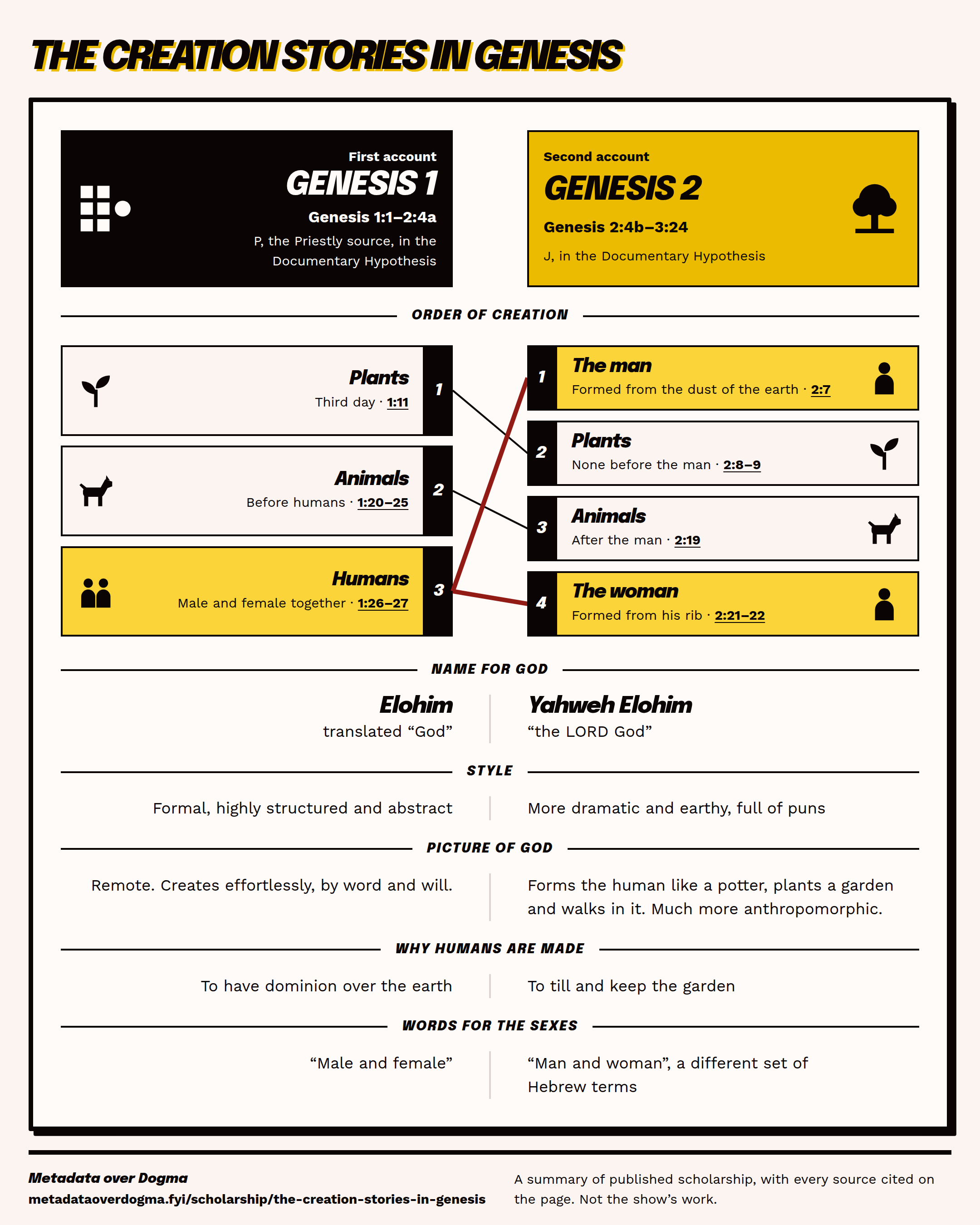
Does Genesis open with two different creation accounts? Yes. Scholars read Genesis 1:1–2:4a and the story that begins at 2:4b as two distinct accounts by different writers.
Christine Hayes's Yale lecture says there are in fact two creation stories in Genesis, with quite a few contradictions between them: the first, in Genesis 1, concludes in Genesis 2:4, and the second begins in Genesis 2:4 and runs into Genesis 3. The chapter summary for Coogan and Chapman's introductory textbook likewise says Genesis provides two distinct creation myths, the first in 1:1–2:4a and the second in 2:4b–3:24, and that their differences suggest the accounts were written by two authors. In the Documentary Hypothesis the first account is attributed to P, the Priestly source, and the second to J, which Hayes says begins with the second creation story, in the second half of Genesis 2:4; the notes of the New American Bible, Revised Edition (NABRE) also assign Genesis 1:1–2:3 to the Priestly source. Shalom Paul's Encyclopaedia Judaica entry calls them the P and J accounts according to the documentary hypothesis and says their sources reflect different epic traditions. The textbook summary for the next chapter adds that, although the evidence does not fit the classical form of the hypothesis as neatly as scholars once thought, almost all biblical scholars recognize that the Pentateuch's repetitions, inconsistencies and contradictions are best explained by distinct sources from different periods.
“the first of the two creation stories that are in the Bible, because in fact there are two creation stories with quite a few contradictions between them, but if we turn to the first creation story in Genesis 1 which concludes in Genesis 2:4”
“So in the second creation story beginning in Genesis 2:4, we read that the first human is formed when God fashions it from the dust of the earth or clay.”
“So what we have in the first few chapters of Genesis are two creation stories that have distinctive styles, distinctive themes, distinctive vocabularies and they're placed side by side.”
“Genesis provides two distinct creation myths, with a different vocabulary and order of events, as well as contrasting depictions of the deity. The first creation narrative (1.1–2.4a) features a six-day cycle with humans being God’s last creation.”
“The second creation account (2.4b–3.24) is very different from the first.”
“Taken in sum, all of these differences suggest that these accounts were written by two authors”
“So the main characteristics of the J source, which begins with the second creation story, so the J source picks up in Genesis 2:4, second half of verse 4 are”
“Genesis 1, the first creation account, is attributed to P.”
“This section, from the Priestly source, functions as an introduction”
“According to Genesis 1:1–2:4a (the p account according to the documentary hypothesis), God created the world in six days and rested on the seventh day.”
“Another story of creation, Genesis 2:4b–24 (the j account according to the documentary hypothesis)”
“The main differences between the two accounts, whose sources reflect different epic traditions, are”
“Although the evidence does not fit as neatly into the classical formulation of the hypothesis as scholars at one time thought, almost all biblical scholars recognize that the repetitions, inconsistencies, and contradictions in the Pentateuch are best explained by the existence of distinct sources dating to different historical periods.”
“the story here in Genesis 1 and then the creation story that occupies much of 2 and 3.”
How do the two accounts differ? In the order of creation, the name used for God, their style and their picture of God.
In Genesis 1, plants and animals are made before humans, and male and female are created together; in the second account there are no plants before the man, the animals are made after him, and the woman is formed from his rib, as Paul's entry sets out. Genesis 1 calls the deity Elohim, translated “God”; Genesis 2 calls him Yahweh Elohim, “the LORD God”. Hayes describes Genesis 1 as formal, highly structured and abstract, and Genesis 2 as more dramatic and earthy and full of puns, and the Coogan and Chapman summary says the second account has a different style and theme from the first; the two also use different Hebrew terms for the sexes. In Genesis 1 God is remote and creates effortlessly by word and will; in Genesis 2 he forms the human like a potter, plants a garden and walks in it, and is described in much more anthropomorphic terms. The Coogan and Chapman summary adds that the accounts give different reasons for making humans: in the first, to have dominion over the earth; in the second, to till and keep the garden. Paul cautions that the first account, though more hymnlike, does not reflect a completely abstract, transcendent conception of God, as is usually assumed.
“in the first account the creation of plants (1:11ff., third day) precedes the creation of man (1:26, sixth day), but in the second before man there was no shrub in the field and the grains had not yet sprouted (2:5–7), trees being created only after the creation of man (2:8–9); (3) in Genesis 1:20–21, 24–25 animals were created before man, but in Genesis 2:19, after man; (4) the creation of man is repeated in the second account, but whereas in Genesis 1:27 male and female were created together, the woman was fashioned from a rib of the man in 2:21ff.”
“Genesis 1 refers to God, as in your translation "God," Elohim, the word that's translated as "God." He's remote, he's transcendent. He creates effortlessly through his word and through his will.”
“So in Genesis 2 the deity is Yahweh Elohim.”
“Also, God is called by different names in the two stories, referred to as “God” in the first narrative and as “the LORD God” in the second.”
“Genesis 1 is formalized, it's highly structured, it has the seven days and everything's paired up. It's beautifully structured, it's very abstract. Genesis 2 is much more dramatic, much more earthy.”
“The second creation story is full of them: there are all sorts of little ironies and puns in the Hebrew.”
“Genesis 1 speaks of male and female, one set of Hebrew terms, but Genesis 2 uses man and woman, a different set of Hebrew terms to describe the genders.”
“He forms the human like a potter working with clay. He talks to himself, he plants a garden, he takes a stroll in the garden in the cool of the evening. He makes clothes for Adam and Eve. He's spoken of in much more anthropomorphic terms then the God that we encounter in Genesis 1.”
“In Genesis 1.1–2.4a God is a distant or remote figure who can produce just by speaking. The God of Genesis 2.4b–3.24 is more accessible and anthropomorphic.”
“In the first myth, humans are created to have dominion over the earth and all of its creatures. In the second, God’s creation of humans is connected to agriculture and the need for someone to “till and keep the garden.””
“Though the style of the first account is much more hymnlike and sublime than the second, it does not reflect, as is usually assumed, a completely abstract, transcendental conception of God.”
“Genesis provides two distinct creation myths, with a different vocabulary and order of events, as well as contrasting depictions of the deity.”
“While Genesis 2.4b–3.24 has a different style and theme from 1.1–2.4a”
When were the two accounts written? The dates are disputed. The classic Documentary Hypothesis put J around the tenth century BCE and P in or after the Babylonian exile.
In the classic Documentary Hypothesis, as Hayes presents it, source critics dated J to about the tenth century BCE, perhaps the time of Solomon, because the borders of the land God promises to Israel's ancestors match those of David and Solomon's kingdom, and they took it to be a document from Judah, the southern kingdom. Julius Wellhausen dated P to the exile that followed the fall of the southern kingdom in 586 BCE or after it, and source critics saw priestly writers as the final editors who brought the older sources together. Hayes calls Wellhausen's dating of P one of his most controversial points, still hotly debated, and says it owes a great deal to his biases and religious ideology. Of Genesis 1 in particular she says it was added to the Pentateuch probably in one of the last rounds of editing, probably in the sixth century, though “we don't really know”. The Coogan and Chapman summary reports that scholars have found fault with the hypothesis's dating of the sources and with its number of sources.
“The boundaries of the land are given there as the River of Egypt, the Nile, and the Euphrates. It was argued by some that those were basically the borders of the Kingdom of Israel under David and Solomon.”
“For that reason source critics thought J must date to about the tenth century and to the time of perhaps King Solomon.”
“So source critics decided this is a Judean document from the tenth century.”
“Now, Wellhausen dated the priestly source to [or after] the exilic period, the period after the fall of the Southern Kingdom in 586 when the Babylonians have taken many of the Judeans into exile in Babylon.”
“the source critics felt that priestly writers were probably responsible for the final editing of the Bible, bringing together J and E and D and adding their materials and finally editing the work.”
“Clearly his dating of P owes a great deal to his biases and religious ideology.”
“this is one of Wellhausen's most controversial points that's still hotly debated today”
“This creation story is added to the Pentateuch probably in one of the last rounds of editing, probably sixth century perhaps, we don't really know.”
“Scholars have found fault with the dating of the Pentateuchal sources and the number of distinct, identifiable sources.”
Near Eastern parallels
How does Genesis 1 compare with the Babylonian Enuma Elish? It shares a number of features with the epic, but leaves out its battle before creation.
Enuma Elish, the Babylonian creation epic, tells how the god Marduk defeats Tiamat, the primeval salt-water ocean, and builds the world from her carcass. Kacie Klamm's Bible Odyssey article says it was likely composed in the second millennium BCE, long before the earliest parts of the Bible were written down. Hayes points to the resemblances: Genesis 1 opens with a temporal clause, as the epic does, has a wind sweep over chaotic waters as Marduk's wind was released into the face of Tiamat, and has God set up the heavenly bodies, as Marduk did. Klamm adds that Genesis 1 runs over seven days and the epic over seven tablets, and that humans are made on the sixth day and in the sixth tablet. Paul's entry finds the same sequence of events in both, firmament, dry land, luminaries, humans and divine rest, and concludes that at least the P account appears to echo the earlier Babylonian story. The Coogan and Chapman summary likewise says Enuma Elish shares a number of affinities with Genesis 1. There are differences too. In Genesis, Hayes says, there is no battle: a listener who knew the old story would hear the wind and the watery deep, and then only a word, “let there be light”. Hayes and the Coogan and Chapman summary describe Genesis 1 as demythologizing the older material; Paul writes that Genesis totally rejects mythology and that the differences are much more striking than the similarities. In Enuma Elish, Hayes says, service was imposed on humans so that the gods were free; in Genesis 1 the creation of humans is the climactic act, and they are given rule over the other creatures. Klamm reports that scholars explain the similarities differently: some biblical writers may have known the epic, given Babylon's power, while others think both texts drew on common ancient Near Eastern beliefs.
“There's the primeval fresh water, fresh water ocean, which is identified with a male divine principle, a male god Apsu. You have a primeval salt water ocean which is identified with a female divine principle, Tiamat.”
“He takes the carcass, he slices it into two halves, rather like a clamshell, and out of the top half he creates the firmament, the Heaven. With the other half he creates the land, the Earth.”
“No one knows exactly when the Enuma Elish was composed, but a date in the second millennium BCE is likely, long before the earliest parts of the Bible were written down.”
“Our story opens with a temporal clause: "When on high," "when God began creating"; we have a wind that sweeps over chaotic waters, just like the wind of Marduk released into the face of Tiamat”
“Gen 1 occurs over seven days, and the Enuma Elish is told across seven tablets. On the sixth day God creates humans, which Marduk does in the sixth tablet of the Enuma Elish.”
“There is, furthermore, an identical sequence of events: creation of firmament, dry land, luminaries, man, and divine rest. Thus, it appears that at least the so-called P account echoes this earlier Mesopotamian story of creation.”
“There are several other creation myths from the Near East that bear striking similarities to the Genesis narratives, including the Babylonian myth Enuma Elish, which shares a number of affinities with Genesis 1.”
“We've got wind, we've got a primeval chaotic, watery mass or deep, and then surprise, there's no battle. There's just a word, "let there be light."”
“So Israelite accounts of creation contain clear allusions to and resonances of Ancient Near Eastern cosmogonies; but perhaps Genesis 1 can best be described as demythologizing what was a common cultural heritage.”
“A good example of this is the demythologizing of the battle before creation in Genesis 1.”
“Nevertheless, the differences between the biblical and the Mesopotamian accounts are much more striking than their similarities”
“In Genesis there is a total rejection of all mythology.”
“Where in Enuma Elish, service was imposed upon humans so the gods were free”
“In the first account in Genesis 1, the creation of the human is clearly the climactic divine act”
“Man is appointed ruler of the animal and vegetable kingdoms; he is not merely the menial of the gods (Enuma Elish).”
“Because Babylon was a significant power in the ancient Near East, it is possible that some biblical writers knew the Enuma Elish. Others think the similarities result from common ancient Near Eastern beliefs that influenced both texts.”
“In the first myth, humans are created to have dominion over the earth and all of its creatures.”
“And he follows that initial ordering by setting up celestial bodies, just as Marduk did.”
What is the “deep” of Genesis 1:2? The primordial waters, which God puts in order without the battle of older Near Eastern myth.
Genesis 1:2 says that darkness was on the face of the deep, and the Hebrew word, tehom, has no definite article. Hayes says it is etymologically the same word as Tiamat, the feminine ending aside, and Paul's entry calls the two etymological equivalents. The NABRE's notes call the abyss the primordial ocean of ancient Semitic cosmogony, and read verse 2 as the chaos out of which God brings order. With the wind of God sweeping over the waters, Hayes argues, the storyteller sets the stage for the cosmic battle that everyone knew, and then tells no battle: the elements are there, but demythologized, and God imposes order on water that is just water. The Coogan and Chapman summary likewise gives the demythologizing of the battle before creation as an example of how Genesis transforms Near Eastern myth. Paul draws the same contrast: Tiamat is a primal generative force, while tehom is merely a poetic term for a lifeless mass of water. Hayes and Paul both note that biblical poetry elsewhere alludes to the older story of a battle with a sea monster, and that Genesis 1 pointedly leaves it out; Paul reads the mention of “the great sea monsters” in Genesis 1:21 as most likely part of that polemic.
“In fact, the text says "and there is darkness on the face of deep." No definite article. The word "deep" is a proper name, perhaps. The Hebrew word is Tehom. It means "deep" and etymologically it's exactly the same word as Tiamat: the "at" ending is just feminine.”
“the Genesis accounts are also innovative since they adapt, transform, and reject many aspects of Near Eastern mythology. A good example of this is the demythologizing of the battle before creation in Genesis 1.”
“The name for this watery abyss, part of which is personified by the goddess Tiamat, is the etymological equivalent of the Hebrew tehom (Gen. 1:2), a proper name that always appears in the Bible without the definite article.”
“So, the wind over the face of deep, now it's demythologized, so it's as if they're invoking the story that would have been familiar and yet changing it. So the storyteller has actually set the stage for retelling the cosmic battle story that everyone knew.”
“God imposes order on the demythologized elements that he finds: water, but it's just water.”
“whereas "Tiamat" is the name of a primal generative force, tehom is merely a poetic term for a lifeless mass of water.”
“This verse is parenthetical, describing in three phases the pre-creation state symbolized by the chaos out of which God brings order”
“The abyss: the primordial ocean according to the ancient Semitic cosmogony.”
“There are many poetic passages and poetic sections of the Bible that contain very clear and explicit illusions to that myth.”
“And the rejection of this motif or this idea in Genesis 1 is pointed and purposeful.”
“It is most likely part of the biblical polemic against the polytheistic version of a primeval struggle between the creator god and a marine monster which was the personification of chaos (see below).”
“It is noteworthy, however, that the stories of Genesis meticulously avoid the use of such legendary material, even eschewing metaphorical figures of speech based on this mythological conflict.”
Reading Genesis 1
Does Genesis 1:1 mean “In the beginning”? Scholars read it as a temporal “when” clause, not the traditional “In the beginning”.
Hayes calls “In the beginning” a bad translation, because it implies that what follows is an account of the ultimate origins of the universe. The Hebrew opening, she says, is pretty much exactly like the opening of Enuma Elish, “When on high”, and is better translated “When God began creating the heavens and the earth… he said, ‘Let there be light’”. The NABRE's notes say that until modern times the line was always translated “In the beginning God created the heavens and the earth”, but that several comparable ancient cosmogonies discovered in recent times have a “when…then” construction, confirming that translation here, and that the traditional rendering does not reflect the Hebrew syntax. Paul's entry says many commentators read it this way, a temporal clause followed by a clause describing the darkness and void, and refers readers to U. Cassuto's commentary on Genesis for the other view. On this reading, Hayes says, the story is not concerned with the ultimate origins of the universe but with how and why the world got the way it is.
“The chapter begins with a temporal clause which is unfortunately often translated "In the beginning," which implies that what follows is going to give you an ultimate account of the origins of the universe.”
“but it's actually a bad translation. The Hebrew phrase that starts the book of Genesis is pretty much exactly like the phrase that starts Enuma Elish”
“It's better translated this way: "When God began creating the heavens and the earth… he said, 'Let there be light and there was light.'"”
“Until modern times the first line was always translated, “In the beginning God created the heavens and the earth.” Several comparable ancient cosmogonies, discovered in recent times, have a “when…then” construction, confirming the translation “when…then” here as well.”
“The traditional translation, “In the beginning,” does not reflect the Hebrew syntax of the clause.”
“The opening sentence in the story – many commentators think (but see Cassuto, Genesis, 1, pp. 19–20) – begins with a temporal clause, "When God began to create the heaven and the earth" (Gen. 1:1), continues with a circumstantial clause telling of the existence of the darkness and void (1:2)”
“And that translation suggests that the story isn't concerned to depict the ultimate origins of the universe. It's interested in explaining how and why the world got the way it is.”
“Our story opens with a temporal clause: "When on high," "when God began creating"”
Does Genesis 1 describe creation out of nothing? No. Scholars read it as God bringing order to material that already existed.
Hayes says creation in Genesis 1 is not described as making something out of utter nothing, creation ex nihilo, but as organizing pre-existing materials and imposing order on them: when God begins, something already exists, without shape. The Coogan and Chapman summary says that in this account God does not create the universe out of nothing, and that the cosmos was formed out of untamed, though preexisting, matter; it counts the formation of the cosmos out of existing matter, in Enuma Elish Tiamat's body, among the account's affinities with the Babylonian epic. Paul's entry says the verb in the first sentence does not imply creation out of nothing, as most traditional commentators believed, but denotes, as it does throughout the Bible, a divine activity that is effortlessly effected.
“So creation in Genesis 1 is not described as a process of making something out of nothing: that's a notion referred to as creation ex nihilo, creation of something out of utter nothing. It's instead a process of organizing pre-existing materials and imposing order on those chaotic materials.”
“So, we find that, in fact, something exists; it has no shape.”
“It is also important to note that in this account, God does not create the universe out of nothing. Instead, this version clearly indicates that the cosmos was formed out of untamed, though preexisting, matter.”
“These include the creative powers of the deity, the formation of the cosmos out of existing matter (Tiamat’s body), and the creation of humans in the “likenesses” of the god(s).”
“does not imply, as most traditional commentators believed, creatio ex nihilo”
“but denotes, as it does throughout the Bible, a divine activity that is effortlessly effected.”
What is the firmament? A solid dome, the sky, that holds back the waters above it.
On the second day God makes the firmament to divide the waters. Hayes says the Hebrew word means something beaten out, as a metal worker hammers out a thin sheet of metal, and the NABRE's notes say it suggests a gigantic metal dome; the English “firmament” comes from the Latin Vulgate's firmamentum, “means of support”. In the NABRE's account the dome of the sky holds up the upper water, from which rain descends, while fresh water under the earth wells up as springs and fountains; Hayes describes the firmament holding back the primeval waters, with windows God will open in the Flood. Hayes says this is the image of Enuma Elish as well, where Marduk uses half of Tiamat's body to hold back her waters, and Paul's entry likewise says that in both texts heaven and earth result from the separation of the waters by a firmament.
“In the biblical text, the firmament appears to be a beaten, the word in Hebrew is something that's been beaten out, like a metal worker would hammer out a thin sheet of metal.”
“The dome: the Hebrew word suggests a gigantic metal dome.”
“The Latin Vulgate translation firmamentum, “means of support (for the upper waters); firmament,” provided the traditional English rendering.”
“So you have this firmament, which is beaten back to hold back primeval waters that are pressing in; you have land which is holding down the waters here. We inhabit the bubble that's created in that way. That's the image in Enuma Elish and it's the image of Genesis 1.”
“Part of it, “the upper water” (Ps 148:4; Dn 3:60), is held up by the dome of the sky (vv. 6–7), from which rain descends on the earth”
“part of it is the fresh water under the earth (Ps 33:7; Ez 31:4), which wells forth on the earth as springs and fountains”
“And later on when God gets mad he's going to open up some windows up here, right, and it's all going to flood.”
“Alright, so he has used her body to press back her waters and that's what the ceiling is, the firmament, a firm sheet or structure that's holding back waters.”
“In both Genesis (1:6–7) and Enuma Elish (4:137–40) the creation of heaven and earth resulted from the separation of the waters by a firmament.”
How are the six days of Genesis 1 arranged? In two matching sets of three days, leading up to the seventh day, the sabbath.
The things made on the first three days are matched by those on the next three: light and darkness on day one, the heavenly lights on day four; the firmament separating the waters on day two, the birds and fish that fill sky and water on day five; dry land and vegetation on day three, land animals and humans on day six. Hayes reads the pairing of vegetation with humans as saying the plants are food for them: humans are given fruit and grain, the animals green plants, and the original creation is imagined as free of bloodshed. The NABRE's notes say the seventh day, on which God rests, falls outside the six-day structure and is the account's climax. The Coogan and Chapman summary says the six days of work are meant to highlight the seventh, and that the account establishes divine cosmic origins for the sabbath; Hayes likewise says part of its purpose is to explain the origin of the sabbath as a holy day.
“There's a parallel between day one, day four; day two and five; day three and six. On day one, light and dark are separated. On day four, the heavenly bodies that give off light by day or night are created. On day two, the firmament is established.”
“On day five, the inhabitants of the skies and the waters are created, birds and fish.”
“On day three, vegetation is produced, is created, and on day six humans are created after the creation of the land animals. So the implication is that the vegetation is for the humans.”
“Therefore, humans, according to Genesis 1, were created vegetarian, and in every respect, the original creation is imagined as free of bloodshed and violence of every kind.”
“In the literary structure of six days, the creation events in the first three days are related to those in the second three.”
“The six days of creation fall into a symmetrical pattern of three days each, in which the creation of light and of day and night on the first day, of the sky on the second, and of dry land, seas, and vegetation on the third are complemented by the creation of the luminaries on the fourth day, living creatures in the sea and sky on the fifth, and land animals and man on the sixth.”
“The seventh day, on which God rests, the climax of the account, falls outside the six-day structure.”
“These six days of work are intended to highlight the seventh day, when God rested upon the completion of his work. Thus, the first creation account establishes divine cosmic origins for the sabbath day.”
“And part of the purpose of this story is to explain the origin of the observance of the Sabbath, the seventh day, as a holy day.”
“And indeed, it's expressly stated by God that humans are to be given every fruit bearing tree and seed bearing plant, fruits and grains for food.”
“In Genesis 1:30, God says that the animals are being given the green plants, the grass and herbs, for food.”
Sources used
| Source | Class | Where read | Date read |
|---|---|---|---|
| Hayes 2006a Christine Hayes, Introduction to the Old Testament (Hebrew Bible), lecture 3 transcript, Open Yale Courses RLST 145 (2006) | Reference | University courseware, open | 24 Nov 2026 |
| Hayes 2006b Christine Hayes, Introduction to the Old Testament (Hebrew Bible), lecture 4 transcript, Open Yale Courses RLST 145 (2006) | Reference | University courseware, open | 24 Nov 2026 |
| Coogan and Chapman 2019a Michael D. Coogan and Cynthia R. Chapman, Student chapter 3 summary of A Brief Introduction to the Old Testament: The Hebrew Bible in Its Context, OUP Learning Link, 4th ed. (Oxford University Press, 2019) | Reference | Publisher companion page, open | 24 Nov 2026 |
| Hayes 2006c Christine Hayes, Introduction to the Old Testament (Hebrew Bible), lecture 5 transcript, Open Yale Courses RLST 145 (2006) | Reference | University courseware, open | 24 Nov 2026 |
| Notes on Genesis 1 2011 Notes on Genesis 1, New American Bible, Revised Edition, Old Testament revision (United States Conference of Catholic Bishops, 2011) | Reference | Church-published study Bible, open | 24 Nov 2026 |
| Paul Shalom M. Paul, Creation and Cosmogony in the Bible, Encyclopaedia Judaica | Reference | Entry reproduced on Encyclopedia.com, open | 24 Nov 2026 |
| Coogan and Chapman 2019b Michael D. Coogan and Cynthia R. Chapman, Student chapter 4 summary of A Brief Introduction to the Old Testament: The Hebrew Bible in Its Context, OUP Learning Link, 4th ed. (Oxford University Press, 2019) | Reference | Publisher companion page, open | 24 Nov 2026 |
| Hayes 2006d Christine Hayes, Introduction to the Old Testament (Hebrew Bible), lecture 2 transcript, Open Yale Courses RLST 145 (2006) | Reference | University courseware, open | 24 Nov 2026 |
| Klamm 2020 Kacie Klamm, The Enuma Elish and the Bible, Bible Odyssey (Society of Biblical Literature, 2020) | Reference | Society of Biblical Literature website, open | 24 Nov 2026 |