This page is Metadata over Dogma’s summary of published scholarship. It is not the show’s work and has not been reviewed by the Hosts. The Episode quotes below prompted the page; they are not its sources.
Prompted by 10 Episodes · not the show’s work
“But one of the first things that I think it's important to understand, even before we get into what this means, is that the academic consensus, a strong academic consensus, holds that this text was not written by Paul. This was written decades after Paul's death.”
“And so, the preponderance of evidence would suggest that 1 and 2 Timothy were not written by Paul. So when people appeal to 2 Timothy, they're appealing to a text that was written pseudonymously, so falsely in someone else's name. And they were written probably late 1st century, maybe even early 2nd century CE.”
“And also First Timothy was not written by Paul. Again, something we can talk about in another segment.”
“So the Pastoral Epistles are First and Second Timothy and Titus. And I would say the majority of— Well, the majority of critical scholars on Paul would argue Paul didn't write these letters. They're written by a later hand in, in Paul's name, which was a very common practice in antiquity.”
“But we have Hebrews, which is definitely not written by Paul. There are some very traditional folks who might try to make the argument that Paul wrote it, but no scholars really accept that.”
“critical scholarship agrees that at least seven of the Pauline epistles were written by Paul or were dictated to a scribe by Paul.”
“Now, the seven Pauline epistles that are considered authentic or genuine are First Thessalonians, First Corinthians and Second Corinthians, Galatians, Romans, Philippians, and Philemon.”
“The disputed ones are where scholars are kind of in disagreement. There's not a clear consensus. On the more critical side, you will have scholars who reject Pauline authorship. On the less critical side, you will have a lot of scholars who assert Pauline authorship. And those are Second Thessalonians, Colossians, and Ephesians. And so for those three, it's a mixed bag. Maybe they're written by Paul, maybe they're not. The last three are First Timothy, Second Timothy, and Titus. These are known as the Pastoral Epistles. And these are ones that most scholars consider spurious. The scholars that assert Pauline authorship of these epistles are in the minority.”
“But then on the. For the spurious Pauline epistles, the Pastoral Epistles, I think you had like 55% said no. Another 20% said I don't know. And then about a quarter of the scholars said Paul wrote them. And so that's. That's not an overwhelming consensus, but that's a, a good majority.”
“Yeah, yeah, it's. It's a strong consensus that we cannot confidently say Paul wrote these.”
“So all of these things combine to convince the majority of scholars, not all scholars, but the majority of scholars and an even stronger majority of critical scholars, that the Pastoral Epistles were not written by Paul, but were written decades after his death by someone writing in Paul's name in an effort to arrogate to their epistles that kind of authority over the church.”
“However, having said that, the places where Paul quote-unquote talks about the Greco-Roman, you know, household codes and all that kind of stuff, those are limited to the Deutero-Pauline or at least the disputed Paulines. So those things were probably not written by Paul.”
“Well, technically it's one of the disputed ones, right? Like the pastorals, a good strong majority of scholars are like, yeah, that's not Paul.”
“Ephesians, Colossians, 2 Thessalonians, I think it's a little closer to half and half.”
“No, this is, this is one of the disputed Pauline epistles. So I think it's more common among your critical scholars than among your apologists and your, uh, and your theologians to acknowledge this. It's not unheard of among the conservatives and the theologians, but, uh, most critical scholars would say that this was likely written by somebody pretending to be Paul after Paul's death.”
“No, the— so we, you've got the spurious, which is generally just the Pastoral Epistles. So that would be 1 and 2 Timothy and Titus. And these are the disputed. So we don't have as much of a consensus as we do with the Pastoral Epistles. But, and these would be Ephesians, Colossians, 2 Thessalonians, probably not written by Paul, but we're not going to put as big a punctuation mark on it as we are with the Pastoral Epistles.”
“Well, and this is why you only see references to a lot of these offices in the text that might have been written either at the end of the 1st century CE or the beginning of the 2nd century CE, because Ephesians was not written by Paul, right? Ephesians was probably written again end of the 1st century, beginning of the 2nd century, when the church had had several decades to get bureaucratic.”
“And they use the Bible against me all the time as far as like, Paul told you to be quiet. And I'm like, no, he didn't. He didn't write the Timothys.”
“And this is one of the disputed Pauline epistles. I happen to think that this was probably not written by Paul”
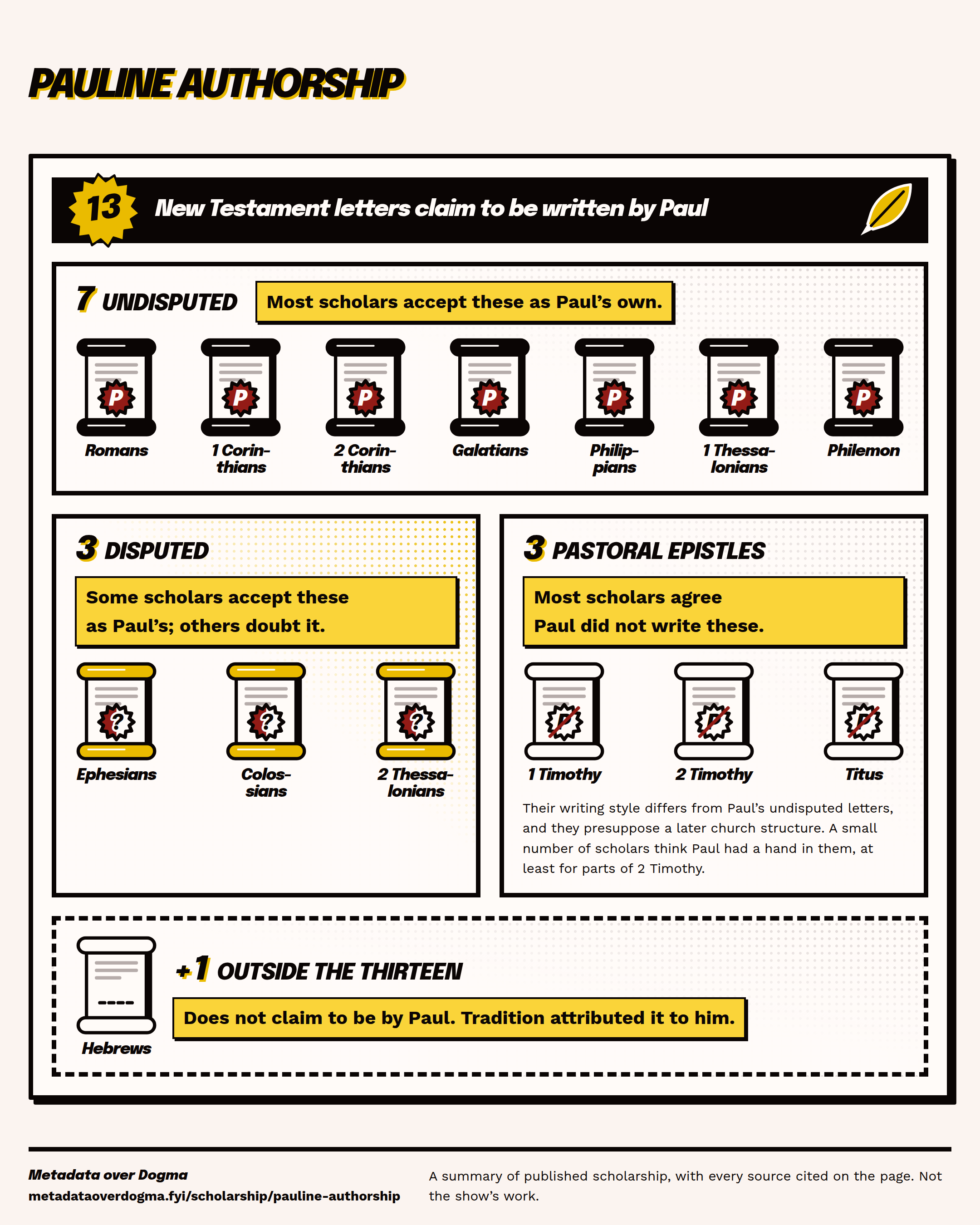
The letters in Paul's name
Which letters do most scholars accept as Paul's own? Seven: Romans, 1 and 2 Corinthians, Galatians, Philippians, 1 Thessalonians and Philemon.
Thirteen New Testament letters claim to be written by Paul. Most scholars accept seven of them as his: Romans, 1 and 2 Corinthians, Galatians, Philippians, 1 Thessalonians and Philemon. These are called the undisputed letters.
“Thirteen of the twenty-seven books of the New Testament claim to be written by Paul”
“the undisputed Pauline letters (Romans, 1 and 2 Corinthians, Galatians, Philippians, 1 Thessalonians, and Philemon)”
“Now you've read seven letters that almost all scholars believe Paul actually wrote.”
Do scholars think some letters in Paul's name were written by someone else? Most do.
Most scholars believe that some of the New Testament letters attributed to Paul are pseudepigraphic: written under his name by someone else. Writing under a false name was not uncommon in the ancient world. Dale Martin's Yale lectures say almost all critical scholars believe 1 and 2 Timothy and Titus are pseudepigraphic.
“Pseudepigrapha, writings under a false name, were not uncommon in the ancient world. Most scholars believe that some of the New Testament letters attributed to Paul are, in fact, pseudepigraphic.”
“The phenomenon of pseudepigraphy, that is, writings under a false name, was very, very popular in the ancient world”
“and then there's the letters that almost all scholars, critical scholars, believe are pseudepigraphic, which are I and II Timothy and Titus.”
Is Hebrews one of Paul's letters? It does not claim to be; tradition attributed it to him.
Hebrews does not claim to be by Paul or by anyone named. Tradition attributed it to him, which is why it follows his letters in the New Testament. Dale Martin's Yale lectures say it is not by Paul, and that guesses about its author have been “all over the place”.
“Thirteen of the twenty-seven books of the New Testament claim to be written by Paul, and tradition has attributed yet another to him (Hebrews).”
“The letter to the Hebrews is anonymous; it doesn't even claim to be by Paul or by anybody else that we know of.”
“It's also not by Paul. Now it doesn't claim to be by Paul, but some Christians throughout the centuries have assumed that it was by Paul, and that's why it's included in the Canon after Paul's letters.”
“There have been guesses all over the place.”
1 and 2 Timothy and Titus
Did Paul write 1 and 2 Timothy and Titus? Most scholars agree he did not.
Most scholars agree that Paul did not write the Pastoral Epistles: 1 and 2 Timothy and Titus. They are called pastoral because they are addressed not to communities but to men appointed as church leaders.
“Most scholars agree that Paul did not write the Pastoral Epistles. These three letters are designated as pastoral because they are not addressed to communities but to men who had been appointed leaders in the churches.”
“Most of us scholars believe that these letters are pseudonymous. We don't believe Paul wrote them.”
“and then there's the letters that almost all scholars, critical scholars, believe are pseudepigraphic, which are I and II Timothy and Titus.”
Why do scholars doubt that Paul wrote them? Their writing style differs from Paul's undisputed letters, and they presuppose a later church structure.
Scholars generally agree that the three letters share one author. The chapter summary for Ehrman's textbook calls their style and vocabulary not Pauline: over one-third of their vocabulary appears in none of the other letters in Paul's name. It adds that the letters presuppose a church organized under bishops and deacons, a structure that developed well after Paul's death. Dale Martin's Yale lectures also name writing style as “a big issue” and say the letters presuppose a later stage of early Christianity, with a different theology and church structure.
“Scholars generally agree that the Pastoral Epistles were written by the same author. The writing style, vocabulary, general themes, and specific content are all very similar, but they are not Pauline. Over one-third of the vocabulary in these three letters is not found in any of the Pauline letters (including the Deutero-Pauline letters).”
“the Pastoral Epistles presuppose a community that is hierarchically organized with bishops and deacons serving specific roles.”
“The Pastoral Epistles, then, reflect a church structure that developed well after Paul’s death.”
“the writing style in these letters is very different from the seven letters that scholars all agree Paul actually wrote, so the writing style is a big issue.”
“these letters simply presuppose a different stage in early Christianity. They don't look like they're from the more primitive sort of time of when Paul was actually founding churches. The theology looks different, the church structure looks different”
When were they written? Both sources read place them after Paul's lifetime.
The chapter summary for Ehrman's textbook says the letters reflect a church structure that developed well after Paul's death. Dale Martin's Yale lectures call the date a guess. Martin places them in the second century, perhaps toward its middle, and says that is later than many scholars would put them.
“The Pastoral Epistles, then, reflect a church structure that developed well after Paul’s death.”
“When did these letters come about? It's everybody guess. I actually tend to think that the Pastoral Epistles were probably written sometime in the second century, and maybe even toward the middle of the second century. That's a bit later than a lot of scholars would put them, and we're just guessing anyway.”
Do any scholars think Paul had a hand in them? A small number do, at least for parts of 2 Timothy.
R. F. Collins's New Catholic Encyclopedia entry reports that by the end of the twentieth century scholarship had reached almost universal consensus that Paul did not write these letters, but that a small number of scholars continue to hold that some of Paul's personal notes were incorporated into 2 Timothy, the so-called fragment hypothesis. Dale Martin's Yale lectures, recorded in 2009, say there are scholars who would defend Paul's authorship of these letters, and that in the years before the lectures some had asked whether Paul himself wrote 2 Timothy, since it looks somewhat like his last will and testament. Martin says he does not tend to accept that.
“by the end of the twentieth century biblical scholarship reached almost universal consensus that these texts had not been written by Paul. A small number of scholars continue to hold that some of Paul's personal notes have been incorporated into 2 Timothy (the so-called fragment hypothesis).”
“There has been some question in the last several years that maybe the actual historical Paul wrote II Timothy because II Timothy looks sort of like a last will and testament of Paul that he may have written in prison. But I don't tend to buy that.”
“So there are scholars who would defend these letters being by Paul and that's what they would say.”
Ephesians, Colossians and 2 Thessalonians
What about Ephesians, Colossians and 2 Thessalonians? They are disputed: some scholars accept them as Paul's, others doubt it.
Ephesians, Colossians and 2 Thessalonians are often called the disputed Pauline letters: some scholars accept them as Paul's and others doubt it. Dale Martin's Yale lectures set them apart from the Pastorals, which “almost all scholars, critical scholars” believe pseudepigraphic.
“the Deutero-Pauline epistles (Ephesians, Colossians, and 2 Thessalonians; this group is often called the “disputed Pauline” corpus)”
“and then there's the letters that almost all scholars, critical scholars, believe are pseudepigraphic, which are I and II Timothy and Titus. Then there are the disputed letters that some scholars will accept as being by Paul and other scholars doubt are by Paul.”
Did Paul write Ephesians and Colossians? Contested; the sources read differ, especially on Ephesians.
Contested. The chapter summary for Ehrman's textbook says scholars continue to debate Colossians, but most agree that Ephesians is not a genuine letter of Paul. Dale Martin's Yale lectures call Colossians and Ephesians probably the most debated of the disputed letters. The reasons given include a writing style unlike Paul's undisputed letters and, in the summary for Ehrman's textbook, a teaching that believers have already been raised with Christ.
“Although scholars continue to debate the authorial claims of 2 Thessalonians and Colossians, most agree that Ephesians is not a genuine Pauline epistle.”
“The two that are the most debated probably now are Colossians and Ephesians.”
“Scholars question the authorship of Colossians for a number of reasons. The writing style of Colossians, for example, differs from that of Paul’s undisputed letters.”
“Ephesians does not resemble Paul’s writing style, and the letter contains an inordinate number of words that Paul does not use in any of his undisputed letters. As in Colossians, Ephesians suggests that the believer has already been raised with Christ—a view that contradicts Paul’s undisputed writings.”
“Why do I say that Colossians and Ephesians were not written by Paul but by a disciple of Paul later? The main reason I want to give is writing style.”
Did Paul write 2 Thessalonians? Scholars are divided.
Scholars are divided; the chapter summary for Ehrman's textbook says they continue to debate its authorship. Many doubt it because its teaching on the end, with events that must take place before Jesus returns, does not match Paul's undisputed letters, especially 1 Thessalonians. Many others, including critical scholars who doubt other letters in Paul's name, still think Paul wrote it.
“2 Thessalonians is one of these letters of Paul that some scholars believe Paul actually wrote and other scholars believe he did not write.”
“The author’s teaching on this issue is one of the main reasons scholars doubt its Pauline origin.”
“This author, however, details a number of events that must take place before Jesus’ return.”
“Many scholars believe that the main themes in this letter do not correspond with the teachings in Paul’s undisputed letters.”
“Some scholars have said what 2 Thessalonians teaches about the end time and the coming back of Jesus differs enough from what Paul had actually said about it in 1 Thessalonians that it might be written by a different person at a different time in a different situation.”
“But scholars kind of divide up on 2 Thessalonians in a lot of different ways, with many scholars, even critical scholars who don't believe Paul wrote all the letters that are in his name in the New Testament, and they'll say they still think Paul did write 2 Thessalonians.”
“Although scholars continue to debate the authorial claims of 2 Thessalonians and Colossians, most agree that Ephesians is not a genuine Pauline epistle.”
Sources used
| Source | Class | Where read | Date read |
|---|---|---|---|
| Ehrman 2020a Bart D. Ehrman, Student chapter 11 summary of A Brief Introduction to the New Testament, OUP Learning Link, 5th ed. (Oxford University Press, 2020) | Reference | Publisher companion page, open | 23 Nov 2026 |
| Martin 2009a Dale B. Martin, Introduction to New Testament History and Literature, lecture 17 transcript: Paul's Disciples, Open Yale Courses RLST 152 (2009) | Reference | University courseware, open | 23 Nov 2026 |
| Martin 2009b Dale B. Martin, Introduction to New Testament History and Literature, lecture 21 transcript: Interpreting Scripture: Hebrews, Open Yale Courses RLST 152 (2009) | Reference | University courseware, open | 23 Nov 2026 |
| Ehrman 2020b Bart D. Ehrman, Student chapter 16 summary of A Brief Introduction to the New Testament, OUP Learning Link, 5th ed. (Oxford University Press, 2020) | Reference | Publisher companion page, open | 23 Nov 2026 |
| Martin 2009c Dale B. Martin, Introduction to New Testament History and Literature, lecture 19 transcript: The “Household” Paul: the Pastorals, Open Yale Courses RLST 152 (2009) | Reference | University courseware, open | 24 Nov 2026 |
| Collins R. F. Collins, Pastoral Epistles, New Catholic Encyclopedia, 2nd-edition text (bibliography to 2001) | Reference | Entry reproduced on Encyclopedia.com, open | 24 Nov 2026 |
| Martin 2009d Dale B. Martin, Introduction to New Testament History and Literature, lecture 24 transcript: Apocalyptic and Accommodation, Open Yale Courses RLST 152 (2009) | Reference | University courseware, open | 23 Nov 2026 |