Contextual Healing
with Aaron Higashi
The Transcript
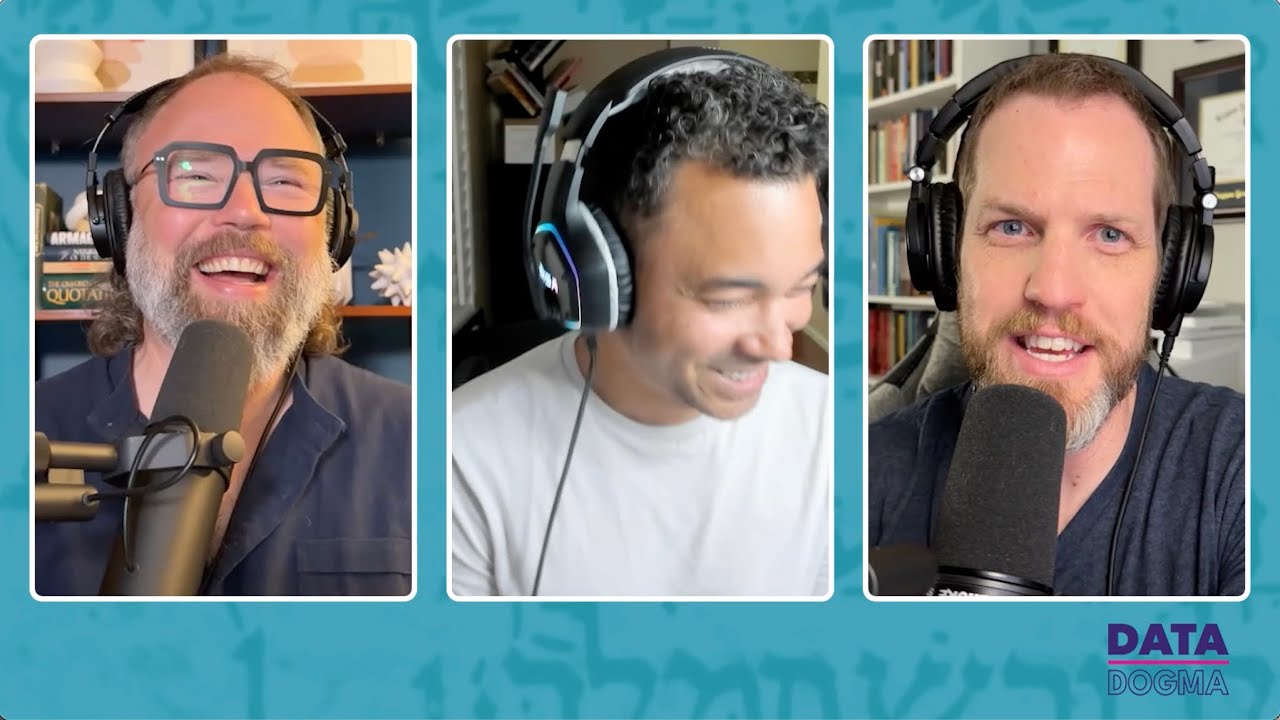
And then that sort of got read back into biblical interpretation. We’re going to get back to it. But I, I have to say you keep saying this as though you can interpret the Bible when obviously that, that can’t be right. It’s the perfect word of God. It’s just devoid of all interpretation. Am I wrong? I thought that’s how it’s supposed to work here. Some people think so. Some people. Some people absolutely hold that. And it’s, that’s often one of the biggest difficulties you encounter in trying to talk to people about the Bible. Hey everybody, I’m Dan McClellan. And I’m Dan Beecher. And this is the Data Over Dogma podcast. Welcome to today’s episode. We’ve got a great one for you today. Indeed we have a guest on. This is— Here’s an interesting thing, Dan. I discovered you when I was just on TikTok, when we all sort of during the pandemic dove into our phones as our, as the last place that we could find any kind of sanity in the universe. And you know, I found your content very interesting. And there was one other guy whose biblical content I found fascinating and honest and interesting and, and engaging. And that is our guest today, Aaron Higashi. Aaron, welcome. Hello. Thanks for coming on the show. I thought you were going to say somebody else after all that. And it’s not this guy, but this guy’s almost as good as that other guy. Couldn’t get him. Okay. This guy is like at, at most fourth down on the list. That’s a great place to be. And hi, I’m very happy to be on the show. Well, welcome Aaron, you’re, like Dan, a public-facing scholar. Excuse me, can you tell us a little bit about your sort of bio—biological— You could tell us about that, but your biographical history—tell us a little bit about where you’re coming from, how you know so much about the Bible, all of that sort of stuff. Oh man, yeah, sure. I, I did most of my growing up in Colorado Springs, Colorado. I take it no Christians there? No, not a single one. Actually, an arid wasteland of Christianity. Actually I grew up like a stone’s throw away from New Life Church. All these mega churches in Colorado Springs, non-denominational, which is like evangelical but without any accountability to an institution or something like that. So that’s the environment that I grew up in and originally attended church in and high school and stuff. I did my first take at college at Colorado State University in Fort Collins. I wanted to be a writer, either journalism or creative writing. I failed out for lack of maturity and moved back in with my parents. And can I just— I’m just going to butt in and say that there’s something very appealing to me about the fact that I’m the only person on this podcast who’s never failed out of a college experience. We should try it. I’m amazed. You’re also the only person who’s not failed out of a college in Northern Colorado. That’s right. I, I went to University of Northern Colorado in Greeley, which is about 30 minutes away from CSU over in Fort Collins. I used to go to parties in Fort Collins at CSU. They’re the best parties. Or the worst, depending on— Depending on what you’re looking for. Less cows, more— More alcohol. I think it does. It doesn’t smell as bad in Fort Collins. Differently bad. Differently bad.ter I failed out of there, I moved in with my parents and started going to community college. And I happened across a philosophy class I took at a community college. And I just… I fell in love with philosophy also. It was the only thing that I was any good at because a lot of it’s just arguing and writing, which I love to do. So I changed my major to philosophy. I went to the University of Colorado, Colorado Springs, which has a beautiful campus seated in the mountains there in central Colorado Springs. And I took a minor in religious studies and took the only religion classes they had on offer, which was like an Introduction to New Testament and Introduction to Old Testament. And that’s where I encountered academic biblical studies for the first time. I read my first Bart Ehrman book, which I still own to this day, it’s still marked up with all my notes. And it just blew my mind that you could think about this stuff from an academic perspective. You know, I had grown up in this environment, sort of in and out of different churches, pretty unsatisfied with that experience. And it just opened, like, every door in my mind to, “you could do this.” You could spend your life studying this in a different sort of way. And so I graduated from there, and I was either going to go to an applied ethics program at Oregon State, or I was going to go to a biblical studies program at Providence College in Rhode Island. Those two things probably seem very different from each other, but the underlying goal was the same. I wanted to figure out how people were interpreting the Bible and then applying it, especially in, like, a social and political context, because this is back in… I’m… I’m old, so maybe not as old as… As… As… As everybody else, but older than most of my TikTok followers probably. So this is back in, like, I mean, I, I went to college in 2004, started then. I graduated in 2008, so a while ago. But this is in the middle of the Bush administration. We have a lot of Bible-believing folks using the Bible as a justification for this or that political policy or this or that war on terror or this or that, you know, funding proposal and stuff. And I wanted to know what that process was like, how do we get politics and ethics out of the Bible? So I was either going to attack that from either end, ethics or biblical studies. My then-girlfriend, now wife, got into her dream program at Brown doing public health. So we went up to Providence College. I got a master’s in biblical studies. And then because you can’t do anything with a master’s in biblical studies, I applied to PhD programs and didn’t get into, like, any, but I did, I did get an offer to do a second master’s at Chicago Theological Seminary with sort of the implication that, you know, if you take a second master’s here, then maybe we will let you into our PhD program the following year. So I did a one-year master’s there. And then I’m gonna, I’m gonna interrupt real quick and say, Dan, you’re also the only one here who has not had to do a second masters because I couldn’t get into a PhD program. It’s. See, so it’s a rite of passage. Amazing. You guys, you guys are basically the same person. Well, Dan, I’m kicking you off. Aaron, you’re in. I’m tagging, I’m tagging him out. And for me, it was… I had been accepted to go to Claremont’s PhD right after my bachelor’s, but I also got accepted to this master’s program at Oxford. And I was like, no offense, Claremont, but you’re not making, you’re not making it worth my while here.. So I’m gonna go to Oxford. I’m going to defer because it’s a one year master’s program. I was like, I will defer for a year if I don’t get into a better program. I’ve still got Claremont. Claremont’s a nice backup to have. Well, it was for a minute, but I didn’t get into a better program. And then I was like, okay, well, I still got Claremont. And then they emailed me and they were like, turns out we’re gonna take this year and just retool the whole program. So we’re not accepting students, so find something else to do. And. Yeah, so then I occupied my time, basically. And so I had been accepted the previous year to Trinity Western University’s Master’s degree in Biblical Studies. So, like, hurriedly emailed them and I was like, is your. Is your application window still open? And it was. And so I was able to get into that Master’s program. So I know exactly where you’re coming from. Basically, the two of you are just bumbling your way through degrees. Yeah, that’s what I’m hearing, man. That’s. That’s how you end up piling them up. Otherwise it would have been a straight shot right through. Right. Such is not the case. I really like Chicago Theological Seminary’s program. It was the only program. I remember googling around trying to find one. And it was the only program that had Hermeneutics in the title. And that was really what I was interested in: the interpretive process. I’m glad you brought that up, because I don’t know what that word means, so if you’ll just help me out with that. It’s really just an obnoxiously fancy word for interpretation. But it also sort of came to be used to describe a field of philosophy in the continental tradition in particular that focuses on how we interpret texts in general. And then that sort of got read back into biblical interpretation and became a word that interpreters broadly use to talk about biblical interpretation in particular. You know, we’re going to get back to it. But I have to say, you keep saying this as though you can interpret the Bible when obviously that. That can’t be right. It’s. It’s the perfect word of God. You just. Devoid of all interpretation. Am I wrong? I thought that’s how it’s supposed to work here. Some people think so. Some people. Some people absolutely hold that. And it’s. That’s often one of the biggest difficulties you encounter in trying to talk to people about the Bible. So I, I really wanted a program that focused on that. And Chicago Theological Seminary had a program called Bible Culture and Hermeneutics. And that’s what I signed up for and got into and, and really fell in love with. And that’s what my PhD is in today. So that’s. That’s how I know at least a couple things about the Bible. I specialize in Hebrew Bible. You got to pick something. And only really like nerds and saints do New Testament. So I wanted to do the fun stuff in Hebrew Bible. Yeah. Nothing nerdy at all about Hebrew Bible there’s much cooler. It’s much cooler. Let me ask you this in terms of you. You mentioned earlier that, you know, when you first started, when you first realized that this was a study, an academic study, you.0:09:56.450] Dan Beecher: You compared the academic perspective to what you had been raised with. Can you talk a little bit about the difference between sort of a layperson, a lay believer’s study of the Bible and what you experienced in academia? Yeah. Laypeople tend, through no fault of their own, tend to read the Bible as a. As a repository of dogma in, sort of crystallized in like a more pure form. And their job is just to go to the text and then to derive, sort of rederive over and over again, dogmatic beliefs that they’re already committed to. So they believe that God is good. They find passages in the Bible that seem to correspond to the idea that God is good. They think that, you know, Jesus rose from the dead. So they find passages in the Bible where Jesus rises from the dead. And so the Bible is just a resource to sort of affirm things that they’ve already come to believe as a result of tradition and church practice. And that’s not inherently bad, but there’s a lot more ways that you can interpret the Bible. And so academics just bring a lot more tools to the table to be able to engage with the Bible. So there’s historical tools to be able to set the text in its original context. There are linguistic tools to be able to get a better grasp of the original languages. There’s literary tools to be able to parse apart the different sections of the text and to speculate about its origins and its different kinds of theories of composition. There are more fancy philosophical and ideological tools to be able to analyze the rhetoric of different authors and expectations of different audiences. So it’s just, it’s. It’s an entire bag of lenses or tools to bring to the text that allow you to ask more sophisticated questions. You know, what is this author’s? Who is the author? At what point in history might they be situated? To whom are they speaking? What are their immediate spiritual, ideological, communal needs? How does this text help them serve those spiritual, ideological, communal needs? And then asking those sorts of questions in a variety of different ways over time. And that’s a lot of what biblical scholarship is, is trying to probe the text with these tools. And it, and it felt very empowering to me because before, you’re not really doing anything right. The work has already been done. The dogma’s already been laid out. It’s a very circular and sort of insular process. You go to the book for the dogma that you already had to begin with and vice versa and over and over again. But now you can discover things, or at least put forward new hypotheses about why the stuff in the text is working in the way it is using these tools. And it puts you in charge of the process of biblical interpretation. And so for people, I think, in particular, who felt like they had been hurt by the Bible in some way or by Christian faith or dogma in some way, the ability to go back and undo some of that with these tools and to think differently about the text is an enormous relief and I think can be very healing as well. I think that’s fascinating. I. One of the things that I, that I wonder about, I, I love that you’re coming at it from that angle, from the angle of this being a healing process or this being an empowering process. I, I do wonder, however, you know, one of the things that our show has done for me and that. That both of your content on TikTok, you and Dan, your content on TikTok has done, is to expose me to viewpoints about the Bible that are true. But were I a believer, would be very challenging to. A lot of those dogmas that you were. That you were talking about before.ng about before. Did you encounter challenges in your… In your academic career that, that, that either made things, made your beliefs, I don’t know, difficult or, or… Or that rocked you in some sort of way that you weren’t prepared for? It’s, it’s… It’s been like a slow… It’s a gradual process over time. But yeah, it’s… It’s… It’s a… I mean, what I sort of end up doing is you go to the biblical text without, you know, from a different perspective rather than a dogmatic perspective, and you encounter there morally problematic stories. You encounter there a God that defies many of your expectations about what you think God is supposed to be like. And then you have to do something with that. And that process can be challenging on a number of personal, professional, psychological… It can be challenging on a number of levels. I think for me, it was still exciting though, because I got to be the one who decided how to reconcile those things. It wasn’t somebody telling me, you know, “Maybe God seems evil here, but it’s really, you know, it’s…” It actually all works out for the good or it’s actually justified that these babies are dying or that these people are being enslaved or this genocide is being done or something like that. I got to be the one who decides, maybe this just isn’t God. Maybe this is just rhetoric, maybe this is just ideology. Maybe this is just something that felt right for them there at that time or was rhetorically useful for them there at the time, but no longer has any use for me. Maybe it did genuinely facilitate some personal, you know, religious conviction at the time, but now it doesn’t. And so it’s, it’s… You sort of feel like a monkey swinging through trees. You’re letting go of one branch as you are grasping onto another. But now at least you get to be the one who decides which branches you are grasping onto and which you’re letting go of. And I think that’s a big part of a lot of the public discourse about how we approach the Bible is who gets to decide. It seems like a lot of the reasons that the Bible is not very dynamic, that we already know everything that it is allowed to say, everything that it says, is because it’s being used primarily to structure values and power. It’s serving the interests of people largely in positions of power, whether it is on a national level, a state level, a congregational level, even within a family. The Bible can be used to structure power and values. And to say, “Well, I’m going to look at it this way,” and suddenly that power structure just collapses, is a threat to a lot of that tradition that has spent so long constructing this approach to the Bible, this hermeneutic, to protect itself. And I appreciate a video that you published a little bit ago where you addressed some of the different theologies that people bring to the text and how a lot of these different theologies—the one that I’m most familiar with is probably liberation theology—is an approach to the Bible that developed a bit ago, particularly outside of the United States, as a way to kind of arrogate some power to the readers and reread the text in a way that served the interest of the underdog, which historically has not been the person or the group in charge of interpretation. And you said that all these other approaches to theology—womanist theology, feminist theology, black theology, queer theology—are qualified. They have these adjectives that are attached to them. And then you say we presume that white male theology is the default. And one of your points there was that all theology is contextual. It’s not like we have decontextualized theology and then all these other junior theologies that are developing. Do you think you could talk a bit about how important it is… well, basically, what’s the… what the— what you’re saying there, and then how important that is to you, that people understand that there’s no objective— nobody can stand outside of all these power structures and all of these lenses and say, “Well, no, I’m doing it purely objectively.” And also in the process, if you wouldn’t mind defining some of these different theologies, that would be awesome. Sure. Yeah. No, I mean, that—that is a bit—there are so many different kinds of theology and so many different ways to—to—to parse out the different kinds of theology. So most people are familiar with just theology, at least in principle. And theology is just God-talk or, in academics, it’s usually the study of the nature of God. But that’s still very, very broad and can be broken down in a number of ways. Some people might be familiar with systematic theology, which is an attempt to be very comprehensive and internally consistent, saying as many things as we can possibly say about the nature of God and our relationship to God, using as much data as possible. So that’s systematic theology, but alternatively to systematic theology is contextual theology. And contextual theology does not aspire to be either comprehensive or coherent with other kinds of contextual theology. It just attempts to speak to the theological imagination of individual communities, often with their experience—their historical experience—as sort of the catalyst for doing that theology. So black theology is going to reflect the community and experience and spiritual needs of black communities, and feminist theology is going to reflect the unique experience and spiritual needs of women, et cetera, et cetera, through these different kinds of contextual theology. So there’s no aspiration there that they’re going to say everything that can or ought to be said about God, and there’s no aspiration there that whatever they have to say is going to match with what other kinds of contextual— So black theologians aren’t concerned that what they’re saying is going to match up with feminist theology, and feminist theologians aren’t concerned that what they’re going to say is going to match up with Asian American, you know, theologians, or something like that. So that’s a big division between systematic theology and contextual theology that you can make if you pick up a textbook on contextual theology. The categories are often given as black, Asian, Asian American, Native American. They are related to ethnic groups and then to gender and issues of gender and sexuality. So sometimes you’ll see gay and lesbian theology or queer theology, feminist theology, and then some that are combinations of these things like womanist theology, which is both black and feminist for black women’s experience in particular. But what you will never find in those categories of contextual theology is white theology or a male theology. And part of that is, I think— That’s what Twitter is, isn’t it? That’s what a lot of things are. I think that’s what church is, isn’t it? It is, for most people in— In the United— In the United States, in a context where a lot of theology is white evangelical theology. Yeah, that is. And so that’s part of the way that you can claim the center of discourse is by not disclosing the context in which you are doing theology. So it is an attempt to depersonalize or decontextualize. You’re saying, “My theology is not coming from my experience. It’s not particular to me or the needs of my community. I am just doing theology.” Right. Everybody else is particular. Everybody else is dependent on the real kind that I’m doing. And it is that—that failure of disclosure—that I was trying to call out in that video. There’s nothing wrong with being a white male theologian or doing theology from that perspective.at perspective. It would be nice if such theologians disclosed this is the perspective that I am doing it from. These are the kinds of personal experience that I am drawing upon. These are the communities that I am trying to serve and whose rhetorical and ideological interests I have most in mind. That’s all you have to do. You don’t have to be like, every time you speak: “I am a white male speaking and doing theology,” just somewhere in your project at some point. This is where I’m coming from. And that’s all that really, that Black theology and feminist theology and all these other kinds of contextual theology are doing. They’re just saying, this is who I am, and this is where I’m coming from. And this is the community that I’m speaking to. And it seems to me a lot of the folks, a lot of the white male folks who are engaged in theology, obviously I’m one of them as well, to the degree that I engage in theology, which I don’t really call myself a theologian. But a lot of it is that in our training, we’ve never been told that we’re engaging it through these lenses and we’re aimed at serving these communities and these goals because we’ve always been kind of the dominant identity within the field. And so we just kind of plod along as if the whole world is our is our playground. And we see others saying, well, I’m doing this from this perspective, and I am, you know, engaging my community in doing that. And we think, oh, well, you’re limiting yourself. We, on the other hand, are addressing this more broadly because it’s usually we don’t get training where we are shown that we are trying to serve certain structures of power or certain communities. And I think that’s a big shortcoming. But to do so is then to, is to acknowledge our positionality and to some degree limit the applicability and limit our ability to structure power over and against others who may be operating in a different field. So unfortunately, that needs to be called out a lot more frequently or the field is just going to continue to train its new scholars to do the exact same thing. Yeah, there’s, there’s a great book by Angela Parker, who also graduated from Chicago Theological Seminary, called If God Still Breathes, Why Can’t I? And it is, and it’s about how so many theological schools and schools of religious study effectively train their students, regardless of their race or gender, how to do white male theology. So you, even people of color who come from other backgrounds are still trained to perpetuate and to speak as like they are doing white male theology. So, yeah, it’s, it’s very infrequently that people get access to these kinds of resources or get taught to think or speak differently about their, the kind of work that they’re doing. Is there a, a sense that, you know, I, I, I read, you know, in, in sort of greater feminism or in, in, in, in other circles, that people talk about intersectionality and, and the need for, for that. When you spoke about Black theology, not necessarily concerning itself with what’s going on in feminist or womanist theology, that sort of thing. Where does the, the, where does intersectionality come into it? Yeah, well, that’s, that’s, that’s, that’s a fun way to ask that question. Womanist theology emerges out of Black theology specifically because of Black theology’s lack of attentiveness to intersectional issues. So interesting. Yeah. Intersectionality is a way of thinking about various elements of social identity, gender, race, class, as though they mutually construct each other. So you can’t look at gender alone, but gender, the way we think about gender is affected by class. And you can’t just think about race alone. The way we think about race is affected by class. And so people sort of lie at the intersections of their different elements of social identity.ity. And it was really a number of black women’s dissatisfaction with what was happening in black liberation theology that led them to then create womanist theology, which is a much more straightforward attempt to be intersectional, bringing together gender, race, and class in the doing of their theological work. So when a straight, white—someone who is afflicted with straight whiteness and maleness, the way Dan is, for example, or myself, and they’re out there trying to study theology, how do you recommend they, that person approach it when, as you say, the sort of structures even in current academia are still pretty geared toward that straight white male perspective? Yeah, fortunately today, I mean, and we’ve only been able to say this recently, but fortunately today we do have a fair number of women and people of color and people from the third world who are actively involved in the academy. Now, they’re still minority voices, but they are present. And so you can go to them directly and purchase their books and read their material. And I don’t think it takes much. It’s more the willingness to do a little bit of that reading that’s the difficult part. But then once you get over that and you can engage with some of this material, I think you’ll very quickly be able to do the adjustments or at least the bulk of—I mean, it’ll probably take the rest of your life to do all the adjustments. It’s an ongoing, it’s a, you know, an existential process, as it is for so many other things, but the bulk of the adjustments that need to be made in a pretty short span of time—you can pick up a couple books, learn from a couple black theologians, feminist theologians, queer theologians, in a relatively short span of time, and I think greatly benefit from that. A book I frequently recommend is called Liberation Theologies in the United States, edited by Stacey Floyd-Thomas and Anthony Pinn. And it has, you know, 20-page chapter-length introductions to most of the kinds of contextual theology at play today. You make it through that one book, right? Just a couple hundred pages and that’s already, you know, you are multiplying your knowledge of the diversity of theology a hundredfold in a pretty short span of time. I wonder if you could give us some examples of, you know, different contextual theologies and how they differ from each other. Just it’s something that, you know, we’ve been talking in the abstract about this thing and I wonder if we could, you know, concretize it in some way. Sure. So you can think about. I mean, a big part of black theology, for example, is trying to think through again, some elements of Christology that white folks sort of just took for granted but are actually quite problematic for a black community and for black experience. So thinking of Jesus as an entirely passive servant figure for people who have, in their historical background, slavery and household servitude can be a bit problematic. That’s not something worth valorizing, right? If. If your primary problem is pride and privilege, then sort of humbling yourself in the image of this humble Jesus might… might be some moral progress for you. But if you’ve already been consigned to this place in society, that’s not uplifting, right? That’s not something to aspire to. That’s not something as valuable about Jesus. And so you see a lot of black theologians sort of reconfiguring the significance of the incarnation, thinking about it in terms of Jesus’s power to confront authorities of the day, or Jesus’s power to heal the poor, or Jesus’s simple ability to feed large numbers of people. And they find more value in these stories as opposed to Jesus’s humility or his suffering. There are a number of feminist theologians who find Jesus’s substitutionary sacrifice to be unjust. They find the idea of God sacrificing a son to be abhorrent because they cannot conceptualize thinking that it’s a good idea for a child to be ordered to their death by a parent, drawing upon, you know, a more immediate and visceral relationship that women have through pregnancy with their children. with their children. It just. It clashes too much with their experience. And so now we got to rethink some of the. The significance of whatever work Jesus is doing in his death on the cross. So it’s often something about the theology they’ve been fed does not jibe with their experience. So back to the drawing board to find a way of thinking about Jesus or God or other stories in the Bible that are going to work better for their community’s aspirations. And I think that that raises an interesting point. A lot of communities that someone who is used to being in a position of power might neglect a lot of their experiences, might not see what they see in the text, but it’s going to be there. There are a number of different ways that the Bible speaks to the oppressed, the downtrodden, the marginalized. And that’s obviously one of the blind spots in the majority theology, is that it’s not seeing things from that perspective, which means it is woefully incomplete. It is not able to reach everyone. And I think one of the. Your dissertation, which you wrote as part of your doctoral degree, was on Ezra, and we have the. Where Ezra is reading out the law to everybody, basically letting them know from here on out, here is how things are going to be. Oh, and by the way, if you married women from these people groups or these identities, you have to divorce them and send them away, which is a remarkably ethnocentric kind of act that we generally like to gloss over when we talk about that in Sunday school. But I wonder if you wouldn’t mind. One could say that there are those out there who would love to not gloss over that. Yeah. And hold solidly to it even in today’s. In. In. In now. Yeah. Again, there’s me defaulting to my own experience with a specific religious community. But I wonder if you wouldn’t mind talking about how you approached the question of inter-ethnic marriage and what Ezra was doing in structuring power. I think you were looking at Ezra 10
, is that correct? Yeah. Ezra 10
is where what is called the intermarriage crisis is discussed. Ezra is in a very transformational and volatile time in ancient, now Judean and not really Israelite-anymore history. We’re talking about post-exile now, the middle of the 5th century BCE. He has the unenviable task of having to reconstitute the identity of his people in terms that make more sense to them. And that is primarily to rethink of themselves as a people whose primary touchstone experience is coming back from exile and resettling in Jerusalem. Prior to this, it had been the Exodus. The Exodus was the defining experience of ancient Israelite collective conscience and ethnicity. And now it’s this other thing is coming back from another place. And part of the way he does that is to draw these very firm but at the same time indeterminate lines on the ground about who gets to marry who. What ethnicity is really going to count as this emerging Jewish ethnicity. At this point we can finally start to sort of use this word Jewish as opposed to Israelite. What’s going to be this Judean ethnicity in this time period? In order to accomplish that, he draws on, at that point, several-centuries-old laws from various legal materials in the Pentateuch to say that the people groups that surround you today are similar enough to—although we know, in literal fact, they cannot be identical to—the groups that existed back then a long time ago. And God said a long time ago, you cannot intermarry with them. So God is saying now, obviously, it must be the case that you cannot intermarry with these people as well. You have to get divorced. This is the only narrative description of divorce anywhere in the Hebrew Bible. Divorce is very rarely spoken about even in legal material. There are only a couple references to it here and there, and I don’t think there are any other narrative examples of it. So it’s here and it’s a mass divorce. And it’s a mass divorce that’s coerced. Right? Ezra has all the people in the entire region gather in the temple courtyard under pain of confiscation and exile from the community. They are forced to go through this proceeding in order to determine which marriages are legitimate and which are not. And everyone who’s found illegitimate is compelled to get divorced. And in the end, about 100 families are broken up as a result of Ezra’s decree. So it’s a very dramatic moment in the Hebrew Bible. Again, like Dan said, we gloss over this a lot. It’s not read hardly at all. I have the Ancient Christian Commentary series that has a bunch of commentary from like the first seven centuries of the church. Nobody except for Bede, the Venerable Bede, or however you say his name, he was the only person for like the first seven centuries of the church that commented on this. And even today we don’t continue to read this text. So it’s under-read and not reflected on often. For the past 70 years or so, biblical scholars and theologians have been trying to justify what Ezra did. As we sort of become increasingly conscious of how bad this kind of ethnocentrism is, scholars have put in a lot of work to try to vindicate Ezra’s decision to force these people to get divorced. Because it’s terrible, especially for the children involved who go off to fates unknown. We have no idea what happens to the children of these marriages or to the wives involved. They could be in immediate threat of death, depending on the circumstances. So scholars have put a lot of time and energy into trying to say, you know, no, Ezra did the right thing. And they give various justifications for that. Is it generally agreed that this is historical? Yeah, I think so. Or at least that it reflects something that happened in sort of smaller measures periodically over the course of a long period of time. But I haven’t seen a lot of attempts to challenge outright the historicity of the event. It’s sort of an embarrassing thing to admit to and it keeps coming up. Some of these issues return again in Nehemiah, which many scholars take to be a bit later. So it seems to be a recurring problem. It’s not just a one-off sort of event. So what my dissertation did is try to find a different way to read it without valorizing Ezra, without finding the meaning of the passage in Ezra and instead try to find some moral significance in what the gathered people do. And there’s this cultural anthropologist named James Scott, who spent some time in Malaysia studying how peasant communities resist oppression in these very subtle sorts of ways. And so I took his work and I applied it to this passage, and I said, look, the people in this scenario resist Ezra and his demand for divorce. In some of those same ways, they. They. They foot-drag. That is to say, they take a long time to do it. They sort of appropriate some aspects of the process. They demand to have their own native judges involved in the divorce proceedings. They do all these very subtle little things that are easy to gloss over. But the end result is that only 100 families get divorced, which is like less than 1% of the population of the community. And they’re almost all priestly families. all priestly families. So it sort of backfired. The Second Temple community is like, you guys out there, you are an existential threat to our community. You’re going to ruin the whole thing. God’s going to destroy us all if you out there in these rural villages don’t shape up. And at the end. At the end of it all, almost all the marriages of the rural villages are held intact. And it’s just really the priests who are most on board with this ideology who end up sort of breaking apart their own families. And I attribute that to sort of the cleverness of the assembly. Wow. I know that there’s a. There’s a long history of. Of re- Well, I don’t know how long the history is, but this resistance, I think, is. Has been discussed in a lot of scholarship. I know I’ve been. I’ve worked in Bible translation for a while, and there’s an example. And I’m from a while ago about. And now I’m going to forget the. The language that it was. But there’s a. Oh, it’s in Southern Africa, one of the Bantu languages, I think there’s a. The translation of the New Testament, it was initially they used for demons. The translators decided to use this word that referred to ancestral deities from the local community as a way to try to kind of influence the locals into thinking of these ancestral deities as wrong, as demonic. And so to try to kind of push them away from. From continuing to appeal to these ancestral deities for guidance and for blessings and things like that. And it kind of had the opposite effect where they appropriated that translation choice and began to appeal even more to these ancestral deities and use the Bible as kind of an icon as. As a piece of cultic. media in the, in the petitions and the interactions with these deities. And so they had to. The folks from Europe who were colonizing this area had to come in and re- translate the Bible. So that’s. They kind of cut out that resistance from underneath the, the locals who were. Had basically taken what they had done as an act of kind of oppression and subverted that. And, and I, I find it so fascinating when we see examples of. Of that kind of thing. And I’ve never noticed that in Ezra, but that is kind of. They, uh, they kind of shot themselves in the foot there and forced themselves to abandon some families just because they were. They were the ones pushing it. And I guess they had to go through with it if, if they were making the big deal about it. Yeah, that’s exactly right. It is. And that’s one of the reasons why I think contextual theology is so valuable. This there. There’s an entire energy for theology that can only be found amongst oppressed peoples. That is. That is such an inspiration for the doing of theology. You know, privileged, relaxed, comfortable people can do theology, certainly, but there’s less of an impetus, there’s less of a need to do it, I think. And so when you put people, you know, in these really desperate situations, they become very theologically creative very quickly. And, and you get to see the product of that creativity in this contextual theology. So yeah, they will, they will take translations, they will play with words, they will subvert expectations left and right, and they will do everything they can in order to ensure the survival of their community. And you get in touch with a little bit of that through this contextual theology.[00:42:23.170] Dan Beecher: One of the things that I wonder about, because it’s very clear, because I loved the examples that you gave of how to use contextual theology and how people use their context to sort of reimagine the stories of the Bible. I wonder, at what point are. Are there points at which it’s not a useful exercise to look at it theologically? And it just needs. And there. There are certain stories or certain ideas from the Bible that you just jettison altogether, as opposed to looking for ways to recontextualize, to make it okay or to. Or to find something good in it. Like, at what point are you stretching beyond the bounds of where that book can actually take you? That’s an interesting question. I think there’s like at least two questions there. One is, at what point do you stop trying to make it okay? And the second question is, at what point do you stop sort of working with it theologically. And I think the answer to that first part comes way before the second part. So I think when we stop making it okay is a point that we’re going to reach first. But just because it’s no longer okay doesn’t mean that you still can’t work with it theologically. It can be used for other things as an indictment on the original author and audience. So yeah, I think there are plenty of stories in the Bible that have no moral value or that I just outright don’t think personally God had anything to do with. I mean I’m a religious person. I think there’s no God here at all. You think of like the genocide of the Midianites in Numbers. I mean this is presented as a direct command from God. I don’t think you can fix that. I don’t think you can fancy theology your way out of that. That doesn’t mean that you don’t say anything theologically about it. But it would instead be an example of religious extremism. Look how bad things can get. Look how twisted our imagination can get. Look at how malicious we can become when we are trying to demonize these other communities, when we are trying to polemicize against other people. Look at how God can be employed in that harmful work. So it’s not that we stop thinking about it, but yeah, there are plenty of places where you just go that has nothing to do with any God that I’m worshiping or thinking about or that’s involved in any way in my life. And the project of trying to accommodate those things theologically is going to be, is going to continue among those groups of folks who can’t accept that God is not in those passages. And so I think we need to stay informed about them as well in order to be able to push back against attempts to rehabilitate things like the Midianite genocide. I did one. Who’s that guy that wrote that book length review of Paul Copan’s? Oh, Tom Stark. Yeah, it was like a 250 page review. Yeah, that’s exactly what… so Copan’s book was: Is God a Moral Monster? And Stark’s response, which is freely available online, you can go find in a revised and updated edition, it’s called Is God a Moral Compromiser? And I think it’s a wonderful, it’s a wonderful discussion of the problems with Copan’s attempt to rehabilitate this perspective about God where these are oppressed peoples who have, you know, they’re under the boot of this empire and the only way they can make themselves feel better is kind of fantasizing about being on the other side. And, you know, once you get out from under that boot, those fantasies should not be operationalized any further. There’s. And, and this is something we talked about with, with Bart Ehrman as with Revelation. People need to find themselves in Revelation to make it relevant, which means finding oppressors around us. And for a lot of the folks who are most concerned about this, they are the ones in the position of the oppressor. And so they’ve got to. To look for others who are. Who can be vilified. But I did want to share. I looked up real quick the language. It was the Setswana Bible translation, the Wookey Bible, which is an old, very, very classic translation, but the word for daimonia they rendered as badimo, which is a word that refers to these ancestral spirits. And there’s a paper by Musa W. Dube. Oh, yeah, okay. Dube. Excuse me, I know a Dube, but it’s Dube there. Okay. And the paper is entitled Consuming a Colonial Cultural Bomb: Translating Badimo into Demons in the Setswana Bible from Journal for the Study of the New Testament back in 99. But that was a great discussion. Sorry, I just wanted to make sure I. No, that’s good context. Yeah. Musa Dube is a great postcolonial theologian. She does a lot of. A lot of great stuff, especially in that sort of African context. And there. And you bring up postcolonialism, which is another framework that can be another. Yeah. Postcolonial theology. Yeah. I wanted to ask a bit about your experience on TikTok and engaging in public scholarship. I know you kind of frame this as kind of forced upon us by the pandemic and being trapped inside, but now that you have become an advocate for public scholarship, have you learned anything about engaging the public and trying to help them grapple with the Bible in a more productive, more informed way? Or have you just decided none of this is going to work out in the end? Man, it depends on the day. I definitely found it worthwhile. I wouldn’t continue to do it if it’s not worthwhile because it is difficult and for me at least, it can often be very time consuming. I don’t know how long it takes you to make TikTok videos, but it takes me a long time to make even really simple ones. So it’s time consuming and it’s emotionally intensive. I do get. I mean, people will write to me and they’ll say, you know, I never knew any of this before. This has been so liberating for me. This has been so helpful for me even up to like, you know, I’m considering going back to the church or I’m considering Christianity for the first time in my life. And those things, those things keep me going. You know, even one or two of those every few months is enough fuel to keep me going through all the nonsense that I put up with on a daily basis. So I definitely found it to be worthwhile. It has been very interesting from a learning perspective. You really have to, I think, simplify, sort of undersell. You have to find something in whatever you’re going to say that’s immediately going to be desirable to somebody who otherwise doesn’t know anything about this material. And trying to do that is difficult, but you also sort of get to see a new side of the material that you’re looking at. Like what is the thing about all this in this 25 page article or in this 250 page book, what is the one thing that somebody completely outside the field is going to latch onto and find valuable? And what I’ve learned is one, there is almost always something there and two, it takes a while to sort of boil it down to that. Yeah, and that’s also been an optimistic thing for me. I mean, no matter how ivory tower this stuff can be, there’s almost always something there that could really spark somebody to rethink Bible or Christianity or whatever it is in a new way.ew way. So would you say that all biblical scholars should take. Take a few reps on, on TikTok and kind of work out that that muscle of learning to distill discussions down to those as kind of the essence of it, but also in a way that is going to be of some kind of interest to the general public. Do you think that makes you a better Bible scholar, a better teacher in the classroom? Or do you think it just makes you a better TikToker? That’s a good question. I definitely think more should. I don’t know if all should, but more should. I think of some who should not. Yeah, some immediately come to mind for the no. But others, I mean it is its own thing. So I wouldn’t shame a biblical scholar for their unwillingness to come on. It is its own skill set, it is its own time and sort of dedication to trying to figure out how to do. I definitely think more should. More importantly, I think I don’t know how you would change this, but I think it would be really helpful if the culture in the academy shifted in such a way that this work was just seen as more valuable. Like oh, such and such is making content for over there. Oh, that’s a great thing. You know, let’s get excited about that. You could go to SBL and have a section on it. You know, you could do, you could do a presentation. You know, this worked for me, this didn’t work for me. I would love to see more enthusiasm in the academy in general, even if people don’t participate in mass, just to have it be wider, more widely accepted. I, I think being able to see it as a part of the academy would be wonderful because, you know, it remains that ivory tower and we’re, you know, pushing the ladders away from the building of the people who want in to want to see what’s going on and saying, no, this isn’t for you. When we treat this as something that, as a hobby that someone does on the side and I think increasingly this is going to be the way that a lot of folks who are not able to get the tenure track positions and things like that are going to, one, see their, what they’re producing be consumed. But two, if they have any hope to make any, any money continuing in something that they obviously have passion for, I think you’re going to see a lot more people moving in that direction. So I, and, and I think there are folks out there who are doing that, who are trying to, to bring it into the mainstream. And you know, 15 years ago there was biblioblogging. I don’t know if you ever saw any of that or got into it. There were a handful of, of bibliobloggers. So I was a part of that for a little bit where we just had blogs and, and tried to do what I think we’re doing a little more successfully now on TikTok but on blogs, which was not incredibly helpful. It was again, just us talking to each other. But. Well, Aaron, I, I, I want to jump into this part of the conversation because I know that it’s not all, you know, peaches and roses turning academic study of the Bible public facing. I’m guessing that especially since most people are used to hearing discussion of the Bible from their church, from the pulpit and they’re not used to hearing it from, I mean, in your case, a believer, but who nevertheless is going to bring some very challenging ideas into this public space. Can you talk a little bit about pushback that you’ve gotten or if you’ve received any sort of like there must be a little bit, there must be some blowback to that. Yeah, there’s a lot. There’s. Fortunately, I guess I’m. I’m lucky that I haven’t gotten the kind of pushback that would really bother me would be, you know, like an all right, let’s see it. You got actually something wrong in your video. That would be the kind of. That would be the kind that I would be like, man, I really need to, you know, fix something here. That would be the kind that I would, like, really take to heart. And I don’t get virtually any of that. I don’t get like, ABH Bible debunked, you know, thing people don’t interact with. Maybe it’s just because I’m not that. That well known, but I don’t get a lot of that very straightforward kind of pushback. I get a lot of the angry TikTok atheists being like, where’s your evidence for God’s existence? I’m like, this is about source criticism, not about, you know, or something. Or something. It’s a completely unrelated topic. And I get a lot of angry fundamentalists who are like, you know, you’re going to hell. Or, you know, they ask weird, like, religious questions in the middle of your, you know, stuff. So that’s mainly what I get. And at this point, that. That sort of weirded me out initially, but I’m like two years into this, so I usually either just play with them or ignore them and it pretty much goes away. That’s been the vast majority of the pushback that I’ve gotten. I do get. I don’t know if it’s pushback, but I do get encouraged to talk more about this or have you considered this? And sometimes people do ask me questions about personal faith things. And I am very. I dole that out in very small amounts. I’m not entirely hands off with it, but I am very guarded about the kinds of things that I share. And I don’t like the conversations that start once you start talking about personal faith issues. There’s no good way to have that conversation with semi-anonymous or anonymous strangers online. It could only be bad. But I do occasionally remind my viewers that, you know, I am a Christian. I’m doing this from a Christian perspective. At the end of the day, I teach at a Christian school. I can’t say that I have a pastoral heart because I think that that’s more than I have. But I am not unsensitive to or insensitive to the needs of laypeople sitting in the pews. And as much as I can, I try to speak to that. So I have been encouraged, gently given pushback on, do more of that and I try to do that where I can. But on the whole, it’s a lot of, it’s a lot of, it’s a lot of nonsense that, that I’ve learned to ignore as far as pushback is concerned. Would you say that your TikTok experience on the whole has been largely positive? Or, or has it been, has the pushback been enough to make it a mishmash? No, the, the pushback hasn’t really had an effect on it. I, I think overall it’s been a net positive trying to build a follower base. I mean, the most difficult part is just like the logistics of it. Like, and it can be kind of demoralizing to, you know, like, not have anything go viral and like not, you know, and, and still and to have a very slow follower growth over time. But that, that doesn’t have anything really to do with pushback or anything. That’s just TikTok and you know, whatever TikTok is doing behind the scenes with algorithms and stuff. So that’s the real God, is the. So whenever I get like depressed and like throw up my hands and I’m like, I’m never going to do this again. It’s not because somebody said something mean. It’s just like, is this still, am I reaching new people? Are new people being invited to the table? You know, is. That’s, that’s the only thing that sort of gets me down.down. But, but on the whole, it’s been a, it’s been a positive experience. Both, both for me and I think for many of the people who have… Been watching, well, it’s been a positive experience for me. I’m, you know, I, I’m an atheist and I’m out there. You know, I don’t consume a lot of biblical or religious themed content, but I really enjoy what you bring to the table. I think that your perspective and you’re sort of gentle, but you, you have this wonderful subversive thing where you’re, you’re, your, your voice is so soothing and your, your content, you know, your approach is gentle and kind and yet you, you don’t shy away from very difficult topics and, and controversial topics. I find your content very engaging and I really appreciate it. I’m very glad to hear that. And he, and he’s not just saying that. When I, when I messaged him and was like, hey, I think we should have Aaron Higashi on, he was like, oh, is he that guy? Yeah, yeah, that would be great. So. Well, what Dan’s not realizing is that earlier I said, hey, should we have this guy on? And Dan was like, yeah, maybe sometime. And then, like, weeks later, he was like, let’s… I’m… I’m getting… I’m working to get Aaron on. Senior scholars represent it that way. Yeah, you have to get the advisor on first so that you can, you know, well, and pay homage to the, to the people that formed you. You’ve got to do that first. For sure. And my favorite videos of yours are the subtly sarcastic ones, like when you’re complimenting me, and I’m like, is he being sarcastic? I can’t. No, no, no. That’s… No, nothing but compliments. I, I wouldn’t. I mean, that’s earnestly. I, I would not be doing this at all had it not been for seeing the success of your channel. I mean, truly. I mean, it would be very easy for anybody who’s interested in doing this to get on and if your channel did not exist, to be like, there’s just no actual appetite for this. Right. There’s. There’s no interest in this at all. And, and so it is very helpful to see somebody do this seriously and have it been successful. It’s bad in the sense that then I go, well, it’s my, my fault it’s not successful. So I can’t, I can’t blame the people out there anymore. But I mean, the, the fact that the, the fact that you have been able to do this means that there are people who have a genuine interest and, and that helps a lot. So. No, I, I, no, no shade at all. Well, I, I appreciate that. And no one was more surprised about that than me. I remember when I, when I got on, when I reached a thousand followers, I did a book giveaway. But not just one book. I gave away five books. I was like, this is a big deal. And I remember somebody saying, in no time, you’ll have a hundred thousand followers. And I was like, you’ve lost it. That’s. That would be bonkers to think about. And, and that, that, you know, it didn’t happen overnight, but it happened a lot more quickly than I thought it would have. And, and nobody’s more surprised about that than me, but I understand exactly what you’re saying about the people messaging you making it all worth it. I get messages every day from all ends of the spectrum of both love and hate. So I think you always. I figure that if I’m getting hate from all sides, then I’m probably right in the sweet spot, I’m doing something right.t. And that does make it, make it all worth it. Every now and then I’ll find one that will be particularly touching and like share it with my wife or something like that. But yeah, that does make it feel like I’m not just out here entertaining myself. I am doing that. But at the same time it seems like it is being helpful for other people. And if it is helpful for other scholars who want to break into this, this kind of activity, then I will be here as long as I need to because that is even as meaningful as all the other stuff is—to be respected by colleagues for doing something that I’m really doing. Because I could not get into full-time teaching, it is something that means an awful lot to me. So I’m glad to see you’re here. I have no doubt that you’re going to, that your success will multiply and increase exponentially in the future as long as you keep with it. So speaking of this, Aaron Higashi, how can people find you? Where are your channels where people now are desperate for your content? They’re, they’re clamoring. Clamoring. I say, I don’t know if we have the authority to say that is the effect of coming to our podcast yet, but I’m clamoring. How do, how do people find you? You can find me on TikTok at ABH Bible, you can find me on Instagram at ABH Bible, you can find me on YouTube, you can search ABH Bible and I will come up, or the actual name of the channel is Bible of Color and a lot of that is the same content. Although I do hope to be producing some content, standalone content a little bit longer form for YouTube over the course of the summer after my kids get out of school and settle down a little bit. I’m finishing up final grades for this last semester at school, so still a little bit busy right now, but yeah. And then I don’t know, I’m sort of thinking about some future projects. But. Well, keep us up to date and let us know when you have something new that you want to pitch and we’ll have you back on. And thank you so much for joining us today. I’m very happy to be here. Thank you very much. Well, that’s it for today’s show. If you’d like to reach out to us, you can reach us at contact@dataoverdogmapod.com or if you’d like to become a patron of the show, check out our Patreon page, patreon.com/dataoverdogma. Thanks everybody for joining us. We’ll talk to you again next week. Have a wonderful day.