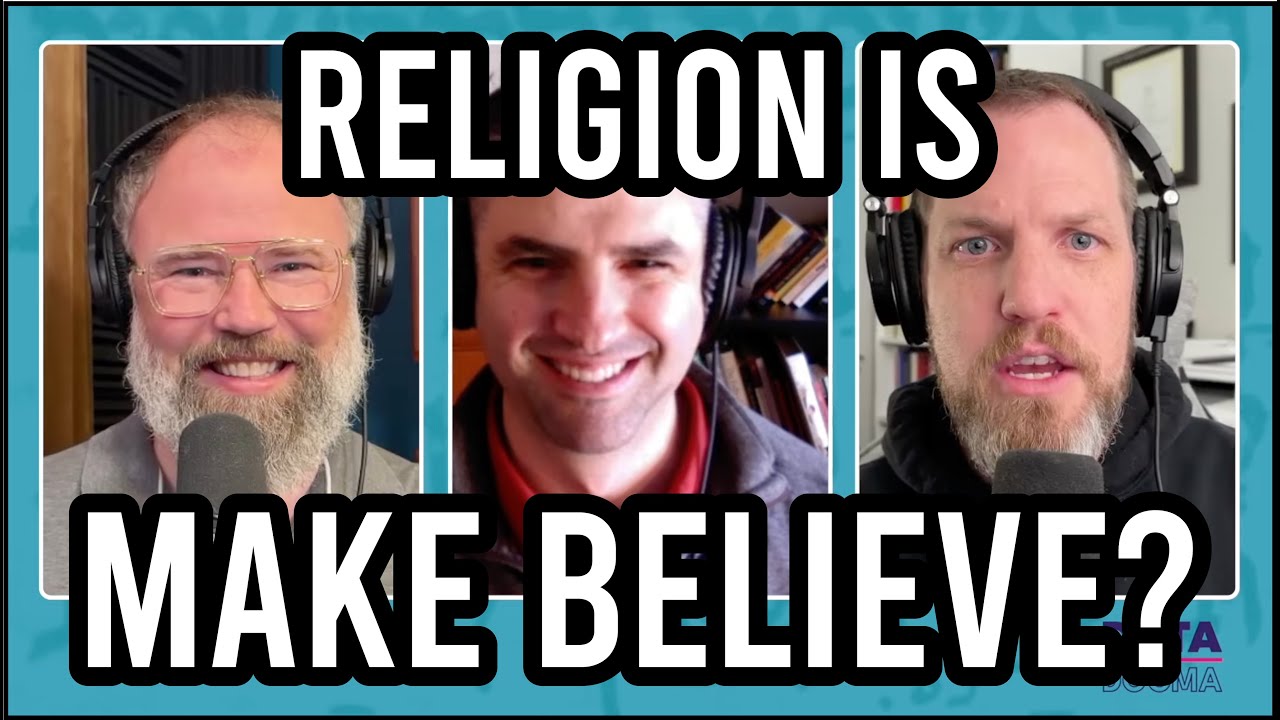
Is Religion Make-Believe?
with Neil Van Leeuwen
The Transcript
I was sort of vilified by the hardcore atheists as a religious apologist. Right. And when your book is called Religion as Make-Believe, I mean. Right. Are there Christians out there? Like, oh, that’s gonna be really cool. This works for us. This is gonna be good for us. Hey, everybody, I’m Dan McClellan. And I’m Dan Beecher. And you are listening to the Data Over Dogma podcast, where we increase public access to the academic study of the Bible and religion and combat the spread of misinformation about the same. How are things today, Dan? Well, it’s a lovely spring day. The, the birds are chirping, the sun is out, and… And we’re going to make some people mad. What a lovely day. As the great poet once said, all shiny and chrome. Okay, so we are very excited today to welcome Neil Van Leeuwen to the show, or Van Leeuwen, if you’re nasty. Neil, thank you for being here. Neil is associate professor of philosophy and neuroscience at Georgia State University in Atlanta, Georgia. Good old Hotlanta. And, and how are things today, Neil? Well, it’s a beautiful day here. I’m really happy to be here. And the sun is shining where I am as well, so I think… I think those are auspicious signs. Signs. Yeah, exactly. Take comfort in that. Auspicious is such a great word. I, I don’t think a lot of people who refer to things as an august body are aware of the relationship of august to auspicious to divination based on the flight patterns of birds. So. Right. Yes, our… The success of our endeavors today have been decreed by the flight patterns of the birds. We have a little bit of snow on the ground here in Utah, but we can ignore that for now. Yeah, we’ll. We’ll be okay. We’ll be okay. And Neil is the author of a new book entitled Religion as Make-Believe: A Theory of Belief, Imagination, and Group Identity. And this is a little bit outside of the beaten path for our podcast because we’re getting into cognitive neuroscience, evolutionary psychology. Cognitive Science of Religion is… Is kind of the, the generic title I have for, for this field of study, which was a big part of my doctoral dissertation and that I like to bring up from time to time, but I wonder, just because some of our listeners probably aren’t familiar with Cognitive Science of Religion or evolutionary psychology when it comes to religion, can you tell us a little bit about the field as you perceive it? What do you think this approach brings to the table? What are the main questions this research is trying to ask? And, and if you’re able to, can you just talk a little bit about how the idea for your book came about based on, on your work in these fields? Yeah, sure. So I’ll start with cognitive science generally, in case people aren’t familiar with that phrase. So cognitive science is basically the more theoretical end of psychology and linguistics. So it’s asking, well, what, what is the basic nature of the psychological structures that guide certain behaviors, like talking, like watching movies, like getting in political arguments and so on. What are the basic structures and processes? So your experimental psychologists will gather data to test certain hypotheses. And you can think of cognitive science as sort of the back end theory behind, well, what do the hypotheses even mean? Right. What is a belief? That’s something that I work on. What is it to imagine an idea? How is imagining different from belief? And you, you start to see that cognitive science is really a place where philosophical questions meet psychological data. And that’s, that’s the space I’ve been working in for quite some time. The way I got into working in cognitive science of religion, which is basically investigating the psychological structures behind religious belief and practice, is as follows. It kind of, I kind of got in there in a, in a surprising way. So I was basically looking at the philosophical question of what is the difference between believing an idea and merely imagining it, right? Like you imagine something for the sake of make-believe play. In either case, you’ve got a mental representation of something. So just to give a concrete example, I could believe that there’s a lion in the hallway, or I could imagine that there’s a lion in the hallway. What’s the difference? Either way, I’m representing it as if there’s a lion in the hallway. And so I was developing a theory of what differentiates what I now call factual belief and fictional imagining as psychological relations or attitudes. And it hit me one morning because I grew up in a very religious context in the Christian Reformed Church. My dad and mom taught at Calvin College. My dad was an ordained minister. It struck me one morning, just sort of out of the blue when I was a postdoc, that it seemed like a lot of the religious attitudes of the people around me growing up and including in my former self, they were much more like imaginings than they were like factual beliefs in terms of their psychological characteristics. And if that’s true, it’s hugely important. So I went from this more purely theoretical philosophical enterprise of trying to do this conceptual slash theoretical work of distinguishing believing from imagining to investigating a lot of empirical psychological research, a lot of research in anthropology, basically a lot of empirical material that looks at the nature of religious activity, broadly construed, and seeing if it would actually support this hypothesis that I developed, namely that a lot of, a lot of religious beliefs are kind of sacralized imaginings. I think that’s a, I think a lot of people are probably bristling right now because. And you, you do go through this very methodically in the book. So I highly recommend that people read it and start to really understand where you’re coming from. But I think a lot of people see their beliefs, their religious beliefs or you know, what you would call religious credences as, as being just as real to them as, you know, their belief that, that their house is located on the street that it’s on. And you make a very distinct differentiation between those two things. Why don’t you talk about how those are, could be considered different? Yeah, so I basically coin a term of art. I’m going to call it religious credence here, like I do in the book. And I’ve been writing about this for almost a decade now. My first big paper came out in 2014 in the journal Cognition. And where I say religious credence is different from factual belief and it differs from factual belief in the way that imagining does. So let’s just quickly go over kind of some of the main differences or actually let’s take one step further back just so people can kind of get the notion of factual belief in their mind. So, so factual belief is just the way you relate to what you take to be knowledge. Right. You could be mistaken about some stuff, but how things are for you at a basic level in the world. Right. Like how you relate to the idea that your house is on Smith Lane, that apples are fruits, that your name is Dan and your co-host’s name is Dan. So all this kind of stuff that you just take for granted so much that you think about it, your relation to those ideas is what I call factual belief. It’s one of essentially epistemic confidence. And you act as if the world is just like that, whereas with, with imagining it’s, it’s a different map layer in what I call a two map cognitive structure. Right. So I’ve got a chair over to the right to me you can’t see it, but I factually believe there’s a chair in my office, another chair in my office. But I could fictionally imagine that say a Wizard is sitting in the chair. All right, so what differentiates those two things, the imagining and the factual belief is one. Imaginings are largely under voluntary control. Right. Like my factual belief that the. The chair is in the room. I couldn’t get rid of it just by choosing to. It’s just. That’s how it seems to me. So factual belief is involuntary. Right. You could choose, you could say, hey, Neil, I’ll give you a million dollars to stop factually believing that you have a chair in your office. And I wouldn’t be able to get the million dollars. I could pretend to factually believe it, but, you know, it’s not under voluntary control, whereas imagining, that’s under voluntary control. I can choose to imagine there’s a wizard in the chair. I can choose not to, and so on. I really liked that when I was reading it in the book. There was, there was, there was something so almost elegant about that differentiation. The idea that, like, I don’t have control over what I factually believe. I’m like. And, you know, you go on later to talk about how factual beliefs are sort of vulnerable to evidence and new evidence can, can alter a factual belief. But, but the fact that I can’t, I can’t not believe something that I know or understand to be a fact is a. What is, is sort of a wonderful differentiation between that and, and other ways of, of believing or, or of knowing things. Yeah. Or other cognitive attitudes more generally. That’s right, yeah. And that becomes a very big idea in your book. Is, is this idea of cognitive attitude. Do you want to go deeper into that idea? Sure, sure. So, so cognitive attitude, it’s. It’s just a philosopher speak, and some psychologists speak this well for how it is you relate to or process a given idea. You can factually believe a given idea, you can hypothesize a given idea, you can suppose a given idea, you can assume a certain idea for the sake of argument. Those are all different ways of relating to some idea. And one of the beautiful things about human cognition is that we have that flexibility to relate to ideas in different ways. So this is what philosophers also call the attitude content distinction. Right. You can have a different attitude toward the same content, or you can have the same attitude towards a different content, and so on. So when we’re talking about these attitudes, voluntariness versus involuntariness is one thing that really distinguishes imagining from factual belief. And then what I argue on the basis of various anthropological evidence and things like that, just as well as personal anecdotes is that at least for a broad range of religious beliefs, they are adopted in a voluntary way. That doesn’t mean that there’s not outside pressures, but the fact that there is responsiveness to outside incentives shows that people are often choosing to have their religious credences. So what that shows, I argue, is that the religious credences with respect to voluntariness versus involuntariness, they’re more like the imaginings than they are like the factual beliefs. So that’s one first important point of differentiation and then another one. You know, this is not the order I go in the book, but no matter. You mentioned evidential constraint, right? So our factual beliefs update in light of evidence kind of so fast that we don’t even realize it. So if you think that the supermarket is open till nine and then you see a sign outside the supermarket that says closing at 8, boom, your factual belief updates because you’ve got some good evidence that’s contrary to it. And vulnerability to evidence is kind of the flip side of voluntariness. The reason factual beliefs are not under voluntary control is that they’re basically at the whims of the evidence that the world throws at them. All right, I walk into my office, and if the chair is not there, I might not know what happened, but I stop factually believing that there are chairs in my office, and so on. So by way of contrast, imaginings can be held contrary to the evidence for as much as you like. So I want to imagine that lion in the hallway. There’s no evidence that there’s a lion in the hallway. I can look in the hallway, not see a lion. I can keep on imagining. So the imaginings aren’t vulnerable to evidence. And here again, I say that the religious beliefs are not like factual beliefs. They’re credences. They’re more voluntary, sorry, more free from evidence. They can be held despite contrary evidence to a large extent, at least. There’s. There’s obviously complications here, and I’m sure your listeners are thinking of some. But there’s plenty of reason to think that not only can religious credences be held contrary to evidence, but sometimes people think of it as a virtue to do so. Yeah, I remember seeing one time a pastor being interviewed, and he said that if the Bible said that one plus one equaled five, he would be. He would. He would accept that over his worldly knowledge that one plus one equals two. And I thought that was an interesting point. It differentiates. It sort of shows the difference between what you’re talking about as a factual belief and contrasts it with how religious beliefs end up working. I mean, what is he gonna do when he has to balance his checkbook? Right, well, and that’s something that you talk about, which is that sort of two-map system where you’ve got a sense of the world and you’ve got how the material world around you works. And then this religious idea can be layered over top of that in a second mapping. Is that a reasonable way of summarizing what you say? That’s very much reasonable. And it’s also true that the two maps function in different ways. And I think we were about to bring out another one of the differences in terms of how people’s minds process the two maps. All right, so I listened to your podcast on the Dead Sea Scrolls, which I really love. So I want to, let’s do a thought experiment, see if this works, right, with the pastor you mentioned who says, hey, if the Bible or whatever says one plus one equals five, I’m going to accept that one plus one equals five. All right, so let’s say that your friend Kip was his name, right? Yep. Let’s say, say Kip has a big discovery. There’s a missing fragment of the book of Isaiah
, and lo and behold, it says one plus one equals five. Right? So we’ve got to add one plus one equals five to the book of Isaiah
, and this pastor is going to have to accept that one plus one equals five. Now here’s a question. Is he really going to act like that’s true all the time? And in all contexts, I’m going to say probably not. So he might preach one plus one equals five on Sunday. He might loudly declare it. He might make a sign and try to get other people to say that as well. But I bet you when he’s at home trying to balance his checkbook, he goes with the one plus one equals two. Right. And that was, that was a fanciful example. I just came up with it. So hopefully it was, hopefully it was entertaining for your audience. But there’s actually a lot of evidence that one of the other processing differences between religious credence and factual belief is that the religious credences do have this characteristic of being compartmentalized. So they guide action. They, they, you know, if you religiously crede something, it might guide your action in sacred and symbolic contexts, but very often it fails to guide action outside that. And that’s very much like again, imagining. So when you imagine that there’s a lion in the hallway or you know, you imagine that one plus one equals five, that might guide your behavior, your expressive behavior, so to speak, in make believe settings or in this particular practical context, but not outside it. And that’s what I call compartmentalization. Factual beliefs, they are operative all the time in guiding your behavior, right? They effectively never turn off. You might pretend like you don’t factually believe something, but even in the setting of make believe play, say you’re pretending that a hard piece of concrete is a nice soft bed. Your factual belief that it’s hard is going to guide how you lie down on it. You’re not just going to flop down on it, right? You’re going to kind of stretch out slowly or something like that. So in any given practical setting, your factual beliefs, how you take the world to be, is going to be operative and guiding behavior. They effectively don’t have an off switch. But there’s a lot of psychological and anthropological evidence, not to mention ordinary phrases like once a week Christian that suggest that psychologically religious credences become inactive when it’s not a sacred time or setting. Again, there’s going to be lots of wrinkles to that story and I’m happy to go into them. But just as we get the basic ideas on the table, I think that’s a pretty salient difference and it’s one that’s relevant to how you do the cognitive science of saying, well, how are we going to classify and theorize the different mental states and processes related to religious belief? I think there I want to bring up two examples of, of ways I think that bubbles to the surface in the real world. The first one is something I saw on Twitter yesterday. Somebody was, was commenting their, their father was some kind of prominent Christian pastor, apologist or something like that. For the life of me, I can’t remember who it is, but she was saying that when her mom was on the edge of death in the hospital, her dad did not let her grieve and said if you believe in God like you claim to, you need to start acting like it and not be consumed with grief about the likely loss of her mother. And I think that’s an example of the father who’s obviously very conditioned to try to let the credences guide the behavior, but knows there’s a conflict there, trying to, because this is a, this is costly signaling. This is a credibility enhancing display. This is a way to show my beliefs are so deeply ingrained in me that they do control my behavior, even when this is a conscious effort to overcome those behaviors. And he’s trying to require it of his daughter who’s, who’s not so convinced that, that that’s necessary, that that’s going to help her socially. She just wants to grieve because that’s perfectly natural. And then the other example is famous experiments that Justin Barrett did with conceptualizing a non-natural entity where he had a bunch of participants. They were given short stories about a supercomputer and Superman and God, little narratives, and then they let some time pass and then they came back and asked them questions about the stories. And as they recalled the details, they not only more accurately recalled the more anthropomorphic representations of God, but even filled in gaps in the stories with thoroughly anthropomorphic representations of God. But then they did it again, only this time they had a questionnaire about, about their, their beliefs about God. And right before they asked him the questions, they said, by the way, here’s what you said. You believe about God, right? And this was all, you know, incorporeal, omnipresent, omniscient, all this kind of stuff. And then suddenly the anthropomorphizing went way down. And they concluded that until the theological correctness switch was on, they were just using their intuitive conceptualizations of deity, which are far more based on just our understandings of human beings. And then when suddenly it was like, oh, I have to. The. That context is triggered for theological correctness. Now they had to override their intuitions with this is what I’m supposed to be believing about God. And so they were suddenly in a situation where it needed to be on. So it was very clearly compartmentalized in that situation. And there are all kinds of experiments that have shown this kind of stuff in all kinds of different areas of, of what we label religion, which I think is just fascinating. Yeah, the Barrett studies are fantastic. Let me go back to this. This situation where the father is telling, it was the daughter not to grieve. I mean, first of all, how tragic is that, right? I mean, the mother is, is passing away and you have this stern message not to grieve. And so the fact that he knew he needed to say that does itself subtly reveal that it’s a different sort of cognitive attitude that he has, right. Otherwise he just would have been like, why aren’t you happy? She’s going to heaven. All right. And I actually have a story about this from one of my critics. So if you’ll indulge me for a minute, I’ll share it. So Maarten Boudry is, is a Flemish philosopher who criticized my, my early papers. He’s, he’s a staunch atheist of the more militant variety. Oh. And so he kind of was criticizing my work because it, he thinks it lets religious people off the hook. Right. So I was, I was sort of vilified by the hardcore atheists as a religious apologist. Right. Do you follow the twisted logic of that? I do. I actually, I’m actually struggling to catch that. Why does it let them off the hook? Bear with me for a second. Okay, so I, I’ve got. This is a big. By the way, this is a big divide in cognitive science of religion. Whether this is, this is helpful for religious believers or whether this is devastating for religious belief. This kind of scholar, and I’m kind. Of like, it just, it just paints the nuance, complexity for what it is. Yeah, like, like if I want to. Take sides here, if it’s motivated by one thing or the other, then are we, you know, that, that, yeah. Then, then one questions how it, like what this, how well the science is being done, doesn’t it? And, and when your book is called Religion as Make-Believe. I mean. Right, it does. Are there, are there Christians out there? Like, oh, that’s gonna be really cool. This is, this is, this works for us. This is going to be good for us. Well, well, so let me, let me first deal with the, the, the atheists that my, my position has managed to piss off. Okay. So the line of reasoning goes like. Or the sort of twisted psychological arrival at this point goes something like this. If you’re a hardcore atheist, it’s a lot easier to vilify religious people if you portray them as simply and straightforwardly, factually believing that there was a talking snake in the Garden of Eden, that the sun stopped, that a virgin had a baby. That is, that is delusion. Yeah, it’s straight up delusion. Wow. If someone just straightforwardly thinks that those things are true, they must be just irrational, delusional, foaming at the mouth. And if your motivation is to basically portray how bad religion is, it’s kind of nice to have the idea that there’s straightforward factual belief in these entities. And here comes Van Leeuwen, you know, the philosopher who’s son of an ordained minister, saying, no, they’re religious credences. They’re not factual belief. That sort of deprives them of a weapon in their arsenal. Right. So even though I’m not, I don’t have any, you know, axe to grind in defending religion. You know, I mean, does good things for, for some people, obviously does bad things for other people. And it’s a massively complicated empirical question, but I was depriving them of a tool in their arsenal. And so that led to certain attacks, including one by Maarten Boudry and Jerry Coyne. Okay. And that, that was published in the journal Philosophical Psychology in 2016. Well, I actually lived in Belgium for a year and I got to know Maarten personally and we’re, we’re actually friends right now, but he told me a very interesting story that actually sort of supports my distinction. So he grew up as a, in a staunch Catholic environment. Okay. And he was playing with his little sister one day. I think I’m getting the story right. Maarten can, can chime in, in comments or whatever if he ever hears this. He’s playing with his little sister one day and her sister, his sister got her head stuck between the, I guess the spindles of, of a stair, a stairway banister. I don’t know those things are called spindles, but you know, the, the sort of spokes that come down. And he was there with his little sister and his, his grandmother and. And. His grandmother, of course, starts freaking out. How are we going to get her head out? She’s, she’s, she’s looking like she’s going to choke. And Maarten, who’s, you know, a little bit of a literal minded guy, says, well, it’s okay, she’ll go to heaven. Yeah, right. And so he’s like, what’s the problem? She’s, she’s going to paradise. And so that it does, that story does a few things. One, it illustrates the flexibility of attitude and content. Right. Because most people. And the grandmother’s, you know, fearful reaction and trying to get the head out shows that she factually believed that death is death, even if she religiously creed it, that there’s this eternal afterlife. Whereas Martin, who’s, I don’t know, maybe five or something at the time, he factually believed that there was this afterlife. Right. And Martin told me this is, this is over dinner, he says, when I said to my grandmother afterwards, why were you afraid she was just going to go to heaven? That the grandmother kind of smiled at him as if he were naive. Right, right. I said, this is a charming attitude to take. So she didn’t want to correct him. But it’s sort of like, you know, the way you would react to a kid who. Who actually thought that Santa Claus had come down the chimney. Right, right. So this is. Again, when we’re talking about, you know, death and afterlife, you often see people talking one way, but acting and fearing a different way. Yeah. It would be a horrifying thing for an adult to say, why are we worried about this child stuck in the thing? If they die, they just go to heaven. Like, if an adult said that, that same thing, it wouldn’t be. It wouldn’t be charming. It would be. It would be terrifying and, and grounds for, you know, removal of the child from the home or whatever, you know. Yeah, like not called child services. Exactly. So I think I. I think that’s an excellent demonstration of. Of. Of sort of your idea that there are these multiple. These multiple things in operation at the same time when it. Because it’s not like grandma didn’t also have the religious credence that if the child were to die, she would go to heaven. Theoretically. Yeah. So how. How. I’m curious, how have people responded to this? I mean, when you say this, when I think about how I would have reacted to this approach when I was a deep believer, and mind you, I was a teenager, so I’m not sure that my cognition, you know, my cognitive abilities would have been excellent at. At receiving something like this, but I imagine I would have bristled quite hard at this. Yeah, well, in terms of reception, it’s. It’s been mostly positive so far. I mean, it’s. It’s. It’s a newish book, so not that many people have read it that far, but. But no hate mail so far. Wait until our listeners get. Get their hands on it. But, But I will say I’ve shared my ideas with people who are currently devoutly religious. I spoke at a seminar yesterday evening at Georgia Tech, up the street from Georgia State, and. And a few of the students said, well, yeah, I’m devout Catholic. I’m a. I’m a devout member of the Vineyard Church. I’m a devout evangelical. And they weren’t so hostile to the idea. They were kind of entertaining it. They. I think a couple of them were like, yeah, the title is a bit aggressive, but in terms of. And I said, hey, look, I wanted to, you know, catch people’s attention, and it does capture the idea of the book. But they weren’t really kind of angry that I had mischaracterized their psychology. They were kind of more intrigued. Right. So in terms of people saying that I’m getting religious psychology wrong, it’s mostly secular academics who are saying that and not the religious people themselves. Right. So it’s not like they clap their hands necessarily and say, you nailed it, Van Leeuwen. Our religious beliefs are like imaginings, but they don’t bristle at it so much either. Right. And partly that has to do with how I go about presenting it. You know, I don’t present things in an inflammatory way, or at least I try not to. And then. But I also think that for, for a lot of religious believers, there is some level of awareness that their religious beliefs don’t operate like ordinary factual beliefs. And that’s something that, that people often wrestle with, especially if they, especially if they think that they should factually believe their religious stories and doctrines. Right. So it might be even like, yeah, my work is in some ways a nice pressure valve for a normative pressure to have more epistemic confidence than they actually do in their religious stories and doctrines. I mean, especially in a religious tradition. Right. Like, I mean, a Christian tradition where there’s this not just enormous pressure to go to church on Sundays, but to have belief. Right. Well, and in the book you talk about, there’s pressure not just to have a belief, but your belief isn’t enough yet. You have to work harder, you have to do. You have to delve deeper, you have to believe more. Right. There’s a lot of pressure there. And I think part of that stems from the recognition that there’s something that this, this belief is a little more fleeting. This is not something that is as embedded in our cognition as gravity, that if we trip, we’re going to fall. And so it’s the, the. I think people are constantly, particularly within strict religious traditions, trying to use how deeply embedded your beliefs are as a way of, of signaling to others that, you know, I’m, I’m one of the real ones. I am faithful to, to the group’s ideals. And I, my, all of my existence is informed by those ideals. And so it functions very much to curate one’s standing within, within a social identity. And I wanted to ask, when you talked about the, the militant atheist position, that religious belief is, is delusion, which is a big part of, of other social identities. Yeah. You’re not saying that credences are entirely exclusive to religious belief. These are things. Anywhere there are strong social identities at work, there is potential for this kind of stuff to come up as identity markers and to be used that way. Yeah, yeah, I’d love to talk about that for a little bit because going back to the attitude-content distinction. We can see that, okay, once we’ve identified what this attitude of religious credence is. And basically it’s imagining plus sacred values and group identity. That’s the, that’s the snapshot formula. How is, how is religious credence different from factual belief? Factual beliefs are your ordinary, how you take the world to be. Religious credence is imagining plus group identity and sacred value. So you can have that attitude in relation to all sorts of different things, right? In ways that might constitute your group identity. So in chapter six, I developed this notion, sort of more general notion that I call groupish belief, where groupish beliefs are those that partly explain what group identity you have. And it’s like religious credence is a species of groupish belief because it works as a sort of internal identity badge. Well, your badge can have different insignia on it. Let’s take a, by now, hopefully by now, somewhat comical example, right? Like people’s attitudes towards surgical masks during the pandemic, right? Now it should be something that you just have the factual beliefs that are best evidenced, right? And sure, the evidence was ambiguous, so you should have maybe a sort of measured factual belief or degree of confidence or something like that. Well, the, the idea that face masks work or that they don’t work, right. Became a sort of tribal identity marker, right? So people would have something like an ideological credence, so something that’s not very responsive to evidence toward the proposition that face masks don’t work, right? And then on the other side of the divide, someone might have an ideological credence toward the proposition that face masks do work. So I mean, that’s again a comical example in a sense. I mean, you might think it’s a tragic example and perhaps both, both claims are right, of how humans, and we’re weird creatures, I mean, we’re really weird that we can do this. We can have sacralizing attitudes toward all sorts of stuff. So I focus on the religious case because I think that’s kind of the, the, in a sense the purest and cleanest example of being able to take a sacralizing attitude of religious credence toward strange and, and interesting and supernatural propositions. I mean, but especially of lately, in the, in the, in the polarized political context in which we live, people end up taking ideological credence or religious credence type attitudes towards propositions having to do with, you know, whether guns prevent crime or cause more crimes, whether, you know, trans women are women or not women, towards whether face masks are effective, towards whether, you know, vaccines and so on cause autism and things like that. So whenever you see these sort of entrenched positions where people appear loath, which often identify in-groups where people are loath to update their beliefs in light of evidence and where you get a lot of signaling, right, which is a form of representational behavior, it’s a good hypothesis that something like an attitude of religious credence is at play. Right. And there’s a lesson there. And I don’t know how to solve this problem, but if someone has a religious credence, say that vaccines cause autism, right? Just take that for example, you can rub their noses in evidence till you pass out and it’s not going to do anything, right. If they had a factual belief to that effect, they might just say, oh, I wasn’t aware that the research has been updated. Oh, thanks for telling me. Right. But so one of the things that I think is valuable about my framework is that it gives us the expressive power to distinguish different kinds of believing if we’ll use believing in that broader way, even when it concerns the same content. And I think that’s hopefully useful for researchers, but also people themselves for introspecting. Well, what’s actually going on with me when I quote, unquote, believe such and such a proposition? This was actually something that I wanted to get to is the practical implications of this, because it’s one thing to be able to acknowledge, hey, this is a credence, this is where this is coming from. But a lot of these credences, and you highlighted a handful of them, they become identity markers, and then they become dangerous. They cost lives. I think they estimated 232,000 plus people’s lives could have been saved if they had chosen to, to be vaccinated. And just yesterday I saw somebody on Twitter, someone with a large following, say, anybody out there who didn’t get the vaccine, regretting it yet? And, you know, thousands of responses saying, nope, nope, nope, nope, nope. And it was like, well, you can’t ask the people who probably regretted it the most anymore because they passed away. And so this is, I think, in my work in the cognitive science of religion, not just with religion, but across the board, these identity markers that then get taken up as these, these credences in these, in these battles are sitting at the root of a lot of our social ills today. And, you know, like Harvey Whitehouse wrote a wonderful book, The Ritual Animal, that in part is discussing, hey, here’s some things we can think about to try to engage this. What do you talk about in the book as kind of the implications. The practical implications of your theoretical framework? Well, I think it’s tough. I don’t really go into practical implications that much in the book because I think it’s. It’s a very difficult thing to just talk people out of their ideological credences, even if they’re harmful to others. But I think there’s. There’s one that I can share now that I’ve. I’ve kind of put into practice in my own life, and it has to do with how we use the word believe. Right? And there’s a. Let me just give the audience a little bit of background. There’s a kind of big difference in terms of how philosophers use the word believe and how laypeople tend to use the word believe. So philosophers have come to use the word believe kind of for what I talk about as factual belief, right? So philosophers will say things like, you know, Fred has the belief that there is beer in the refrigerator, right? Which is kind of like, that’s a funny way of talking. You know, most people would say, Fred thinks there’s beer in the refrigerator, right? Okay. So. But given kind of the historical baggage with the word believe, it tends to be a sort of group identity marker, right? And that’s why you see the word believe when people recite creeds. And so it’s sort of like believe. And there’s semantic flexibility here, and there’s various uses and so on. But one very common use of belief is to show your group identity, right? So if you say, you know, in this house, we believe in science, okay? It’s doing more than just saying, well, I think the products of scientific investigation give us a good guide to how the world is. Notice I use the word think there, right? And it feels less aggressive. So here’s. Here’s the kind of practical upshot of that that I want to share that is. Is maybe useful for talking to people who are kind of in different. In groups from you, right? Religious versus not religious. So when people ask me, you know, if I. If I believe in God, I don’t say, I don’t believe in God or I disbelieve in God. I say, well, I just don’t think that there is a God, right? And even when I say this to people who are. Are theists, it comes off as less aggressive, right? Because I’m. I’m reporting my factual beliefs. I’m not saying, hey, I’m opposed to what you are, and my identity is opposed to what you are, but I’m just reporting my factual beliefs in, in as honest a way as I can. So. And I think we should do the same thing for when it comes to other ideological stuff, right? Like I think anthropogenic global warming is happening, right? And if you’re, if you’re talking to someone you, you disagree with and you say, well, I think on the basis of a lot of evidence that such and such, it has less of that identity juice and it can be more productive even though it’s, it’s less emotional. I mean, maybe because it’s less emotional, it can be more productive for, for engaging in honest dialogue about things. So one of those tweaks you’re gonna. When you hear someone saying, well, I, I believe in the Bible, not in science, the natural reaction say, if you’re like a secular liberal like I am, is to come back with, well, I believe in the science, but I think a more productive thing to say would be, well, I think science has given us a lot of accurate descriptions of how the world is, right? And then that’ll invite a different kind of dialogue from the believy talk. I mean, I think one of the things that you’re talking about that I think is so useful is this is the idea of somehow trying to decouple a practical conversation from the identity ideas. So, like, what I take from what you’re saying and correct me if I’m wrong, please, but what I take from that is like, if you can use your language to separate to, to, to, to extract the, the, the, the sort of tribal elements of it out of the conversation, you’re going to have a much more productive conversation. If you can say this isn’t about who you are versus who I am, but rather let’s actually just tease out ideas and let those ideas sort of talk to each other, we’re going to be in better shape. We’re going to be able to avoid some of the pitfalls that the credences can give us. Yeah, I think that’s right. Or that’ll be one of my hopes for the book. And then since we’re sticking on the practical applications for now, I unfortunately don’t think I have any sort of cure for the social ills that stem from ideological credence. But I do hope that my framework can help people in their own personal reflection and maybe alleviate some of the pressure to quote, unquote believe and say, hey, well, look, maybe it’s just the case that I have a religious credence that Jesus rose from the dead and not a factual belief and that’s okay, right? That’s going to be what faith is for me. And I think that sort of self-honesty might, might be a healthy thing to realize. Now I know that it’s difficult to convince people to think critically about themselves. It’s pretty easy to think critically about other people. But, but we have, we have a hard time thinking critically about ourselves, particularly in public discourse, the kind you see on social media and in a lot of the media. And you know, I make my living trying to engage a lot of what’s going on in that discourse. And one of the issues is that there’s an awful lot of attempts to one-up the other side. Like even in the way I talk about how the Bible develops, I talk about ratcheting up rhetoric about the majesty and sovereignty of our God over and against your God. And at least within my religious tradition, the Latter-day Saint tradition, there’s, there is a lot of social capital in one-upping even, even claims to belief where when people testify, share their, their testimony, it is, I know. And they will even go into detail about how they are convinced factually about these kinds of things. And, and there’s, there are a lot of rhetorical flourishes—with every fiber of my, my being, I know—and things like that. And, and we see that in some of the dialogue as well. It’s not so much, well, I, I think this about vaccines, because that’s not going to be as rhetorically powerful. But you have a lot of attempts to come over the top with well, I know, or this is just the way things are. And, and I think that’s, that’s wonderful counsel for, for everybody on all sides of this to, to have a Coke and a smile and think a little more self-critically and try to engage not to defeat the other side, but to try to offer your perspectives in a way that can be accepted in the spirit that they’re given rather than in anticipation of somebody trying to take a swing back, which is—and I’m pointing at myself first—not an easy thing to do. Yeah, but it’s, it’s relieving, right? Yeah, kind of. It’s like a big weight off your shoulder. Yeah. It is an interesting almost irony that while the, what the category that you call factual beliefs, while that’s, I don’t want to say more real, it’s operates differently and is sort of impenetrable unless new evidence comes to light there. The, the religious credences or ideological credences are more recalcitrant. They’re more they, they, they can lodge themselves so firmly in a person and, and are vulnerable to almost nothing that feels that, that feels counterintuitive to me. Yeah, it’s if the, sorry, if the religious beliefs are, are. Are as you say, closer to imaginings, it’s, it’s an. It’s interesting that they are so much harder to, to, to puncture or to, or to even allow a question. Yeah. Well, the way I would put it is, is the psychological levers are, are just very different. Okay. So it, it’s in a sense, as you’re, as you’re pointing out, it’s, it’s very easy to change people’s factual beliefs. You just show them some contrary evidence and, and they, they update things. Whereas the kind of what, what sociologists have found when, when people leave cults, it’s sort of like you have to leave the cult. Right. And so because in a sense, because the motivation for holding religious credences is belonging to a certain group and it’s sort of like that’s what’s hanging over your head. If you don’t at least profess what you religiously creed, then it’s kind of like you’re stuck with them for as long as you’re stuck as, for as long as you choose to or maybe are even forced to remain in a certain religious. In group. Right. So when people do deconvert, often what you see is people will certainly lose their religious credences when they, when they deconvert, but it’ll go by way of changing social groups first and then, and then dropping the religious credences. Right. And so, for example, if you, if you look at what people say when they leave the Vineyard church, is they, you know, found maybe that there was a certain kind of social isolation that was attending being in the Vineyard church, or they’ll cite the immoral behavior of the pastors and elders. And I’m, I’m referring here to another ethnography of the Vineyard by an anthropologist named Jon Bialecki. So the, the levers for adopting, the psychological levers for adopting and getting rid of religious credences appear to be much more kind of social motivations rather than evidence and logic and straightforward reasoning and so on. So I guess I don’t, for me, I’m just kind of so used to thinking that way. I didn’t, it doesn’t surprise me to see that. But, but I think, I think the contrast is, is, is pretty striking once you, once you think about it. I think there, there are a lot of folks. There’s, there’s a community on social media. They generally refer to themselves as deconstructionist. Community is a group of people, the formerly religious, who are trying to weed out of their cognition the, the detritus of what they were conditioned to accept as, as a credence. And, and so I, I think a book like this can be incredibly helpful in helping them understand the mechanism of how these things get in there and, and hopefully can help give people the tools to more effectively and efficiently go through and, and, and weed them out. And you, your discussion about, about staying with credences as long as you’re in the, with the, in group makes me think of examples where the interests of the group change and so the credences then change. And the one that springs immediately to mind is how in the 90s, I can very clearly recall a specific group of people saying that a president who cheats on his wife will cheat on his country. And the same group of people is now convinced with every fiber of their being that an unfaithful president is not a big deal because you’re choosing a leader, not a pastor. And, and I think that was, that was a kind of credence that had to kind of quietly get put out to pasture while another one was trotted in because the, the group’s attempts to structure power and values and boundaries had to change because of circumstances. So I think the dynamic of the interplay of the identity politics and the credences and the access to power and resources is such a fascinating feature of all these things that are going on. Yeah, it’s shocking how quick that one changed. Well, I mean, it says to me that there’s like an overarching credence, right. There’s a superseding credence that’s more important than, you know, these individual things. Whatever that is. I wouldn’t even venture to know. Yeah, yeah, there is. I mean, it’s worth pointing out that, you know, with respect to big picture credences of your in group, those are very much fixed. But with respect to the, the more detailed ones, there’s a lot of creativity and making up and so on and so forth. Like, I was at the gym the other day and I saw this, what looked like a personal trainer with a sweatshirt on that said something like, God is a personal trainer. Right. And you could kind of see how, you can kind of see how you might want to think of God in that way, but there really is a certain amount of creative flexibility and, and what I call in my earlier work Free Elaboration when it comes to how people imagine God. Right. And so I think that’s, that’s kind of supportive of, of, of my position but, but still consistent with the ideas that, you know, for, for the, the group defining religious credences, there’s, they’re more doctrinal and dogmatic and, and hard to get rid of unless you, unless you leave the group. Let me say one more thing. Yeah, dive in man, if I can. About, about these, these deconstructionists, because I think in a way that, that is a group that I would like to speak to. I think one of the hard things about relieving leaving a religion, that was a Freudian slip. One of the hard things about leaving a religion is that even if you kind of see clearly that the religious credences or the stories and doctrines are not for you, I think the emotional tendencies tend to persist. Right. And I think that’s really one of the more powerful things about religious credences. So some people tell me, look, religious beliefs are factual beliefs because they’re so serious, people must straightforwardly believe them. And my response to that is, well, you just underestimate the power of imagination. Because if you have an imaginative credence type relation to a certain story and doctrine and you rehearse that every Sunday week after week after week, it’s going to inculcate certain emotional tendencies in you that make you bond to and that make you similar to your in group members and that are going to stick with you well after you, you leave the church. Right. I mean, I grew up in a Calvinist context and even when I was a kid, the doctrine of original sin didn’t seem that plausible to me. Right. But I credented it because that’s what I was supposed to. But I think in terms of, you know, like talking to my therapist all these many years later, right. I can sort of see how this doctrine of original sin, it sort of shapes how I feel about myself in ways that, well, frankly, I wish it wouldn’t. But the important thing is, yeah, religious credences, they’re not mere imaginings. Like you play make believe that you’re a robber for 10 minutes and then it goes away and you’re not emotionally changed by that. The persistence with which we play the religious game of make believe, it really does shape our own emotional tendencies. play the religious game of make believe, it really does shape our own emotional tendencies. And I think the social function of that is, is to bond us to the in group. But the, the result of that is that the emotional tendencies don’t go away even when the credences are still there. And that’s just a sign of how effective the make believe game actually is. I, I love that topic. And here’s what, here’s the mean thing that I’m going to do. I like to do a mean thing at the end of every episode. This one’s a mean thing. I want to talk to you more about that idea of these, these remaining psychological and, and, and, and sort of emotional things that, that sort of track with people even after they leave religion. But we’re going to do it in the the patrons only afterparty. So we’re, we’re, for now we’re going to leave the this, the main recording and and thank you so much Neil for, for joining us today. The book is and I’ll hold we’ll both, we’ll all hold up our books. There we go. I have my, my PDF of the book on my screen. So imaginary. Yeah, exactly. But yes, religion is make believe. Neil Van Leeuwen, thank you so much for, for joining us today. I’m sure a lot of people will have a lot of to chew on. Yeah. I assume the book is just available sort of out in the world, wherever you get fine books of this sort. Yeah, Let me, let me say a word about that. It’s available on Amazon.com, Barnes and Noble. I don’t think it’s in that many bookstores, but easily findable online. Harvard University Press’s website, that’s the press that published it. I will say it’s only in hardcover at the moment so it’s, it’s a little bit pricey. But I like to encourage people to recommend it to their local public library along with whatever other books that they hear about on your podcast. And that’ll be a way of accessing it without so much cost and then also a fun way of engaging with the local public library. So encourage your, your listeners to do that and I would love to hear from people feedback on what they think. Do you want to give people a way to give you their feedback? Sure. Well, I’ll, I’ll say my, my email is address is easily findable if you just Google me and I’m, I’m happy to hear from people. Okay, excellent. Well, thank you so much for joining us. If you would like to hear the rest of our conversation with Neil, you can become a patron at patreon.com/dataoverdogma where if you’re a $10 a month or more patron, you’ll be able to hear all of our patrons only content. Even lower categories can get early access to an ad free version of every show, so that’s always a great thing. If you’d like to contact us, please feel free to do so at contact@dataoverdogmapod.com and we’ll see you next week. Bye everybody.