Jesus Murks a Tree
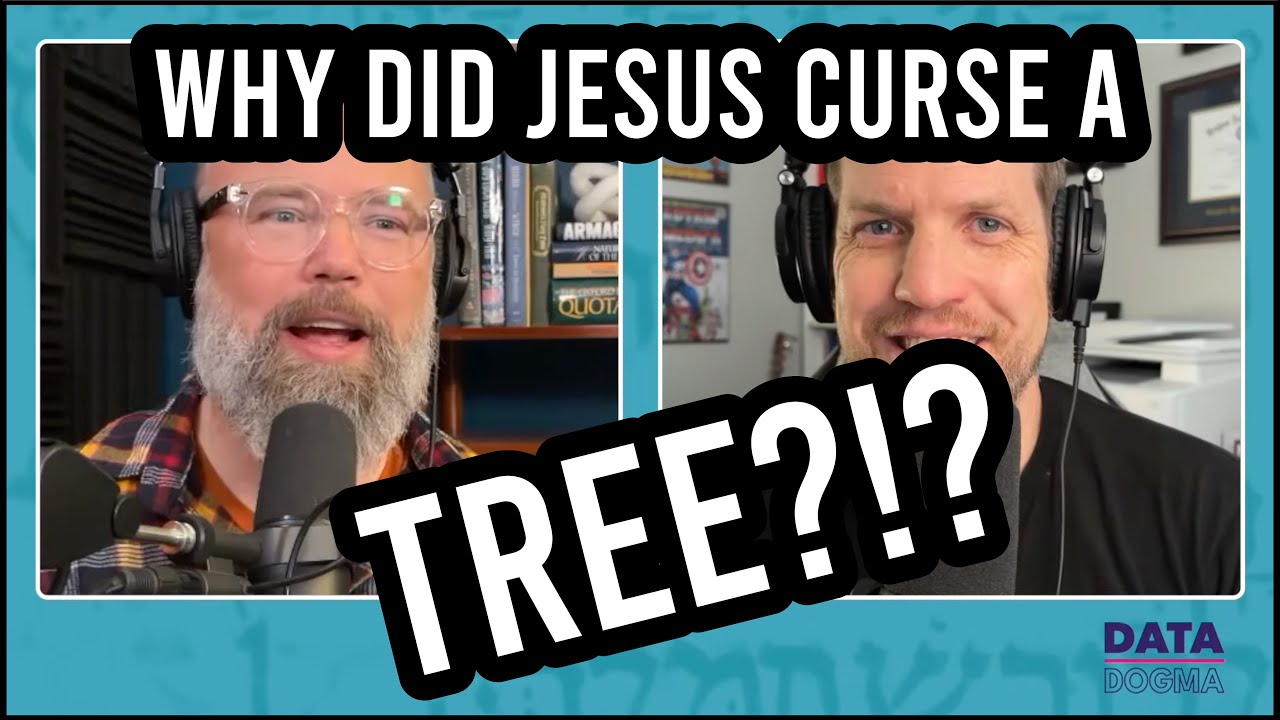
The Transcript
Out of methodological necessity. Critical scholarship cannot accept real prophecy, at least in my opinion. Which means that, no, if the text says there’s this dude named Cyrus. That text was written after that dude named Cyrus was on the scene. Hey, everybody, I’m Dan McClellan. And I’m Dan Beecher. And you are listening to the Data Over Dogma podcast where we increase public access to the academic study of the Bible and religion and combat the spread of that pernicious misinformation about the Bible. How go things, Dan? Things go well. We’re gonna kill some foliage today. We’re gonna. All right. We’re gonna murder a tree, among other things. So that’s exciting. That’s always fun. Yeah. And. And I. I have high hopes that you’ll help me to understand what. What the heck’s going on with that story. So that’s where we’re gonna start out. We’re gonna start out with a chapter and verse on that. Awesome. And then you’re gonna tell us. You’re gonna help us out with a. What does that mean? Because I have heard you use the phrase Deutero-Isaiah before, and I have no idea what we’re talking about. Yeah, so that’ll be fun to. To get that all covered. Yeah, that’ll be. That’ll be a lot of fun. It’s something that has been controversial for a long time. So we’ll clear the air a little bit and explain what. Excellent, excellent. Well, let’s start with chapter and verse. And we’re picking up, I guess, in. In Mark 11
. Is that where we want to pick up? Yeah, Mark’s the earliest gospel. So scholars are in widespread agreement that this is the earliest iteration of this story. Now it’s likely that there is some tradition that pre-existed the Gospel of Mark
. There might even be some sayings in an earlier sayings gospel that Mark might have used as a source. But the earl. The first access we have to this story is in Mark 11
. I gotta say, I feel like whatever the precursor things that Mark was drawing on, they must have made more sense than this because I am wildly confused by this story. Should we just dive in? Like, okay, so here’s what happens. Jesus has just made his triumphal entry into Jerusalem. And you know, there’s a whole thing about him riding in on a colt and people throwing down leaves in front of him and all this sort of stuff. Right. And then the next day, Jesus is out for a walk and sees a fig tree in the distance. It’s got leaves on it. He meanders over there. It is not the time, it is not the season for figs. This, this, this fig tree is not fruiting currently. And Jesus talks to it, which I think is weird, and says, may no one ever eat fruit from you again. And then, and then, then they take off, which I feel like vindictiveness against a tree is odd. And I don’t. And I, and okay, so, so there’s that, that’s, that’s part one. Yeah. Then there’s this whole thing where Jesus and we, we remember that Jesus cleanses the temple. Right. So, Right. Jesus goes. You know, there’s several, several verses where Jesus goes into and turns over the table of the money changers and scolds the people who are buying and selling things and makes some very, people very angry. And they, they tried, they want to kill him. And then that’s, that’s that little thing. And then we’re back to the tree. Yeah. So picking up in verse 20, they go. The next morning, the disciples go back to the tree and it has withered away to its roots. And Peter said to him, hey, look, the fig tree that you cursed has withered. And Jesus says, have faith in God. No, okay. He says, have faith in God. I’ll just read it. Truly, I tell you that if you say to this mountain, be taken up and thrown into the sea, and you do not doubt in your heart, but you believe that what you say will come to pass, it will be done for you. So I tell you, whatever you ask for in prayer, believe that. Believe that you have received it and it will be yours. Now I can see saying, you know, if they’re amazed by what he did to the fig tree. Yes. I can see how, how it follows to say, you know, you can make, you can move mountains if you believe. Why did he kill a fig tree? I’m so confused by this. So, so walk us through the whole thing. I’m, I’m, I. The whole thing just baffles me a little bit. It’s a bit of a head scratcher. So what we’ve got here is one of Mark’s sandwich stories where we have kind of the introduction and the conclusion, and in between we have a separate story. But usually these stories are kind of bookending whatever’s in between and all, and they relate to each other. And so the fig tree is a metaphor. Surprise, surprise. Right. And we hear talk in the, in the New Testament and elsewhere in the Bible, this notion of bearing fruit, and particularly in relation to Jesus, this has to do with good works. This has to do with producing results, doing the things that are expected of you. And we have right before they go and see the withered tree is the threat that we see in verse 18. And I finally got the digital version of the updated edition of the NRSV, so I’m up to date now and here. And it says in, in verse 18, when the chief priests and the scribes heard it, they kept looking for a way to kill him, for they were afraid of him, because the whole crowd was spellbound by his teaching. And he’s just gone into the Temple. And the Temple is not bearing fruit. The Temple has become, in the eyes of Jesus, through the eyes of the Gospel authors, a den of thieves. The chief priests, who are supposed to be the ecclesiastical authority of the day, the scribes, who are supposed to be the learned men of the Jewish tradition, are also not bearing fruit. They’re trying to kill their Messiah. And so this is a metaphor for Jerusalem, for the Temple, for the Jewish leadership. He shows up as the Messiah. He’s been up north, he’s been in Galilee doing his thing, and he comes down to Jerusalem to enter triumphantly into his city. There are leaves everywhere, and he wants fruit, and they have none to offer him. And this is one of the indications that Mark was written when either the destruction of the Temple was imminent or had already happened. Because the idea here with the cursing of the fig tree is Jesus says, hey, I showed up looking for fruit. I didn’t see any. Guess what? Boom. Roasted. No more fruit ever. And this is a symbol or this represents the destruction of the Temple, the scattering of the leadership of early Judaism. Now, later on, toward the end of the first century CE and into the second and third century CE, we’re going to have the development of Rabbinic Judaism, which is going to be carrying on the Pharisaic tradition. It’s organizing around the traditions that are going to develop then. But when Mark is written somewhere around 70 CE, either immediately before or shortly after the destruction of the Temple, they have no understanding that. That Judaism is going to come back together and organize and carry on. And so from the perspective of the author of the Gospel of Mark
, the tree is cursed and has withered. The Temple is gone. The idea is basically, yeah, that’s never bearing fruit again. I see your problem. It’s, you know, you’re cursed. You’re not going to bear any fruit ever again. And but this is an issue because Jesus’s followers are, at this point in time, all Jewish folks. And so it’s kind of frightening. Well, what’s going to happen now? Right? And the, you know, look, the tree has withered from its roots. The Temple is gone, the leadership is gone. And so the response from Jesus is, have faith in God. And then goes on to explain that through their faith they can accomplish all these great things. So they’re going to be able to move mountains going forward. They don’t need those things that were not bearing fruit. And it, it says that when Jesus went looking for the figs, it was not yet the time for them to be bearing fruit. And so he shouldn’t have expected to find fruit on there. So it seems a little, a little callous for him to go zap. Yeah. Because it wasn’t doing anything wrong. It’s not fig season. Yeah. The tree’s like, I’m just, I’m what. I’m doing exactly what I’m supposed to be. I think of Steve Martin in his little mask in Little Shop of Horrors with the little bubbles filling up with air and then emptying, going, what did I ever do to you? And then Jesus goes, it’s not what you did to me, it’s what you did to her. And, and, and so it’s in, in my opinion, this is Mark’s, kind of like Jesus is, is killed at the Passover in March slash April, which is too early for the fig season. So he’s like, well, I got to get it in there somehow. So in my opinion, he’s, he’s just fitting the story in where he can. Although there are some scholars who will argue that, that Jesus’s arrival showing up to Jerusalem is, is before the Messianic fulfillment is supposed to take place. But I don’t, I don’t know about those, those timelines. But in short, this is, this is a metaphor. This is condemning the, the scribes and the, and the high priests, the chief. Priests, the dove sellers. Yeah. The money changers. This is condemning the leadership there in Jerusalem for not bearing the fruit that should be expected. And then saying, but don’t worry, we don’t need them because you’re going to have power to do all these things moving forward. Okay. I mean, to me, that make. Yeah, that makes more sense a little. Bit, but it is unique. It is the only miracle of Jesus’s that is destructive. Yeah. Where. And very much so. And just. Yeah, it just feels mean to, to a tree that ain’t did nothing just to just, just to be a metaphor. Well, and yeah, I don’t know how they thought about the personhood of trees anciently I mean, they obviously use Jesus referencing it in the second person. Yeah, kind of like, look what you made me do. But, but I don’t know if they had sympathy for, for trees back then. But yeah, that’s what a lot of people these days are like. But yeah, that’s what a lot of people these days are like. Tree didn’t do nothing to you. When they asked Jesus if he had cut down the tree, he said, I cannot tell a lie. So, talk a little bit about the temple. Because if this is a metaphor—is it a metaphor for the temple or is it a metaphor for sort of Judaism as a whole? It’s both. And it’s, it’s encapsulating the temple and the people running the temple and the other folks who are supposed to be representative of, of the best of, of Judaism of that day. And so there is, there is an anti—it’s kind of anti-clerical and anti-Jewish all at the same time. They rejected Jesus, they rejected their Messiah, according to the authors of the Gospels. And so this is the author’s opportunity to, to take a little rhetorical jab back at them and say, you’re like a withered tree. Yeah, “suck it.” Is the temple— You know, we’ve talked about the temple, about the destruction of the temple, but we’ve never really dug into what the temple was about. What happened in the temple. Clearly there’s commerce going on there. Is it a building, is it an area? What is the temple? Well, by the time of Jesus’s day, we have the Second Temple. The First Temple was destroyed in 587 BCE by the Babylonians and was rebuilt about 70 years later. And this is when, according to the biblical text, Cyrus the Great allows the Judahites after conquering Babylon, who had taken them captive, Cyrus the Great allows them to go back and allows them to rebuild their temple. And so the Second Temple, also referred to as the Temple of Zerubbabel, was rebuilt. It was probably on a smaller scale, not as grand as it was before. And later on this gets supplemented even further during the Hasmonean kingdom. So when the Maccabees run off the Seleucids who have come in and have desecrated the temple and have destroyed parts of it, they’re rebuilding parts of it. And then the Romans come in and they annex Judea and then they put a client king in charge of Judea, Herod the Great. And he rules for decades. And part of what he does is engages in these large-scale building projects. He wants to build up cities, he wants to create new centers of commerce and culture, like Caesarea Maritima. And he wants to expand the temple. And so the temple complex was a large courtyard enclosed in walls that had gates in it. And then inside you would have had the, the temple proper, which had a, a courtyard and an inner sanctum and then the Holy of Holies. So it’s what’s known as a tripartite temple. And they have—there are a few different styles of, of temple in, in that time period, but he significantly expands the, that courtyard to the south, which requires building a bunch of underground supports so that it can extend out over a hill that’s actually going down quite a bit. And if one visits Jerusalem today, there are parts of the wall that was constructed by Herod, which is characterized by what’s called ashlar masonry, where they have—they kind of create a kind of textured look for the face of the stone, but then there’s a, there’s a trim around the outside that is cut smooth. And so if you go there, you can see some of the lower levels of the, the wall, particularly on the south, that are remains of Herod’s temple. But it was rebuilt to some degree in later periods, not the temple itself, but just the, the platform and the walls and things. And I think one of the coolest parts of the, the whole temple complex that you can still see today if you go to what’s known as Robinson’s Arch, it’s at the southwest corner of the Temple Mount. You can see the southwest corner. You can see some of the layers. Of. The wall as constructed by Herod. And you can see large sections of the wall scattered around the base of that wall, as well as the, the sidewalk, the. The base that is cratered in. Because when the Romans destroyed the temple, one of the things they did was had their soldiers push a lot of the stones off of the top of the wall, and they came tumbling down and just cratered the, the stone sidewalk and platform area below. And so when you go visit, you can actually see these craters in the stone and then all the pieces of large stone scattered all around. And so you can kind of. There’s just enough cues there to give you a sense of this just enormous destructive force and to imagine what. What would have happened at the time. And this is something that the historian Josephus personally witnessed. Oh, wow. So. And so when you read some of Josephus’s history, he talks in some detail about what went on during the, the siege of Jerusalem and the destruction of the Temple. And, and so does he talk about. The fig tree situation at all? I think he overlooks the. The fig tree. This is happening, ostensibly, this is happening decades after Jesus’s life and death. So the fig tree, if it had been withered, at some point, somebody came along and went, we got to get this thing out of the way. And so I don’t know how big it was. Probably not incredibly big. They probably could have just yanked it out by hand. But now Mark is not the only place that we find this story. We also find it in Matthew. Yeah. It feels like it gets a little bit more streamlined in Matthew. It’s not separated, it’s not sandwiched, as you say, the way that Mark did. So this is Matthew 21
. And. And basically it’s. It just has the story and it all happens at the same time. It’s not. It. It doesn’t have the intervening day. It just says that. That Jesus saw the tree in the morning, said, may no fruit ever come from you ever again. And then the fig tree withers right there in front of them. You know, it’s basically the same thing. And, you know, the disciples are saying, wow, that’s amazing. And he says, if you have faith and do not doubt, not only will you do what has been done to the fig tree, but even if you say to the mountain, be lifted, here’s the thing. Nobody ever does the mountain thing. Yeah. And none of the disciples ever seem to be able to do the. The fig tree trick either. Yeah. It feels like, I mean, I guess part of me when I read the you’ll be able to move mountains if you have enough faith thing. If it’s in the context of a story that is metaphor, I’m much more comfortable with it because he’s speaking metaphorically. Yeah, but so many people have attempted crazy things, believing that their faith would be enough to. To make it happen or to keep them safe or whatever. Can we just make it the. The policy of the Data over Dogma podcast that you should not try things that are physically impossible, even if your faith is really, really strong. Yeah, yeah. The. As Jesus said, you shall not tempt the Lord your God. And frequently people try it in context that render what they’re doing tempting to God. They’re. They’re like trying to say, oh, I’m going to, you know, whatever ends up. You know, people have died because they’ve done silly things believing that. That God was going to save them, and which is really inviting a sign tempting God exactly as Jesus said when he was. Yeah, jump. Jump off the temple. Come on, man, you can do it. Everybody else is doing it. In fairness, though, it does seem like Jesus is saying here, if you, if you have faith and do not doubt, you can just do anything. Yeah. So that seems like it’s in conflict with. With the. Don’t tempt God. But again, you must see this as a metaphor. Yeah, well, and, and, you know, Matthew has Jesus saying things that conflict with themselves, as do the other gospel authors. And I would argue that Matthew probably because Matthew’s like, hey, you can do the same thing as I just did to this fig tree and other things as well. But wait, there’s more. Anything. And so it seems to me that the. Matthew has kind of missed some of the metaphorical message that Mark was. Was using or at least understands it in a different way. I think the message is a little harder to. To get from here than it is from the Gospel of Mark
. And so it seems like it’s a story that Matthew was like, well, we gotta include this silly little story. We’re gonna work this in here. Yeah. And he didn’t. And he didn’t want to split it up with the cleansing of the temple like Mark did. And so he has to have it happen immediately. He’s just like, zap. And then immediately the tree desiccates and. And withers up. Yeah. Which makes for an even more peculiar story. Yeah. Because the, and the disciples are not like, why the hell did you do that? Point of order. Why did you. Yeah. Kill the tree. Luke does an interesting thing. He. I, I think by the time this gets around to Luke. Is Luke after Matthew? I think most scholars would probably say Luke is after Matthew. Yes. Because Luke. In fact, more and more scholars are arguing that Luke may be early second century. Oh, wow. Yeah. Okay. Because Luke skips Jesus killing the fig tree altogether, but has a fig tree moment. Yeah. He has a parable. It’s just a vibe at this point. Yeah. It’s just, it’s just like. I mean, and Jesus isn’t even involved, and it’s very clearly a parable. It’s labeled as a parable, which is nice. Like when you, you know, when something’s. When something’s labeled as a metaphor as opposed to just like I’m saying this metaphor. Maybe you’ll get it, maybe you won’t. But, yeah, the parable of the fig tree is much more. It’s about a guy who plants a fig tree. It doesn’t ever, you know, for three years, it doesn’t bear fruit. Dude’s pissed off. He says, you know, I love the idea. Why should it be wasting soil. And then a dude says, give it another year. I’m going to dig around, I’m going to do some, put some manure on it. If it bears fruit next year, that’s good. If not, you can cut it down. I don’t know what that’s a parable for. Do you? Well, I think we still, I think this is a little more clearly a metaphorical reference to the house of Israel bearing fruit for God. However. Yeah, it’s Luke’s probably like these idiots, they’re not, they’re not gonna get this. And, and probably also he was thinking. Of me, Luke was thinking of me. I appreciate it. And was probably also wanting to distance Jesus from a destructive act. Doesn’t want to represent Jesus as doing this because the, the tradition of Jesus has developed a little bit more. Jesus is probably a little more lovey dovey by this time period. Luke is certainly one who’s, who has more concern for the, the more vulnerable and marginalized of society. He’s championing women and he’s championing the Gentiles more. And so I think he’s probably like, we don’t want to hurt no little tree. Let’s just, we’ll, we’ll put it in a parable. So it’s not even history, it’s just metaphor explicitly. But, and they don’t represent them destroying it. I mean, it’s the first time, it’s the first time we get the idea of like, let’s try to make this. Okay, let’s, let’s see if we can actually like salvage this tree and have it bring fruit. Which I think is interesting because the other two are just like, oh, no, fruit, you’re dead forever. And then it looks like there’s the Infancy Gospel of Thomas, which is one of the, one of the Gnostic gospels, probably written in the mid to late 2nd century CE, has a quotation, “Behold, now you also shall be withered like a tree and shall not bear leaves, or, nor root, nor fruit.” What is going on with the trees in ancient Southwest Asia? That they are withering? I don’t see that many withered trees. Do you see withered trees? Anyway? Go on. Well, you have, I’m, I’m trying to remember where this is, but I think you have figurative language where, you know, fruit can also, in addition to being a reference to like good works and productivity and, and progress and things like that, can also be used to refer to offspring and descendants. And so a withered tree or a withered root or something like that is somebody who does not have any. Any children, any offspring— Shooting blanks? Well, yeah, if. If you want to get clinical about it, I think that’s the technical term, but I’m trying to think of a. There’s. There’s a reference somewhere to somebody being like a withered tree. I’m just saying they’re using this metaphor a lot. And it just seems like maybe the trees there were. Were not doing great horticulturally. It seems like they need arborists in. There were not a ton of trees in the area. The soil is pretty rocky, for one. And historically there were. There were a lot of trees further north, you know, the cedars of Lebanon, for instance. A lot of people are familiar with that. But those. A lot of those trees were. There’s a lot of deforestation. A lot of those trees were used in earlier periods. And so by the time of the first century CE, there was not really a ton for them. And this is why a lot of scholars think that Jesus wouldn’t have been a carpenter, but a stone mason or something like that, because the wood would have been at quite a premium. And so most of the construction and things like that would have been in stone. And you even have, right around this time period within Judaism, the use of stone utensils, like stone cups and pots and things like that is, for a brief period, very popular. But this has to do primarily with purity, because stone, unlike clay, would not transmit or maintain or retain impurities. So a clay dish, if it was rendered impure, it would transmit the impurity to whatever was in it. But stone would. The impurities would bounce off, and then whatever was put into it could be purified. So. So stone was more important than wood in that time period, in part because trees were not abundant, although you do have a lot of olive trees in the area. In fact, in the story in Mark and in Matthew, he’s spending the night in Bethany, which is down the valley, up the Mount of Olives, and kind of heading to the other side of the Mount of Olives is Bethany. So it’s. It doesn’t say where exactly this fig tree is, but if he was going from Bethany to Jerusalem, it might have been located overlooking the… what’s called the Kidron Valley. And so it would have been directly opposite the temple on the other side, which is. There’s a. You can go there today. There’s like a lookout point, like a. A platform and a railing and a place where people go to take pictures. Because. Because you have the. The Dome of the Rock and the Temple Mount directly opposite. All right. Yeah, there you go. Lovely area. And, and Jesus said unto them, this is good for Insta. If you guys want to stop, get your phones out. Yeah, well, they were living in the now. They were living in the moment. Back then it was let’s kill this tree rather than let’s. I love your, the idea that, I love that you pointed out that he was theoretically a carpenter. Because you would think that a carpenter would have more respect for a tree. At very least don’t wither it, you know, cut it down. Make something out of it. Have some, you know. Yeah. Make a nice box or something. Honor it. Honor it. Turn it into something productive. Give it a second life. That’s right. But yeah, and then. Yeah, every, every time I think of Jesus as a carpenter, all I can think of is that’s the cup of a carpenter. Well, yeah, there you go. All right, well, thanks for that. The story now makes some sense to me. I’m going to, I’m going to give it, I’m going to allow it to have some sense. It’s not, it’s not maybe meaningful, but it is. Yeah. Well, I mean, not, not to me. It’s coherent. Yeah. I had, I, I have no personal. What am I trying to say? Like connection to the temple, but. Yeah. Or to like the structure of Judaism or Israel at the time. But I get it. So that being said, let’s move on to Deutero. What does that mean? What’s that mean? We’re talking about Deutero-Isaiah for this segment. And Deutero, I mean. If you speak modern Greek, you’re thinking deftero. But Deutero-Isaiah means second Isaiah, basically. And this is a theory that sees the book of Isaiah
as a multi-stage composition, as something that came together over a long period of time. Not just the work of one author, but of at least two. And the theory, the main theory has three authors. Theory, the main theory has three authors. They call them First Isaiah, Second Isaiah, and Third Isaiah, and Deutero-Isaiah is the more common designation for Second Isaiah. And this runs from Isaiah 40
to 55. Okay, so Isaiah as a book in the, in the, the Hebrew Bible goes to chapter 66. So 66. There’s a lot. I’m sorry, I’m just full of movie references today. But you are, man. When you said 66, I thought it was 6. 6, 6, 6, 66. 66 times. Which is. You don’t know me on that one. Okay. That’s The Great Outdoors. Oh, yeah. So. And how many times you’ve been struck by lightning? Okay, so, so yeah, Isaiah is a prophet writing in the middle to late 8th century into the 7th century BCE. So would have been a prophet that was there in the courts to see the reigns of, of a couple different kings. But Hezekiah is the main king, and so that is associated with Hezekiah. And do we believe even. Even. Let’s just say. Let’s just say that we’re going to accept for, for purposes of this argument or of this discussion, the Deutero-Isaiah theory. Do we believe that the first part of Isaiah was actually written by a dude named Isaiah? Yes. Okay. Yes. Critical scholarship is in agreement that there was a dude named Isaiah who probably was a core prophet for perhaps King Hezekiah. Now we see some stuff about. So Isaiah would have been ministering, prophetizing, however you want to say that—that’s not correct, but that’s what came out. It’s good enough by me—in before the destruction of the northern kingdom of Israel around the year 722 BCE at the hands of the Assyrians, and then would have been around for Sennacherib’s invasion of the southern kingdom and then siege of Jerusalem, which ultimately was called off, leaving Hezekiah to declare victory. Even though in the Sennacherib Prism, an Akkadian text written a little bit later, Sennacherib crows about having trapped Hezekiah in his capital city like a bird in a cage. But Isaiah, for a long time, people have noticed there seem to be different segments of Isaiah. You have chapters 1 through 12 talking about judgment and salvation for Israel and for Judah. Chapters 13 to 27 are a bunch of oracles against the nations or woes. You have 10 woe untos that run from chapter 13 to chapter 23. Chapters 24 through 27 represent Isaiah’s kind of apocalypse. We have chapters 28 through 35, which we come back to some woes, but they’re leading up to the Sennacherib narrative. And then chapters 36 through 39 are the Sennacherib-Hezekiah narrative. So we’re kind of zooming in on the story that’s told in Second Kings, chapters 18 and 19, where Sennacherib comes up against Jerusalem and lays siege to it. And we have a slightly different telling of how that all went. And then we have chapters 40 through 55, Deutero-Isaiah, and this tells the story of the fall of Babylon and the restoration of Zion. And then chapters 56 through 66 kind of represent a concentric arrangement where you have the earliest and the latest chapters talking about gathering the people to God’s holy mountain. And then you move into next-latest and next-earliest chapters. There are complaints about the nature of the deliverance, and there’s a divine response. And then you move in, there’s a theophany to punish the wicked. And then the very center of this concentric arrangement is about restoration, the restoration of Israel. And around the year 1800, scholars began to take seriously this notion that there were multiple authors responsible for what we know as the Book of Isaiah
, and that at least a part of it was probably written during the exilic period. So centuries after the historical Isaiah would have lived and preached and prophesied. And this is thanks to, to a series of Johannes. So Johann Benjamin Koppe, Johann Christoph Doederlein, and Johann Gottfried Eichhorn are authors in the late 18th century who, who are kind of developing a theory of, hey, some of this looks like it’s coming from a later time period. And then we have a scholar named Bernhard Duhm in 1892 who published a commentary and argued for a first, a second and a third Isaiah. And what, what were the, talk about the, the clues that led to these conclusions? And this is important because a lot of people think that there’s this kind of cynicism about authorship where critical scholars are like, I’m beginning from the presupposition that none of this happened and none of this was written by who claims to have written it. And this just simply is not the case. This is critical scholars coming to the text, accepting it at face value until given a reason not to. So these earliest scholars weren’t like, you know, every chance I get to say something is not Isaiah, I’m going to say it. Because the first people were like, oh, it’s just chapter 50, and it’s just chapter 42, and it’s just chapters 13 through 16 that seem like they were probably written by somebody much later. And then the theory gets refined, and the theory gets refined, and the theory gets refined. But the biggest division is between Isaiah 1
to 39 and Isaiah 40
through the rest of Isaiah. Because here’s something interesting. Isaiah’s name is mentioned over a dozen times in chapters 1 to 39. The word of the Lord, which came to Isaiah, the son of Amoz, and the Lord said to Isaiah, and Isaiah said to Hezekiah, and all this. And you have it occurring like 4 times in Isaiah 37
, 3 times in Isaiah 38
, 3 times in Isaiah 39
, and his name is never mentioned again in 40 through 66. There’s no reference to Isaiah at all so one thing, the language shifts, the topics shift and the time frame seems to shift because Isaiah 1
to 39 are talking about the future destruction of Israel by Babylon. It is prophesying about this, this is coming, this is coming, this is coming. I’m prophesying that this is coming. And then you get to verse or chapter 40 and all of a sudden we’re no longer prophesying. It’s now saying that happened, that happened, that happened. It’s in the past. It’s not the prophetic perfect. It’s not this speaking about it with such confidence that you speak about it as if it already happened. They’re just saying, hey, this thing happened. None of it’s speaking prophetically, none of it is attributing anything to Isaiah. It is all talking about, here’s how we are picking up the pieces and here is what’s, what’s coming. And so scholars are like, what do we do with this? We gotta figure something out. And then you have some other, you have some other clues. So Isaiah 45
calls Cyrus the Great, explicitly refers to Cyrus by name, who is someone who conquered Babylon, the Persian emperor who conquered Babylon in the year 539 BCE so a good 200 years after Isaiah. And it says that Cyrus is my anointed one. And in the Greek translation of this, it is my Christ. Literally. And so, and this is because Cyrus conquered Babylon and then allowed the Judahites who had been exiled to return. And according to who we referred to. Earlier in the show. Right. And so they’re like, well it kind of seems like whoever wrote this section that’s very, very different and is looking back on the whole Babylonian exile as something that happened in the past, maybe is referring to Cyrus. Because they’re writing after this all happened right now. And a lot of people will, I get accused of this a lot. A lot of people will say, well that’s your anti-supernatural bias. You just don’t allow for the poss. Possibility of real prophecy. And that’s not what the scholars who developed these theories were doing. Now I will argue that it is a methodological necessity to reject the possibility of real prophecy if we want to function as scholars at all. Because when you say we have to allow for the possibility of real prophecy, there is no circumstance then where you can interrogate or question a claim to real prophecy. Because when you say we have to allow for real prophecy, you’re saying the normal critical scholarly methodologies and frameworks and lenses. We’re going to exempt this story right here. They do not apply. Right. But to say anything is not real prophecy requires the imposition of those very frameworks and lenses and methodologies. And so you pick and choose which story gets to be exempt and which does not. And so if you say, well, you have to allow for the possibility that Isaiah really prophesied about Cyrus, but then you turn around and say, well, no, Joseph Smith obviously didn’t predict the coming of the Civil War. You’re imposing historical-critical methodologies on one place and you’re saying, no, this gets to be exempt in the other place. So whether it’s the Book of Mormon or the Bhagavad Gita or the Quran or anybody else who has claimed to. Prophecy, Hank Kunneman talking about Donald Trump being definitely reelected in 2020 or whatever. Yeah. Or even the failed prophecies. I mean, the people who say, well, this has to be real prophecy make excuses for failed prophecy. And so even the folks who said, yeah, that comet over there, we’re going to be riding that thing next week, even those folks, you cannot. You. You don’t have a way to consistently apply the same approach and wind up at, that’s real prophecy. That’s fake prophecy. So out of methodological necessity, critical scholarship cannot accept real prophecy, at least in my opinion. Which means that, no, if the text says there’s this dude named Cyrus, that text was written after that dude named Cyrus was on the scene. It does certainly seem like an Occam’s Razor moment. Right. Like, the simplest explanation for it is clearly that they knew. Because if, even if nothing else, most of the prophecy throughout the Bible that I’ve encountered, it’s not specific like that. It’s not. It doesn’t name names. It says, you know, a great. And it’s usually metaphor. Right. It’s usually like a giant statue is erected and it has, you know, blah, blah, blah for feet and it has blah, blah, gold for head or whatever it is. It’s not. It’s not being. It’s not saying. And the head, the gold head is Julius Caesar. And the. It’s not. Because prophecy isn’t specific in that way. It’s not naming names. Yeah. Unless it’s about, like, two weeks from now or whatever. And you see this in all of the different ways that attempts at prognostication and prophecy manifest, they’re always vague. The palm readers who will say, like, I’m sensing the letter M. Oh, I live on Maple Street. That’s the one. There you go. Boom. Or. Or, yeah, you have a lot of vagaries, but it’s when it’s like it was the guy, Cyrus, specifically Cyrus the Great, the first one, the Persian, he was. That’s specific enough that it’s not even claiming to be prophecy. Right? It is just saying, hey, Cyrus, my anointed one, he did this thing for me. And so it’s not even claiming to be prophecy at that point. And so when you gather up all the data and. And there are a number of other things. There are Aramaic loanwords in the book of Isaiah
. And the Judahites picked up Aramaic, including the Aramaic script, while they were exiles in Babylon. So when you have Aramaic loanwords in the text, or at least a higher concentration of them, that indicates this text was written in. When they were in much closer proximity to the use of that language. That all of this combines to make it far more likely that Isaiah 40
-55 at least, were probably composed after the Babylonian exile. Most scholars would say somewhere around 520 BCE. So after the return, right around the time that the second temple is being rebuilt, is probably when you have the first layers of Deutero-Isaiah being produced, and then Trito or third Isaiah is coming even later than that, probably in the Persian period. Is there any theory as to why these were tacked on to Isaiah rather than just presented as their own. As their own books? Well, there are lots of theories because since the late 20th century, there’s been a big concern for trying to drill deeper because a lot of people thought, okay, the real Isaiah wrote Isaiah 1
through 39, and then the next guy came through and wrote 40 through 55, and then somebody later on came through and wrote 56 to 66. But then scholars are like, well, I don’t know about this. Like, Marvin Sweeney, I think his dissertation and then some of his early work was talking about how Isaiah 1
through 4 fits much better thematically with Deutero-Isaiah. And so he was saying what we. We’ve got literary layers still from later periods in first Isaiah. And so there is a. And now scholars are trying to piece together how exactly Deutero-Isaiah and first Isaiah and third Isaiah came together. And so there was even a paper published in 1990. Coggins, I believe, was. Was the author who’s. And the paper was, do we even need Deutero-Isaiah or something like that? Like. And the. The argument was, if this is not a coherent single source, do. Do we even need to treat it as. As its own segment? Because it seems like parts of Isaiah 1
through 4 are probably from the same or even a later author. And then we’ve got parts of some of the other segments within Isaiah 1
through 39. And so, you know, some scholars are like the original Isaiah only wrote these six and a half verses in this one chapter. And that, that’s kind of on the extreme end. I think most scholars would say the majority, half to the majority of Isaiah 1
-39 is probably the work of an 8th-century prophet who went by Isaiah and then as it accumulated more layers and was redacted and you bring in this post-exilic work, you have people kind of adding introductions and you have people writing other things into some of the later layers and earlier layers. And so it is a very complex, has a very complex compositional history that scholars are still working on, trying to, trying to come to some kind of agreement on. But what the overwhelming majority of scholars agree on is that Isaiah 40
through the end of Isaiah were absolutely not written in the 8th or even the 7th century BCE, but were written much later. And much of Isaiah 1
-39 was probably written later as well. Can you confirm for me, I, you know, I, I, when I was looking this up, doing a little bit of research, I of course found articles that were, we’ll call it, skeptical of this claim. Yeah. Can you confirm that as the, as GotQuestions.org says, the theory of multiple Isaiahs is one example of skepticism from those who want to call into question the Bible as God’s inspired word. Can you confirm that it’s just scholars trying to, to ruin it for all the believers out there. So that’s a, that’s a value judgment. Right. And that is, that is making some pretty irresponsible assumptions about where these theories are coming from. Because these, these don’t originate in people who are like the Bible’s dumb. You know, this, this is not. Some at GotQuestions would beg to differ, sir. These are people who are just trying to honestly engage with the data they’re, they’re finding in the text which, and, and we’ve talked about when we had our friend Aaron on to talk about the star of Bethlehem, you know, he was saying I wanted to know more as a believer. Yeah, I wanted to know more. And I got to the point where I was like, I, I can’t sustain this, this position anymore because I got to know more and you know, not. There are scholars who, who then leave the, the traditions they grew up with, abandon them and, and continue to have a lot of interest in studying this kind of stuff. And then there are others who stay in the traditions and treat the, treat the text from an emic, inside perspective. Hey, this is, I consider this to be authoritative literature. I consider this to be important. I use this to guide my life. But I’m also engaging it as honestly as I can because a lot of them feel that that’s really the best way to try to apply it is to try to better understand it, even if it means being critical about it. So, yeah, there’s apologists are, I’ve said this before, apologists begin with the conclusion in mind, and then their goal is just to try to find a way around the data to generate an argument that sounds at least possible to say, the data do not make it impossible for me to arrive at the predetermined goal. Now, what critical scholars do is they will allow the data to operate on their own terms and allow the data to lead them where the data are going, going. And that’s. Those are two very different approaches. One is let’s go see where this takes us. The other is this is going to take us here, and we just need to see how many, how many train transfers and how many walking routes we have to take to get there. Okay, look, just because the road doesn’t lead us there doesn’t mean we can, we can’t drive there. We just got to go off road a little bit. Yeah. And you see this a lot there. There are folks who, who will respond to critical scholarship by saying we can make a plausible case. It’s not impossible. Yeah. And tons of things are not impossible. I mean, as Russell’s Teapot shows, there’s an awful lot of stuff that’s not impossible. And if that’s, if that’s the bar, it is underground. So, yeah. Those also shouldn’t be taken seriously. On the other side of it, you know, you talked about how, you know, for the work of critical scholarship, you have to sort of assume. No. That. Prophecy? You have to assume that prophecy isn’t, isn’t correct or isn’t real until. Somebody can demonstrate it. Yeah. That doesn’t mean that that’s for the work of the scholar. That’s right. That doesn’t mean that you can’t have a faith that is, that does include prophecy. Oh, absolutely not. I agree 100%. Anybody can. I mean, you get the meaning and the significance and the utility out of it. That’s going to make you a better person, is going to help make you a more contributing member of society. For a critical scholar, I would say there are, there are boundaries to where we should be going, because our goal is not to say, look how awesome the Bible is. Our goal is to try to use the data, to find out what we can about where this thing came from, how it came together, how it has been used in the past, what it means to us now. And I think we have a responsibility to point out when it is being used for destructive purposes, to structure power and values and boundaries over and against the interests of marginalized and… And minoritized and oppressed groups. And that’s what an awful lot of apologetic work is doing, is trying to structure power in favor of certain groups and over and against others. And so, yeah, there are folks, I think, who do a responsible job of allowing for the possibility of real prophecy, but they’re not the ones on the internet barking at critical scholars and condemning them and, and denigrating their work and denigrating them as people and even denying that it’s possible for them to have faith or be believers, which is something. That I see thrown at me an awful lot and claiming that the goal of this scholarship is to… To… To denigrate the… The Bible or to… Or to undermine the belief in… Yeah, in God’s inspired word or whatever. And I think that’s rhetorical prophylaxis. I’ve used that word a lot. A lot of people are like, what even is rhetorical prophylaxis? You’re talking about a word condom. What are you saying? So prophylaxis is a barrier or a protection against the harmful or the undesirable effects of something. And so a prophylactic is something that we have a technical use for. But rhetorical prophylaxis is my term for when people use positions or arguments or things like that that have… That only exist to deflect away criticism. Yeah. So that is rhetorical prophylaxis because it is a way for someone to dismiss critical scholarship so that it does not hurt their faith. It’s not a legitimate claim or concern. It’s a fallacy. But if you can convince enough people that these people are out to harm your faith, then they will immediately put up a barrier. And then those people have cut off the harmful effects of that critical scholarship through this fallacious ad hominem attack. And I get that all… Every single day, dozens of times, every single day, people will comment across social media that I’m trying to destroy the Bible or destroy Christianity or destroy Mormonism or destroy Judaism. I get accused of that stuff all the time. And you guys, everybody pay attention. Just because that’s what’s actually happening and he is destroying those things doesn’t mean that’s why he’s… That he’s trying to. That’s totally different. All right, friends. Well, that’s it for this week’s show. Thank you so much for tuning in. This Deutero Isaiah thing, I like it. We’ve referred to it before. Now we all know what it is. I’m… I’m very pleased about that, dude-bro Isaiah. Deutero Isaiah is another way to… To refer. Like, I feel like it’s, you know, there’s… there’s got to be something about the Big Lebowski involved in Deuterino Isaiah. If you’re not into the whole brevity thing. That’s right. El Duderino Isaiah, which is now what it’s called in my mind forever. You’ve locked it in. That’s solid. All right. If you would like to become a part of making this show, go and get ad free early access to every episode, as well as access possible access to our after party, which is bonus content. Every week. You can do so by going to patreon.com/dataoverdogma if you would like to write into us about anything, the email address is contact@dataoverdogmapod.com and we’ll just see you again next week. Bye, everybody.