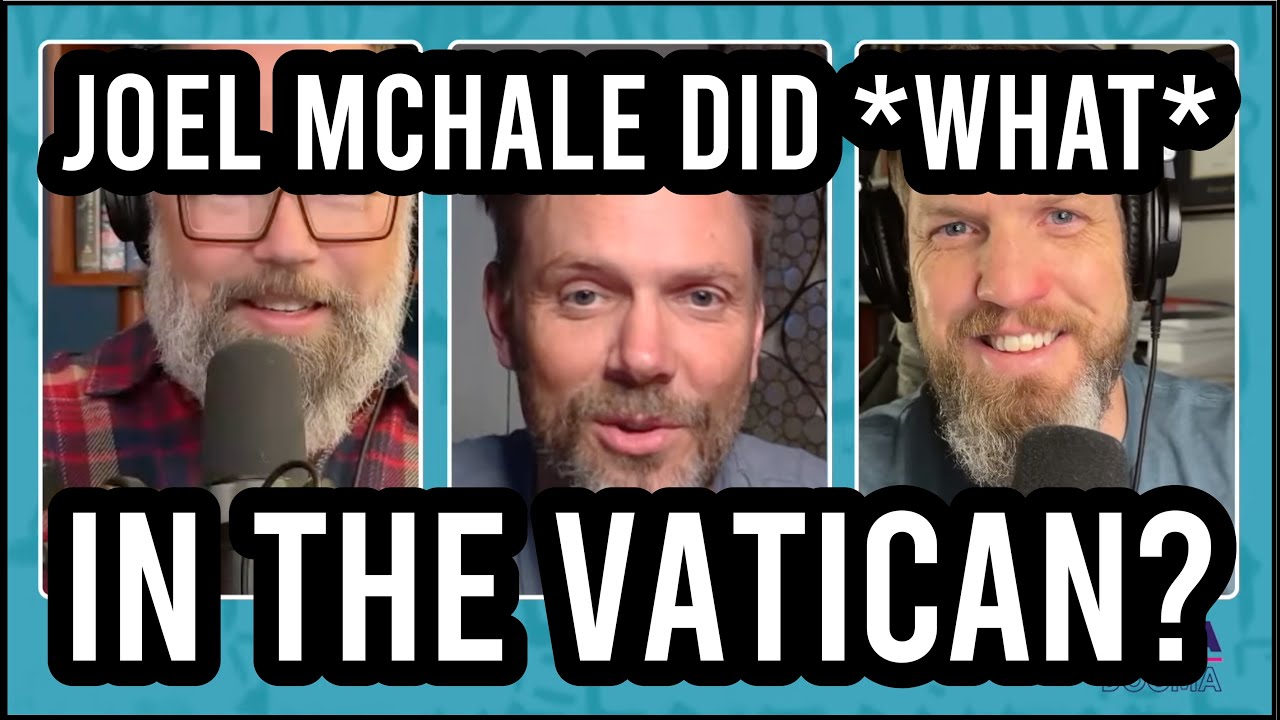
The Joel McHale Episode!
with Joel McHale
The Transcript
It’s gotta be demoralizing for his other prophets for him to be like, you all suck. I’m gonna go visit an illegal necromancer to find my dead prophet. Yeah, exactly. Hey, everybody. I’m Dan McClellan. And I’m Dan Beecher. And you are listening to the Data Over Dogma podcast, where we increase public access to the academic study of the Bible and religion and combat the spread of misinformation. About the Bible. How are things, Dan? Oh, man. You know, here’s the thing. We’re both sick, you and I. Like, you’re in the… In the interview that we’re about to play. You’re even sicker than you are now that we recorded that a little while ago. You have not yet fully recovered from that sickness. I’m starting a new sickness. I’m pretty sure that you gave it to me over the… The internet. Yeah. So I’m… I’m coming up the 18th fairway. So I, I’m… I’m getting there. But yeah, I’m still not back to 100%, but, yeah, this is… This… What was this, three weeks ago that we recorded this interview? Oh, my gosh. Don’t… Don’t tell the people how long it’s been. Anyway, coming up is a really cool interview. Those of you who follow Dan’s, you know, all of his social media and whatever know that we… We teased a celebrity guest on the show. This is that show. Joel McHale, star of stage and screen. I don’t know if he’s ever done stage work. I assume he’s done stage. I don’t know. He’s star of screen, a lot of stuff. Yeah, he is. He is going to be appearing on the show for the first half of the show. That’s really cool. We had a really fun conversation with him. Our patrons get to hear even more of him in… In the patrons-only stuff. So that’s kind of cool. So you can sign up for that if you want to hear that stuff. And then after that, we’re gonna do a Chapter and Verse. Yeah. So most of the interview was totally unusable. It was just a train wreck. So I was gonna say it. It was a lot of… It was… There’s a lot of energy. Yeah. Yeah, we had a great time. Don’t get me wrong. It was actually a lot of fun, and you guys are gonna have a lot of fun listening to it. But we also wanted to get some Bible content into the episode. Want to make sure those of you who don’t like fun, but like the scholarship, are getting, are getting yours, too. So we talked a little bit in the interview with Joel about the famous story of the necromancer of Endor. And so the chapter, it’s about an… Ewok witch, you guys, right there is literally an Ewok in the Bible. You’re going to have to stay tuned through the whole episode to find out about it. And this was not written until after the second episode of Star Trek. Right? That’s right. That’s what we’re talking about. Well, no, Star Trek. That’s right. The second episode of… Right. I… You just blew a lot of people’s brains out of… I was, I’m playing. I’m… I’m totally playing. But yeah, we, we’re going to talk about First Samuel, Chapter 28 and the Necromancer of Endor and go on a deep dive about what’s going on in that chapter because it’s so fascinating. Yeah, it’s a really, really interesting story. Yeah. And Joel’s in it. This is going to be a fun episode. I think we should just launch into the. To the interview. All right, let’s see it for once. We have an interesting show for you today. Yeah, we’ve, we’ve avoided it for so many episodes, but we had to be interesting at least once. No longer a sleep meditation app. Not anymore. We’re welcoming a special guest. We’ve. It’s a celebrity guest, even more than Bart Ehrman, I think. Welcome, Joel McHale. Thank you. It’s great to be here. I’m very excited to be here. I’m not joking. As Dan McClellan knows, very fond of all the, all the Instagram posts, and I just love the stuff you guys do because, you know, as a man of faith, as a man of the cloth, as I am, it can be a pretty turbulent and crazy, crazy time out there in America. So, Joel, you are, you’re. You’re known as Jeff Winger on the hit sitcom Community. You came rocketing into my consciousness way back in the early aughts by being mean to reality show stars on the Soup. You’ve hosted game shows. You’ve done a bunch of fun voiceover stuff for cartoons and I think video games. Question mark, is that the thing you’ve done? And you’re doing a great job of reading my Wikipedia. And listen, some of the current projects should be brought up, too. I’m getting there. I’m building. I’m building. You know what? I’m trying to. I don’t know what Fortnite is. I don’t I just don’t know what Fortnite is. Can we be a little bit generous with an old guy? Gosh, Fortnite. Look, Epic Games is in Utah. It’s based in Utah. My words. Well, Dan is barely based in Utah, but. And you’re the. You’re the scientist. Right on. I am the scientist on Fortnite. Thank you, Dan McClellan. That’s a point for you. I feel bad for the people that tuned in to hear about the Bible and they’re like, the hell is going on here? Yeah, yeah. Some. Dan mentioned something to me earlier, and I don’t know if I knew this or forgot about it or what, but you were not born in. In the United States of America, is that correct? No, I was born in Narnia. Thank you. And Narnia, well done. And I wanted to. No, I was born in Italy. And here’s the. I was born in Rome. And I’m not kidding when I say this. I. Which makes me holier than each either of you. I was baptized at the Vatican. At the Vatican? Yeah. Okay, very cool. That’s. That’s fancy Catholic. And right there. That’s. Yeah. They took Jesus off the Pieta. They put me. They poured holy water on me and then reattached Jesus. It was. Yeah, it was. Why not? If you’re in Italy, why not? Right? I had a homeless guy pour his water on me in Italy. In the Vatican. Does that count? Is that the same thing? I think that was Jesus. Okay. See, well, if you… If you go to Capernaum on the northwest shore of the Sea of Galilee, there’s a… There’s a statue of a homeless man laying on a bench covered in… In a… A shroud right outside the front entrance. And if you look closely, you’ll see nail marks in the feet and in the hands. So representative of Jesus as yon homeless man. So right now… Yeah, I assume that that was… That was something. That was a pretty brief stay in Rome. You didn’t grow up there. No, I was only there for three years of my life. And then my parents moved to Seattle. Literally, there were billboards that said, “Will the last person in Seattle…” It was so depressed. It said, “Will the last person in Seattle please turn the lights off.” It was… It was the… It was the OPEC crisis. So Boeing was slowing down. The… Timber industry was slowing down. And that’s… That was the major industries in Seattle. So you could… You could… And then, then now, you know, then all of a sudden the 90s hit and late 80s and we became the coolest place on Earth. And I just assumed that’s how it happened with every city. I was just like, everything just gets better. Everything’s cooler. It’s Microsoft and Amazon just show up and then start everything. Everyone likes your stuff. And then my friend… My… My friend Gillian was like… “I was raised in Pittsburgh.” I’m like… Okay, where they say “baggle,” right? Bagel. Gillian Jacobs, one of my favorite people on the planet, played Britta on Community. Yeah, I did want to ask you, since this is a Bible podcast. What… Tell us about your background with the Bible. You told us about… I assume you’re Catholic if you were baptized in the Vatican or at least were Catholic. Well, yes, I was raised Catholic in Catholic schools and an altar boy. And then… About which we have no further questions. Just so that you know. Oh, no, no. My mom and dad were so proud because we would serve Mass, and it was… Both my brothers and I, we’d be doing the Mass together, and my mom would be like, leap out of the pew and start taking photos with an old Nikon. And she was so happy. That’s adorable. But, yeah, then I had, like, a conversion experience when I was about 17 at a Young Life camp. And that’s, you know, that… That… That was kind of the, you know, like, traditional—not tradition—I guess it is traditional where they say you have to give your life and all that. And… Yeah, and I definitely converted. I don’t know what I was converting to, but I was in. And… And so then I went to a… I went to a… Let’s say… Well, I’m going to, I guess, a Methodist church now. And I went to a… Well, my brother’s an Episcopal priest. I’ll just start just. Then I. The Presbyterian. I was very Presbyterian for a while. This sounds. But not. I’ve never. I could never go to a megachurch because it. They freaked me out. That’s. There’s my history. No, I love it. I love it. I think. I mean, that’s obviously like. If you’re into Dan’s work, if you’re into our work, then it’s. It there. You know, there’s two camps of people. There’s. There’s the hardcore atheists who are just, like, trying to understand the. The book from. From a different perspective. And then there are believers like you who are. Who are interested in hearing the Bible as they’ve never heard it before. Did you ever read the Bible? Did. Was that ever. Did you ever, like, try to dive into it cover to cover? Oh, Dan I can’t read. That’s my problem. I am very dyslexic. So when I remember the Simpsons episode where Homer thought he was dying from the piece of sushi that he ate, and he decided on the Bible on Tape read by Larry King. And it was so funny. I don’t know. I. So I’ve never actually, like, sat down and read it. I did read Numbers over and over again. That’s the good stuff right there. But I did say to Dan, because I’m always right on the verge of atheism, for me, it’s either you believe it or just. Just. It’s not. It doesn’t exist. So I’m always like one step away from that. But that’s why when I started following Dan on Instagram, I was like, oh, this is what I needed to hear. And. And then I. We. I grew up with this kind of like, I used to take this. It wasn’t. It was a group of us in college that would listen to music, and the guy that led it was a. A scientist at the University of Washington. And it was like. It was kind of like a. It wasn’t a Bible study, but it was like a bunch of people that kind of had the same faith. And we would just listen to. We would break down songs and listen. So his science, like, he was very. Was great because he was like, Bible’s not a science book. And. And I was like, that’s right. And that’s. So that’s just one small. His name is Dr. John Medina and is still. Look him up. He’s got a bunch of books out. He’s. He’s really and his wife Kari are incredible people. So anyway, that all said. So that’s kind of how it started. Started and. And then, you know, watching Dan break it down because I feel like American Christianity is pretty screwed up because it’s very American. And so it. Dan’s way of breaking it down, which is data, which is great. Which is like Dan points out all the times it’s like, well, this doesn’t really make any sense, but this is exactly what it said. And so. And then this other stuff makes so much more sense when. When Dan has broken it down. So it’s just. Yeah. Kind of a revelatory. So when I went down, when I had dinner with Dan in Salt Lake and his lovely wife, I was very starstruck. It was great. And Dan had no idea, but it was super fun. Oh. And I was going to ask you just every time I talk to you when you’re Flying in and out of somewhere. You like, do you try to get flights that get in at 11:30 at night? Is that just. Oh, I take the very earliest flight or the last flight if I. It’s the shortest amount of time when I need to be. I can be, you know, go be away from my. Yeah, so it’s. I always sacrifice my sleep for that. But no, it’s. Yeah, I always take the very last flight even if I’m working all day. But I never would wait another. I wouldn’t sleep and then get up and go. No, that same. That sounds insane. How big is your family? You. Who do you got? You got kids, I assume? I got two boys, 18 and 15. What do you got? I got nothing. I. I’m nothing. I’m a free bird. I like, I like to, I like to travel light. That’s. Yeah. You saved a lot of money, dude. Well, I, I do want to ask you some. One of the things. So we put out a call for questions for you, Joel, on our various TikTok accounts and whatnot. And we, we had some response. So I, I was curious. 1. So one of our TikTok listeners, viewers, whatever, asked, curious how you see the Bible used behind the scenes in the movie slash TV industry. And I don’t know what that means necessarily, but I, I am curious about like you hear a lot of. I’m not going to name actors, but a lot of actors who are pretty hardcore Christians complaining that. That they’re not allowed to talk about their faith and that they. That, you know. Faith. Yeah. Thinking of Kevin Sorbo. Yeah, I, I’m not naming anybody, but there’s a lot of. What are your thoughts? It’s a pretty loaded that question. Not that the TikTok user wanted to add. Ask a loaded. The. The stereotype is that Hollywood is a godless, lawless brothel. And it’s ironic since, you know, Los Angeles is the birthplace of many things including neoconservatism and megachurch. Megachurch was started here in the 1930s, so. But it was also the birthplace of JPL and a thousand other things that all started here. And so 90. I’m going to say that 99% of. Well, I. When it was like it’s the lot like this industry that it’s godless. And I was like so doctors and lawyers, their industries are super clean and like they’re, they’re just the epitome of, you know, virtue and righteousness or, you know, whatever it is. I’m always like, yeah, whatever. It’s the Same. It’s just the same as everywhere else where there’s some really great people. Most of the time they’re decent people. Everyone’s working their butts off here. And then there’s really awful people. And it’s funny because the awful people that eventually gets around and then they eventually get kind of pushed out, thank God. eventually gets around and then they eventually get kind of pushed out, thank God. But it is the only industry where you can fail upwards and most of those are executives. But I suppose you can do that in most churches too. But. When I hear just like I always see this common complaint like I can’t talk about my faith that I’m talking about right now in this interview that will be broadcast and I think it’s more that comes down to more political persuasion than it does to faith because, you know, I mean, yeah, there’s a, if you look at an overhead map of Southern California, there’s churches everywhere and there’s synagogues everywhere and there’s mosques everywhere. And, and so I, I don’t, I never thought it was something to hide. And so, yeah, I mean that’s Hollywood is littered with people that, you know, go to church and I, I, I’m guessing the percentage has to be the same of, you know, people that believe and practice. Anyway, that, that’s a very long answer for I, I, I don’t think it’s a problem. I love that because you’re right, there is a, there’s a huge stereotype that, you know, at least and I hear this a lot among like, you know, people, people promoting Christian movies that Hollywood would never—Hollywood just kicks you out immediately if they find out you believe in God and you have to swear to become an atheist if you’re going to get cast in anything. I don’t—it’s nuts to me that—I mean that—when I hear that, I’m like, I, I don’t know where the anti-faith police are touring around Hollywood searching. It’s—I—they just haven’t gotten. To you yet, Joel. Yeah, they’re, they’re on the other side of my fence. Thank God it’s electric. But, you know, like, I don’t think the same type. I again, I think it comes down to political persuasion probably because like a movie like Susan Sarandon’s performance in Dead Man Walking is pretty incredible and also pretty true to how a lot of people see their faith as Catholics. And I was like, yeah, that’s, I mean that, you know, that didn’t seem to be a problem. I think, like all entertainment, like most entertainment, it is very fragmented. And now you can watch, you know, like it’s so dispersed that you can watch exactly what you want to watch. And, and so, yeah, and then when I hear people complain about, you know, like, I can’t say what I want to say now. Anyway, this is my fourth Lamborghini that I bought and I was like, yeah. Were there ever discussions about religion, you know, backstage in your shows, you know, between takes, did you and your fellow cast members talk about that sort of stuff? Be like. And cut. And another thing, this three-person God thing. Well, like any, don’t get me started on the Trinity. Like any. Like any conversations that happen anywhere, I would say in any business, if you are close to people, you end up talking about those things. So of course, yes. I don’t know. Do you guys sit around in religious groups and talk about movies and television? Yes, I do, but mainly because I’m a nerd. So we just got back from a biblical studies conference actually, and yeah, I hang out with the other religious studies and Bible scholar nerds. And we mainly talk about pop culture and movies and, and our scholarship a little bit as well, but. Well, there you go. And you’re like, did you think that Ben Affleck’s Daredevil was, you know, was. Had points that were, look, the. Now you’re hitting home for Dan’s nerd nerve. Well, you know, there’s. And, and there are. I have friends who deal with the intersection of like sci-fi and pop culture and religion and comic books and religion and things like that. So there’s, there’s actual research that goes on regarding that kind of stuff. And the new, the, The Daredevil series, I thought, did a great job of incorporating contemplation about religion. I thought it was, it was phenomenal and I was very upset that it got canceled. And I am very much looking forward to whatever this resurrected series is going to be. Can I ask you some more questions from our, our TikTok people? Yes. So AprilsLily on TikTok asks, “Do you have a favorite Bible story or stories?” I think, well, I guess the story when Jesus is hanging on the cross there with the thieves and the one thief starts like giving him shit, he didn’t do any— The other guy, he didn’t do anything. And Jesus. “Yeah, don’t worry, we’re going on a trip. You’ll see.” And I liked that because I always kind of felt like one of the thieves. So I was like, which day are you that guy? That’s heckling people or the guy that’s like, stop giving him a hard time. And I thought that I always liked that one. And then, of course, I just read Revelation every night because it’s… It’s really… It reminds me of some of the, you know, like a really good Grateful Dead concert. Yeah. I don’t know what happened, but it’s fun. It’s comforting is what it is. It’s a… It’s a good nighttime story. It’s like a Dali painting. Very, very topical. Yeah. No, I don’t… I don’t know. Yeah, I mean, yeah, I know. I guess. Yeah, those are… that… Yeah, that’s my answer. Thank you, Lily’s Lily. AprilsLily. Yes. And then Coach Crane asks, are you ready? I can ask you—wait, hold on. Yeah, you ask. Because the way they divide up the verses in the Bible, like some of the New Testament stuff, I was like, okay, that makes sense. They stop there, and then they picked up with that. And then other times, I’m just like, what? Who numbered this thing? Yeah. And… Yeah, it’s… Yeah, it’s great. So 1551, and his name was Robert Estienne, also goes by Stephanus. So the Textus Receptus was a Greek edition of the New Testament that originally was created by Desiderius Erasmus and didn’t have versification for the New Testament. And then in 1551, the edition that Stephanus produced was the first one to introduce versification. Totally arbitrary, just like here, here, here, here, here. And since then, that’s what the King James Version was based on. And everything since then has had verses. Now that I know. See, I don’t even know that. And I’m just like some dude. Some dude. Just some— And… But it’s so… it’s become so embedded in the tradition that, you know, now we have earlier manuscripts. We know that there are about 16 verses in the New Testament, at least the traditional New Testament, that we know were not a part of the earliest manuscripts. And so we take them out, but we don’t reversify the… the chapters. It just… The verses will just go… The verses will just go 17, 18, 19, 20, 22, 23—no 21. And when people stumble across that, they get really confused and really upset. So understandably, I do like that. And then they make a video that Dan has to respond to that says something like, “Ah, there’s a conspiracy. They’re eliminating numbers.” And then they make a video that Dan has to respond to that says something like, ah, there’s a conspiracy. They’re eliminating numbers. There’s. There. There. There are whole verses that are disappearing. I can’t imagine the people who can’t direct message you and what they’re. I can’t imagine people give me crap for like, how come you didn’t like that angel food cake and can’t believe what you must get? I do. Like how the Torah, they had the two books right on the same page. Somewhat contradict. Like, they often contradict each other. And I was just like, that seems about right. Yeah, yeah. Frequently contradict each other. When you have dozens and dozens of people writing stories over a period of almost a thousand years, they’re going to disagree. And it’s a lot easier to enjoy the Bible and to make sense of it when you can acknowledge that. When you’ve got to go to work to try to make this all agree and harmonize everything, that just makes the Bible become. Well. And then growing up, it was like, well, you know, God breathed, oh, yeah, really? Okay. And I remember going like, yeah, we can’t argue with that. Right? I mean, we can’t. I mean, literally, there’s no way you can argue with that. And I was just like, come on. It was. Yeah. All right. Another TikTok. Oh, man. You know, we, we had some that were. That were more addressed to. To Dan, but also like, we’ll just throw it to the ground. Yeah, we’re gonna. So somebody was. Somebody asked witchcraft, necromancy, is it okay if it’s for God? Why the heck would. Would any deity need a witch’s skills? I. I think this is probably a reference to or. Or could be a reference to. To 1st Samuel, Dan, and the. The witch of En Dor, which I always. Yeah, Star Wars. So it was a witch on Endor that exploded. Yeah, yeah. You didn’t. She was in the woods. It was kind of a Blair Witch setup. She had just gone there. No. And the Death Star just hovered above. And we’re like, she had Ewok friends. It was delightful. But yeah, En Dor is, is the name of a place in, in Southwest Asia. I think that’s probably where they got the name of that planet from. But we have this story in 1st Samuel 28 about the. The Necromancer of En Dor. And the, uh, the title is. People call her witch, but the title is. Is, uh, Baalat ov, Which literally means mistress of ghosts and mistress in the sense of master, not in the sense of like the feminine form of master. And yeah, Saul can’t seem to get access to counsel from God, direction from God. And he’s outlawed necromancy everywhere, but goes in disguise to this necromancer to go see if he can get information on whether or not he should go to battle the next day. And so the witch is able to conjure up the deceased prophet Samuel. And it says. She says, I. I see gods coming up from the underworld. And Saul says, let’s describe them to me. And she describes the prophet Samuel. And then Samuel tells Saul, you’ve been a bad boy. You’re gonna go up to battle and you’re gonna die. And. And that’s what happens. And so it’s. It’s a fun story because you have Saul going to a necromancer. And then it works. And Samuel wasn’t actually there. She just said, here’s what he told me. Well, this, the narrative tells it as if this is what actually happened. So it’s representing it that way. And then Samuel is. Is chewing Saul out through the medium of the necromancer. But Samuel, who was dead, right? Yeah, Samuel’s dead. I mean, for necromancy to work, someone has to be dead, right? Yeah, that’s. Thus the. The word necro. Wait, did you just see this question or did you see. Did you answer? I get asked this kind of question a lot. And. And I actually. And that’s. I have. I have a few pages of discussion in my book on this. So that’s the real witchcraft, that you could just pull that answer out. And. Yeah, I was just like, how? What? I can’t even. I can’t even tell you what I did two days ago. And it’s very. To further answer the question. Yeah, witchcraft is just, you know, divine agency. It’s like, like, the same processes, the same tools, the same media that a prophet uses are the same that a necromancer, a witch would use. Only instead of seeking out the guidance of the deity, you’re seeking out the guidance of a deceased person. And anciently, a deceased person was a deity. So it’s really saying, you’re doing this. You’re approaching the wrong person. And this is part of God’s jealousy. You don’t go seeking after information from the gods of other nations, from the ancestors. You only come to me. So that’s why it’s considered a problem. So the line between magic and prophecy is an artificial one that people draw only when they’re trying to structure power and say, we’re the only ones who are allowed to do this because we’re doing it with the appropriate agent. And so everybody else, you’re not allowed to do it. But if a witch, you know, sinks, then they’re not a witch. Right? If she floats and she’s made of wood. And. Movie called Three Sovereigns for Sarah, I think it was called, about the witch trials. No. And they were like, well, if you can get through the Lord’s Prayer without stuttering, then we won’t kill you. Yeah, that’s the. The. There’s a long history of ordeals, and there’s been some cool scholarship on. On the use of the ordeal where, you know, it would be everything from. We’ll throw you in the river. And if you die, you are innocent, but if you survive, then you’re guilty. So we’re going to kill you. Right. But most of the ordeals, it was. The idea was we’re going to threaten you with a bad time. God is going to punish you if you lie. And then the hope is that that fear of God will compel them to be honest and admit whatever. And. Yeah, I’m like, someone going like, well, we’re going to shoot a hostage every five minutes. We have no choice. I mean, it’s up to you if you wanna. Oh, gosh. Yeah. The. The ordeal is. Is. Has such an interesting history. Yeah. Not. Not a great history. It’s not. It’s not a good thing that happened. I would like to. Cheers. I mean, this is. How happy was every fantasy writer when the word necromancy started where they were like, wait, what? We can use that. Oh, that’s gonna be in every book. The Necronomicon. That’s the. That’s one of the greatest words. Yeah. Yeah. All right, you know what I’m gonna do is I am going to say that we are going to take the rest of this conversation and throw it into. We’re gonna keep talking with Joel McHale, but we’re gonna chuck it into the. The patrons only stuff. Joel McHale, thank you so much. How many people will be left? It’ll probably be like, I wonder who’s going to stay around. It’s just going to be the elites. Patreon, the paying people. That’s right. That’s right. For the rest of you, thank you so much for. For, for listening. Joel, thank you so much for joining us on the show. We really appreciate that and thanks for making it this far. Whoever hung in there and I can’t stop talking, please forgive. Well, let’s get into our second segment. Our chapter and verse and. And what I have only known as the Witch of Endor. I feel like there should be like a swoosh. A musical. Something or other. Yeah. About it because. Yeah. I think it’s. It’s a shame that we don’t have some kind of. Certainly there’s got to be some kind of cinematic interpretation of this story. We, I don’t think we’ve seen this in, in any movies. It’s not in the Ten Commandments. It’s not. Because it’s kind of crazy. Like, it’s, it’s a, it’s a weird story. If I were trying to make a movie of it or something, I wouldn’t know what to do with it, but I wouldn’t know what to do with. I mean, you know, you. Every time you watch anything, any movie or, or retelling of a Bible story, they don’t know what to do with it. Yeah, you’re, you’re always like, what are they going to include? Oh, I’m so excited because, like, they. Totally made that up. Well, they kind of have to. Yeah, exactly. They don’t have a choice. So. So we’re in 1 Samuel
, toward the end of it. We’re in chapter 28 and we are dealing with. Saul is still the king. David has run off and he is hanging out with the Philistines, of all people. How dare he. Yeah, it’s just he’s betrayed his tribe. And there’s a, there’s an argument to make that this kind of warlord, mercenary origin story may have some truth to it, that maybe David was really a warlord who kind of took over down in, in the kingdom of Judah, conquered Jerusalem, took over, and then made his way into proclaiming himself king and starting up this chiefdom kingdom in the south. So, yeah, we may have to have a whole show about the historicity of David. We’re going to have to do that at some, some point, definitely. But when we move into chapter 28, we have the Philistines gathering their forces to war. And Achish, or Achish is David’s master, leader, ruler. David’s just kind of serving under him and they’re ready to go to battle. And then we cut into verse three, which is a segment that runs from verse three to the end of chapter 28. And just real quick, just so you know, chapter 29 and 30 have nothing to do with what’s going on in the Saul story. It’s. These are two different stories and you can tell things have been edited together. Here because it’s a little confusing to read. Yeah, because you got Achish and David getting ready to battle. And then it says, so the Philistines gathered for battle at Gilboa, and that’s where Saul’s in the story. And then it says, now the Philistines gathered all their forces at Aphek. And then we’ve got these other battles that have nothing to do with Saul. And then it says, so Saul went up to battle against the Philistines at Gilboa at the very last chapter of 1 Samuel. And so, more than likely we are seeing different stories stitched together. So that’s how we can most easily. Occam’s Razor is going to tell us. These come from originally distinct stories, and they’ve been stitched together. But 1 Samuel 28
, verse 3 through 25 is a single sense unit. It’s a single story. And this is where Samuel has died, all of Israel has mourned, and Saul has expelled the mediums and the wizards from the land. Let’s talk about Samuel and Saul, by the way. So we know that Saul was the king. Samuel was like a prophet, right? Like advisor to the king guy. Yes. So in this time period, prophets primarily were like court prophets. The king just had a retinue of. Of prophets who had different specializations. And if he was like, you know, I think I want to go to war. What does God say? And the prophets would push their glasses up on their nose and they would go off with their calculators and everything, and they would come back and say, favorable or unfavorable or something like that. Mercury’s retrograde. I don’t think it’s a good idea. Or he would say, I think I’ll have the fish. And they would go off and they’ll say, yeah. And as everyone knows from the movie, Airplane, fish is a bad choice. It’s a bad choice, yeah. Milk also a bad choice. So the. The mediums and the wizards are also doing the same kind of stuff. It’s still divination. It is still trying to divine the will of the gods or the universe or whatever, using different instruments and different means and techniques and things like that. And so the difference between a prophet and a witch, a medium, a wizard, all these kinds of things usually has to do with who’s on the other end of the line. And it’s either you got an acceptable entity on the other end of the line, or you got a bad entity on the other end of the line. And therefore what you’re doing is outlawed. Right. And sometimes even if it is an acceptable entity on the other end of the line, if you’re not a part of the acceptable group, if you don’t have the authority, and the authority was basically the people who are on my side have the authority. Anyone who’s not on my side. Even if they’re still working for the God of Israel. That’s a big no-no. So they get dismissed as, as wizards and magicians and, and all these other things. …as wizards and magicians and, and all these other things. So anyway, Saul has, has outlawed all of this and the Philistines are coming up to, to battle against him. And Saul goes to his court prophets. Samuel’s not there, but he’s got other folks that he’s going to go consult. And it says here in verse 6, when Saul inquired of Adonai, Adonai did not answer him, not by dreams or by Urim or by prophets. So the idea being dreams were one way that God could communicate their will to folks. Urim, this is the Urim and Thummim. Latter Day Saints are going to be familiar with this term. Urim and Thummim is how it is also pronounced. These are two objects of some kind, probably stones of some kind that were a divinization. I keep saying divinization are a divination tool, a means of trying to divine the will of God or by prophets. Because he’s got, you know, however many hundred prophets. It’s a secret decoder ring. Yeah. And you know what, there were all kinds of different ways that you could do this. Casting lots is divination. You see that in the Hebrew Bible. You see it in the New Testament. That’s how they pick. As a matter of fact, doesn’t Saul’s story start with casting lots to see or with some sort of a game of chance almost to see who gets. To be the king kinda? It has to do with Samuel, as God is telling him, like, you know, you’re going to see this, that and the other, and this is how you’ll know that this is the right one. So it is kind of a sign that Samuel is going to get. He rolls double sixes and. Yeah, yeah. And in all the stories. Yeah, in all the stories, it starts out as a, as a nat 20. It’s like, look at this one. And God’s like, he’s the one. He’s the one. And then before too long, he’s not the one. That’s a shame. So Saul needs to know, what am I going to do? And so he says to his servants, seek out for me a woman who is a, a medium or a necromancer. And I just want the very thing that he banished, the very thing that he banned. Right. And that’s because these things work. But he’s, he probably figures. Well, the, the first thing to note here is that a necromancer is somebody who tries to communicate with the dead. There was a very active cult of the dead in ancient Israel. And probably a wonderful book from just a couple years ago by a scholar named Kerry Sonia, it’s called Caring for the Dead in Ancient Israel. Talks about necromancy, talks about the cult of the dead, but basically everybody believed that the dead were still around in some sense. And when people died, you. You put them in. You buried them in a mortuary chapel where you would set up, like, a standing stone or something, and you would go have meals there, and you would go consult with the deceased. You could ask for blessings and things like that. So. And you know what we do in cemeteries today? Go and talk to headstones and things like that. Very, very similar things going on. So the idea that you could consult with the dead was normative up until, I would argue, the reign of Josiah. I think Josiah is probably the king who tries to put a stop to this. So the fact. Other than Saul trying to put a stop. Well, that’s what. And then participating in it. Well, that’s what I was gonna. That’s what I was gonna put point out. This story was written afterwards, but it’s about a time that’s way before. And so if there is a social memory from centuries before about Saul visiting a necromancer, there wouldn’t have been an issue. But writing about it later, they were like, now Saul had outlawed all these people, and then he goes to visit one. Come on, what’s going on here? But the idea of the king going to visit a necromancer, not really. Wouldn’t really have been that unusual or surprising in the periods before the 7th century BCE. And so the necromancer. And here I want to. I want to plug a book real quick by a scholar that you and I have both spoken with, Esther Hamori. And the book is called Women’s Divination in Biblical Literature: Prophecy, Necromancy, and Other Arts of Knowledge. And it’s a wonderful book. And there’s a great chapter all about the Necromancer of En Dor. Door. And it starts off talking about what we’re calling this person, because colloquially, this is who. Well, the Wikipedia page article is about the Witch of Endor. Right, The Witch of Endor. The Hebrew phrase here is eshet baalat ov, which means the woman mistress of ov. And ov is a word for ghosts or the deceased or something like that. And so the woman, the mistress. And this is mistress in the sense of the feminine version of master of ghosts. There’s a word for witch, almost a wife of ghosts. Yeah. Like could. Could get to that. That’s another sense. Well, that’s. That’s not. I don’t think that they ever use that. That sense for the feminine of baal. But the word baal, which means master, can also mean husband. But I think we got to decouple those. Those senses. I think it’s. Mekhashefa is the. The word for witch. So in Exodus 22
, you will not suffer a witch to live. That’s. You also have spellcaster, which I think is chover chever. And then you have the baalat keshafim, which would be the mistress of sorcery or witchcraft or something like that. By the way, I can just hear our listeners screaming for the show about all of these different categories of. Of. Of magic users. Yes, it does feel like we’re starting a D and D campaign. Yeah, yeah. What is your race? What is your class? Mekhashefa. Those are the words that are used to describe a witch. None of those words appear anywhere in this chapter at all. Because a witch uses poisons and potions and casts spells. This person is doing none of that. This person is consulting the dead. So they are a medium or a necromancer. Right. So colloquially, people refer to her as a witch, and there is. That is gendered in a lot of ways. This is boo. She’s. She’s a villain. She’s a witch. Kill the witch. Yeah. So to start off, I want to make sure that we’re referring to her the correct way. And she’s just trying to scratch out a living. Right. And then, yeah, she’s literally just like. She’s like a phone operator. She’s. And she’s got a gift. So, yeah, she’s good at it. She is. She’s genuinely amazing at it, according to the story. And. And so Saul asked his servants, he’s like, I need a witch. And they’re like, oh, yeah, there’s a witch over here. And it’s not like. It’s not like, sir, you outlawed all the witches. We wouldn’t know where to find any witches. They’re just. Just like, oh, yeah, we know one. We use her. You got to know that. One guy. One guy didn’t speak up. One guy was like, this is a trick. I know this is a trick. I’m not going to say anything. So he goes in disguise and, you know, lays the money down, and she asks, who do you want me to bring up? And he says, Samuel. And she’s kind of. She. There’s not a great vibe initially. And she. She’s. She’s suspicious because. Yeah, she’s doing something illegal. Right. And she says, Saul has outlawed this. And. And the disguised Saul says. Swears by the name of the God of Israel that nothing will happen to her. I. Why. She would be like, oh, well, I guess it’s okay then. It feels like one of those. It feels like one of those if you’re a cop, you have to tell me sort of moments. And. And then she. She immediately brings up Samuel. And the text does not say how. And scholars have debated this, and. And it’s just not a part of the story, but somehow she understands that this is Saul. And now is. I’m. I’m picturing the. The scene in. In Prince of Thieves. The painted man. Oh, my God. You. You just went back hard. Yeah, I even. I don’t remember the Prince of. This is the. What’s his name? Robin Hood. Yeah. Yeah. Anyway, but she gets freaked out. The. The crone. And. But Saul’s not worried about this. He’s like, who did you see? And she says, I see an Elohim coming up from the earth. Oh, okay. Elohim means God or gods. And there. There is a little question here about whether this is supposed to be singular or plural, because she says, I see Elohim coming up from the earth. And the. The participle is in the plural. But Saul then says, what does he look like? Oh. And. And then the woman says, an old man coming up. He’s wearing a robe. And then Saul was like, oh, that’s Samuel, obviously. Old man, robe. That’s the right guy. There can be only one. Yeah. Old man in a robe. I love. I also love that he. He doesn’t go to a prophet. He goes to a necromancer to talk to his favorite prophet who is dead. I think that’s amazing. Yeah, that’s. It’s got to be demoralizing for his other prophets for him to be like, you all suck. I’m going to go visit an illegal necromancer to find my dead prophet. Yeah, exactly. And so. And the first thing. The first thing that Samuel says is basically, you should have let me sleep. He says, why are you disturbing me? And. And it’s such a tantalizing little taste of how they must have understood the afterlife in some sense. Samuel is just chilling. Samuel is at rest. Or Samuel is just enjoying or at least experiencing whatever they conceptualize the afterlife to be. Bowling in the great alley beyond or whatever. And. And Saul’s gotta wrench him up from the. From the underworld. And so he’s like, what? And pissed. And. And so Saul says, I’m in great distress. And I’m reading here from the NRSVUE, New Revised Standard Version, Updated Edition. I am in great distress, for the Philistines are warring against me, and God has turned away from me and answers me no more, either by prophets or by dreams. So I have summoned you to tell me what I should do. And Samuel’s like, look, if God’s not responding. She’s just not that into you. Yeah. And he continues, Adonai, the Lord has done to you just as he spoke by me. For the Lord has torn the kingdom out of your hand and given it to your neighbor David, because you did not obey the voice of the Lord and did not carry out his fierce wrath against Amalek. Therefore, the Lord has done this thing to you today, and then the Lord will give Israel along with you into the hands of the Philistines. And tomorrow you and your son shall be with me. Wow. That is. That is not the message you want to get when you visit the. The. The necromancer of Endor. Yeah. Now, normally, something like that happens. Most people would be pretty despondent and probably just run home crying. Says immediately, Saul fell full length on the ground, filled with fear because of the words of Samuel. And there was no strength in him, for he had eaten nothing all day and all night. And it doesn’t say why, but fasting would have been a part of many attempts at divination. Like, there’s one kind of divination called incubation, where you would fast and then you would go spend the night in the temple in the hopes that you would be visited by the deity in the night. So Saul is probably fasting in an effort to try to make thinner the. The barrier that separates the living from the dead. Okay. And then the necromancer is like, by the way, I’m still here. She says, your servant has listened to you. I’ve taken my life in my hand and have listened to what you have said to me. Now, therefore, you also listen to your servant. And. And she gets him bread so that he can. Yeah, she makes him a nice meal. Strength. Yeah. And he’s like, no, I don’t want it. But they urged him. So he got up from the ground, sat on the bed, and she had a fatted calf in the house. So she slaughtered it, took flour, kneaded it, and baked unleavened cakes. Which is not the fastest way to get food to a starving guy. It’s like, “Just sit down and…” “Three hours, I’ll be back.” Yeah, exactly.
But here the necromancer says that you… That you will… The army of Israel will be given into the hands of the Philistines. And what does that mean? Total domination, total destruction. The Philistines rout them and take over. So it is a weird story to set up a tragic ending to the life of who? The guy who was supposed to be the man.
Yeah.
And a lot of scholars would argue that this is written much later, and this is an effort to take some… Some vague, spotty social memories about this king back then and kind of use him to create this narrative about starting off good, but, oh, you did the wrong thing, and so God royally screwed you over.
What? Wait, was the wrong thing visiting the necromancer? What was the wrong thing?
No, it was before that.
It was.
It was before that. Yeah, that’s… Saul is visiting the necromancer because God is, like, not on speaking terms. He’s getting the cold shoulder. And as a friend of mine said, he’s been… He’s been ghosted.
Holy ghosted.
Well, I was… I was going with the necromancer ghosted.
But yeah, yeah, it’s… It’s ghosting in all of the best…
There. Yeah, there are levels. There are levels to that. So… And he had to go to… And… And so some people, you know, they’re like, “Oh, the… The necromancer didn’t have power. This was just the Lord working through and allowing this to happen.” And I was like, “The necromancer makes a living doing this.”
Right.
It’s not like she’s like, “Holy crap! It actually worked for the first time ever.” This is what she did for a living. And… And so the fact that Samuel is an actual deceased person referred to in the text as a deity, or a divine being, or a god, pretty securely indicates that in this time period, that was not a bridge too far. That was not unusual, that was not odd. Yeah.
So go visit your mediums, everybody. The Bible is totally down with it.
Throw a coin to your necromancer.
That’s right. That’s right. Yeah. It’s kind of amazing. I, you know, I have seen videos of pastors and, and ministers decrying this story and saying that it was false. It didn’t really happen this way because that. That stuff isn’t real or whatever. And it’s just like, okay, well, now you’re just denying what happens in your own book. It just very strange.
I just made a video about this.
Oh, did you?
There’s been some crazy stuff going on on Twitter lately.
Yeah.
And I’ve had some people coming after me and some of them. And I am hearing a lot these days that I am denying the word of God. And so the video I made was saying everybody denies the word of God.
Right.
And folks who are like, this story didn’t happen. It’s like you’re denying the word of God according to how you usually assert it has to be understood. So, yeah, everybody at some point or another is. Has to say, I don’t buy that. Whether it’s here, whether it’s the command to sacrifice your firstborn child in Exodus 22:29 , or all the stories about the numerous gods or 2 Kings 3:27 , where the God of Israel loses, everybody at some point is going to say, yeah, I don’t buy that.
Yeah, it’s so funny to me because there, There is this. This very strong denial that has to happen. If you don’t come at the Bible with. From the perspective of this, you know, as you always talk about, it’s not univocal. It wasn’t written by God. It was written by people of a time, and those people frequently disagreed with people of another time. And like. And if you can come at it from that perspective, it’s fine. It’s all fine.
Yeah.
You know, all of it. You don’t. You don’t have to take every word of it as literally true. And you couldn’t if you wanted to.
Yeah, yeah. It’s. It’s. At some point, you got to be like, all right, we got to find a different way. We’re going to have to read some stuff into this. And. And as you and I have both talked about before, and as I hear in. In. In messages from people all the time, it gets so much more interesting when you can just let it be what it wants to be and. And just engage it on its own terms. I think it’s so much more fascinating. And how cool is this story and. And how interesting where you got the king visiting? Somebody’s like, no, I’m. I’m outlawed. And. And we’re gonna pull up Samuel, and Samuel’s a god, and Samuel says, you’re. You’re going down, Saul.
Yeah.
So it’s. It’s just such a. Such a fascinating story, and I feel bad for people who have to be uncomfortable, who feel uncomfortable about it and have to find ways to talk around it and. And make excuses for.
It’s so much fun. Yeah.
There you go.
All right, well, that’s what we’re about here.
Fun.
We’re all having fun here. That’s the whole. That’s the whole gig. Thank you guys so much for tuning in. If you would like to. To be. Have even more fun, you can go to our Patreon and become a member there. And at the right level, you can have more fun with Joel Baden later in the bonus episode there, and you help out our show and help keep it going. Uh, that’s patreon.com/dataoverdogma. If you’d like to write into us, you can write to us at contact@dataoverdogmapod.com and other than that, we’ll see you next week.
Bye, everybody.