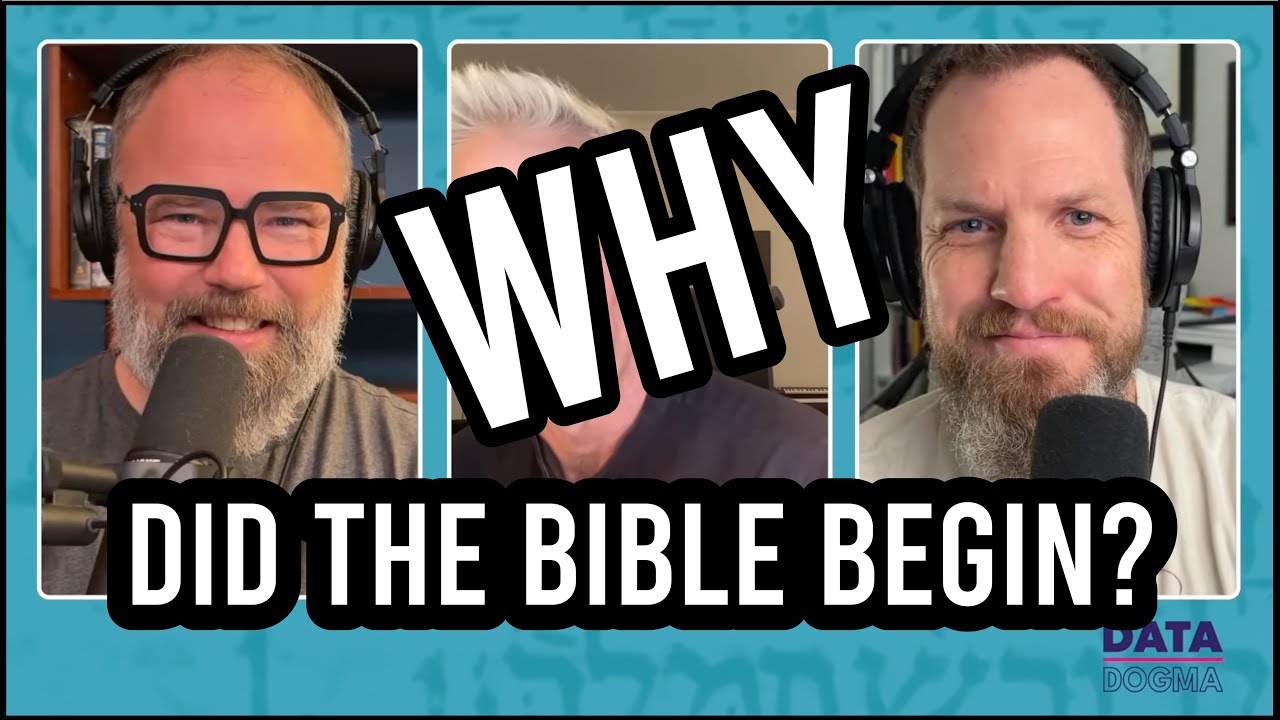
The Why Question
with Jacob Wright
The Transcript
That’s where the Bible really gets going in interesting ways. It’s in a certain sense, very real sense. All responses to what makes a people, what brings us together as a people, how do we survive, you know, what role does a kingdom play in all? How is that not everything? What do we do when that kingdom is defeated and conquered? And the biblical project, I think, is just this magnificent collaborative effort. Effort to prepare for that or to respond to it in very honest ways and also creative ways. Hey, Everybody, I’m Dan McClellan. And I’m Dan Beecher. And you are listening to the Data Over Dogma podcast, where we increase public access to the academic study of the Bible and religion and we combat the spread of misinformation about the same. How are things today, Dan? Things are good. We’ve got a great guest today hawking a book that I have found very interesting. Why don’t you introduce him, Dan? Yeah, so this is Jacob Wright. He is a professor of Hebrew Bible at the Candler School of Theology at Emory University down in Hotlanta. And welcome to the show, Jacob. Well, it’s nice to be here, Dan and Dan. And it’s not too hot today. It’s actually like maybe 45, 50 degrees. I guess that’s normal. Yeah. Right now it’s 31 where I am. So I imagine in Atlanta, the people are walking around in full on winter parkas at that temperature. Exactly. I put my gloves on to go out. Well, as long as it’s getting toward winter time. And so fewer people being carried off by mosquitoes, I imagine right now that’s true. I just decided, I got a call from the exterminator for the mosquitoes and they said this is the only three months that they’re not going to spray for mosquitoes, but they’ll pick up in March. So there you go. Well, hopefully that’s because they’re not around and not because they’re just not worried about it right now. Jacob, you’ve just come out with a book through Cambridge University Press, Why the Bible Began: An Alternative History of Scripture and Its Origins. And we’ve been, Dan and I have been poking around in the book, and there have been a handful of books in recent years that have talked about this kind of thing. Both Scribal Practices behind the Composition of the Bible, Source Critical Theories behind the Composition of the Bible, how the Bible got started. Can you tell us why you decided to throw your hat into this ring? What was the impetus for this book? Thanks for that, Dan. I mean, the why question. I still think has not really received the attention it deserves. It’s a question that we as scholars, I think, Dan, you would agree with this. To explain why something happens is a really tricky and messy problem. We can say what, where, who, when, but why, that’s a philosophical issue. And it’s like, why is there something rather than nothing? And it gets really to existential kinds of questions, but also to culturally difficult questions like does it say something about the superiority of monotheism, or is it about Jewish genius? Or all these kinds of really culturally problematic things that we want to avoid. And we set aside that question, and I think to our detriment, because the answer to the why that we have informs the way we think, but we’re not doing it in an explicit way. And the thing that really informs us is an answer that had been provided long ago to the why question. And it’s Wellhausen’s answer. And he began. Wellhausen was this scholar in the late 1800s in Germany. And then your work engages it him still, right? We all are working in the. In the shadows. And in the following Wellhausen and what his approach was to this why question is that what emerges in Israel and Judah is some kind of transition to religion, right, from a political community to what he called das Judentum, which was a new artificial construct. And it was a separation of religion from the political sphere, which we might appreciate in our democracies. But for Wellhausen, that was problematic because he wanted a. He didn’t want, you know, the French imperialism of the age. He. He was working after that where he wanted Germany to be a spiritual nation in which religion and nature and all of that came together. And he kind of was poking his finger not at Jews, really, he didn’t have that much, but at Christians and at the church. And he did that by showing how the church is really the inheritance, you know, claims the inheritance of what begins in the Hebrew Bible and how that is something that we need to avoid. So he had this idea of the why question. Well, the Bible exists because it’s scripture for religion. There was this nation and it was destroyed, and something new emerges from it. And it is what he called a cult, religious cult or religious community or religion itself. And it’s created by imperialism, where imperialism wipes out the place for individual nations to flourish. And I’ll stop there, but for me, that really gets it wrong in terms of the concepts of nation. Maybe we should talk about that. I was going to ask you what you guys think of the term nation. Well, I mean, in your book, you talk about nation. And you talk about how the people that coalesce around the Hebrew Bible cease to be a nation. And you call them a people rather than. Rather than a nation. Talk about that differentiation. Talk about why it’s no longer. We’re no longer talking about nation or state. I would say this. So there’s two different kinds of things. Generally, I would say, like a state is a kingdom or a country in the modern sense, like America, Canada, Venezuela. Those are countries, states. They may have a nation within them, but we often confuse nation with state. Why would I say they have a nation within them? A nation is the people. And Wellhausen had problems with the term nation in my mind, too, because he conflated nation with kingdom. And what I’m actually trying to argue, Dan, is that peoplehood is the term I use to avoid that problem with nationhood because it’s so misunderstood. But really, nation refers to the people, and I call it a state of mind. It is a people coming together around memories, around the narrative, around future aspirations. And it’s something that’s very difficult for armies to conquer. Whereas a state has institutions and borders and armies and things that are very physical and that armies can actually destroy. And what emerges from the destruction of ancient. Go ahead, Daniel. Well, no, I was just going to say that the idea of, of destruction of armies, of stuff, this is central to, to what happens, you know, where you talk a lot about the Assyrian conquest and, and, and, and you, you mentioned specifically the primary factors behind the Bible’s formation are political division and military defeat. So I wanted to, you know, you started in with the military. Let’s, let’s talk about both of those ideas. Okay. Yeah. Good. Thank you, Dan, for also spending so much time with the book. You really have gotten it very well. Do I say Dan A and Dan B, how does this work? We’ll just assume that everybody will figure it out. It’ll be fine. Dan Beecher, thank you for spending time with the book. I appreciate also that you’ve all brought these questions to a head like nation. And how does. Do we understand that? Briefly, again, Wellhausen is saying there is this nation and it gets destroyed, and then this religion forms. And I’m saying, no, there’s this kingdom or state, it gets destroyed. And what emerges is properly what we’d call actually nation, even though that’s misunderstood. So I call it people or peoplehood in order to avoid that. So people really focus on the kind of communal dimension. Well, if I may. Not religious community, but political community. Yeah. If I may interrupt here, I think that’s also a little more accurately when we look at the terminology that’s used in the Bible. I mean, in Greek, the word we translate nation in the New Testament is ethnos. That’s an ethnic identity. In Hebrew, you have amim, you have goyim, you have mamlakah, would be kingdom. But amim is used synonymously for nation. And those are peoples. They’re just different ways to kind of organize a sense of identity, a sense of. Yeah. And you’re good at Hebrew. What is the word, the Hebrew biblical Hebrew word for religion? Well, that’s the thing you bring up, Wellhausen. In my field in the cognitive science of religion, religion is something that developed between the Renaissance, the Reformation and the Enlightenment. That is, this is not something. This is not a discrete sociocultural dimension that existed in the ancient world. And so to speak of this becoming a religion is thoroughly anachronistic on Wellhausen. Yeah, I agree with that. Thank you for that. And so we’ve got to find new terminology to think about what they’re organizing their understanding of identity around. And I think that’s one of the things that you’re striking out to do in this book is say, let’s not think about it in our modern terms, but in terms that are a little more native to the text themselves. And it’s not just in terms of being more accurate in terms of the emic versus the etic. Emic refers to how the text or the communities describe it themselves. And etic is how we as scholars describe it. So emically, there’s nothing. There’s no concept, there’s no word for religion. But there’s something greater at stake than that, and that is, we miss that. The making of the Bible and the why question and more of the how question should. Should occupy our attention as societies, as communities, more than the what question. What is the what question is like what the Bible teaches. And the. And Dan, you’re doing such a great job in terms of. I’ve watched you grow over the years, and I wanted to say, go, go. And you didn’t need me to say that because it’s just taken off. What are you doing? You’re addressing that what question. Kind of what does the Bible teach? How has it been misinterpreted? How do we push back against that? And you see how it becomes a battlefield of biblical teaching in society, whether it should apply to us or not. And what we miss by this is not just historically not getting it right in terms of the category, but also that what the biblical authors are doing in terms of connecting stories of rival communities, bringing a defeated, traumatized community together around text and refocusing attention on the lives of average folk, re-envisioning gender roles, making wisdom available for the whole people, not just for the elites. All of these things are not laid out explicitly so that one can argue or quote a verse, but it requires us to step back and to appreciate the whole. And when we do that, and I’m not expecting everyone to get on board with this, but what I’m really encouraged by is that people across the globe find that to be useful. This began as a Coursera course long ago. And there are a lot of students in America and Europe or maybe from Christian places throughout South America. But there were a lot of students who were from Muslim countries, Iran, Iraq, Saudi Arabia, as well as China and India. And their interest was that how and why question: why does the Bible exist? What is it about this literature? And they come at these texts with. It’s quite remarkable how you create a community around text and how you don’t create a master narrative, but you connect multiple narratives to bring people together so that they have a common story and to affirm that we all go back to one family originally. Those kinds of things are really wonderful for them. What is not really wonderful or interesting to them is what the Bible teaches, like, okay, thou shalt not kill. We all agree on that. Great. We don’t need the Bible to tell us that. Some people seem to even more so today. But that’s. I think that’s a wonderful 30,000-foot view of why that question of why is so important here. And in a lot of ways the question of why helps us to understand the what a little better—interpretation is guided by our own assumptions about. I’m fond of referring to rhetorical goals. What’s the. The function, the intended function of the text. But I wanted to go dive into the book a little bit. You start off. Each of the chapters uses some kind of vignette, some character to kind of introduce the theme of a given chapter. And you start off talking about really the history of the rise of Israel. But it’s not like for people who are in scholarship, this is a history that is fairly well known. But I was struck by how reading through this, there are a lot of things about the history, as you lay it out, that would not be. Are not well understood among the general public. What do you think are some surprising aspects of the rise of Israel and Judah that someone in the general public might not be aware of? Thank you for that. Yes, it is kind of a part of the book. It’s 150 pages where I go over the rise and the fall before I get to really the post-fall place where everything starts to happen. And like so many books, you know those first chapters, you get into the weeds and you have to kind of do some boring stuff. And people have criticized—they see like Amazon reviews like “why those first chapters are difficult to get into” because it’s so many facts and figures and so forth. Here’s the takeaway. I think that’s going to surprise people. There are many different points, but one would be that Israel and Judah were never together and that these are two very different countries. It could have easily been Israel and Moab. There’s nothing, you know, within Judah that goes back ethnically to a common population or some kind of monotheistic sensibility that they shared or anything. It’s quite coincidental that Israel had really overshadowed Judah and then placed one of its own members, Athaliah, a powerful queen on the throne, and really had subordinated Judah to its interest and that then Judah regretted that, resented that, and Judah really probably would have been very—I call it Judah’s jubilation—would have been happy to see Israel fall. We see that in various texts. And this is not this division is one of the like you pointed out, Dan, uh, Dan Beecher, the division is really one of the most important reasons why we have a Bible. All the all countries, all kingdoms were defeated. So why for me, the question is like we got to get defeated. That’s an essential component, but it’s not sufficient, meaning that there’s other factors. Without defeat, there is no Bible. But what’s the other more sufficient factors? And that’s this division, this relationship between Israel and Judah. And I’m building here on Dan Fleming’s work from NYU where he really shows how Judah he calls his book The Legacy of Israel in Judah’s Bible. And the Bible we have is a Judean product. The difference between me and Dan Fleming, whom I really adore as a scholar, is that he would say that there is some commonality among the populations. And I’m saying it’s easier to say no. It’s purely political. And the first move in terms of affirming some kind of union was a political affirmation, meaning that Judah and Israel were once united under David and Solomon, which I argue is totally fictional. It’s an attempt by later Judean kings from Hezekiah, Josiah, to say what we’re doing, what we’re asking you to do as the defeated northern population, to join our fold is something not new. What we’re doing is going back to the way it was and the way it was supposed to be. Yahweh, our God, chose David and Jerusalem and all of that. And you guys have left the fold so you can return now. We’re going to make Israel great again, right? Yes, make Israel great again. And it’s going to be from our Judean perspective, it’s not even going to be Israel itself doing that in a real sense. I would complicate that a little bit by saying that the biblical text that really, that we appreciate most, the stuff about the patriarchs and the matriarchs and the Exodus and so forth, doesn’t come from Judah. That’s the story. The Judean stories are the Davidic stories. And the stuff in the Book of Kings, it’s a very. It’s placed way back in the narrative. And the stuff that is. Goes back to some older Israelite stuff is the stories of peoplehood, of liberation and so forth. And so why we have that kind of. If you would think that it’s just a Judean Bible, the Judean kingdom would have then shaped it by beginning their narrative with David. David is the one who brought us to the land. David liberated us from bondage. But they have Yahweh. They’re trying to think of their past without a monarchy, a native monarchy. And that explains how David gets pushed back and bracketed so that whatever the kingdom becomes, it also falls. And one can have an expectation that there can be a enduring political community, some kind of identity. It doesn’t depend on our political power. It doesn’t depend on the Davidic dynasty. So it’s very much, I think, an Israelite Bible. And what. And the Judeans are picking up on stuff that had been begun, that had begun among the defeated northern population 130 years earlier. And maybe some of the scribes from the north, I know, you know a lot about this, Dan, had maybe come down after the destruction. And maybe they are continuing to work. Even if they’re working. These were great scribes. This is from a great kingdom. And I think that they probably would have found employment in the Davidic court. And so they probably listen. This is how I imagine they’re probably listening all day to the Davidic kings saying, you know what this propaganda. And in the nighttime writing their text about we can be a people without a king. And I know that’s speculative, but what do you guys think? Well, I think that’s… Well, there’s a lot to go off of there. But, yeah, I think it makes sense that, well, the Northern Kingdom was a much larger, much more complex kingdom than the South. And it only makes sense to me that the south would try to appropriate whatever resources and experts they could from the north following their fall in 722 BCE. And I liked how you divided the stories into a people’s history and a palace history. Could you talk a little bit about the origin of that and how that fits into the rubric you’re developing of an identity that can outlast the destruction of a kingdom? Outlast, that’s right. Yeah. Thank you for that word. So the common approach to the narrative, what’s called the primary narrative from David Noel Freedman, and a lot of us still use that. What is the primary narrative? It begins in Genesis with the creation of the world. It ends, not like in Christian Bibles, with Ezra-Nehemiah, the return. Ezra-Nehemiah is in a totally different section of the canon, and it’s called a late section called the writings, the Ketuvim. It ends with this, the destruction of Jerusalem, the exile. So creation to exile, kind of like the banishment out of Eden, east of Eden. That kind of exile is then recapitulated on the national level. So that whole narrative has often been understood as in terms of the Pentateuch. And you have the JEDP stuff, and then you have this thing called the Deuteronomistic history, which begins in Deuteronomy, and it continues on. And that’s the second section. They were brought together. And I find that difficult for various reasons. I find it also better, just for practical purpose, to distinguish between a large block of text. It’s not that they all came from the same hand or from the same period, but the history in Genesis is a history of how we got to this land. And building on the work from some European scholarship, my doctor father included in Germany, that Genesis is its own story. And I think everybody kind of agrees now about this, that it’s a separate story than the Exodus story. And so we have the Genesis and the Exodus story. What. What they have in common is thinking about a people without a king. And the Exodus story continues into the book of Joshua
, where they take the land by storm without a king. And the. The enemy consists totally of kings. We don’t know all their names. We don’t know much about their people. And on the other hand, there’s this kind of citizen’s army and militia guided by Joshua who is a non-king. And so all of that has this orientation away from the palace. And I call it the people’s history. It consists of various blocks. The palace history begins in the book of Samuel. And it’s a problem because the book of Joshua
ends with this high point of like we conquer the land, choose this day whom you shall serve. We’re going to serve the Lord and it’s all going to go well. The book of Samuel begins with the Philistines and the Ammonites. They’re in a supreme role and they’re subordinating Judah and Israel. And Israel and Judah are once again in bondage in a certain sense. And who rescues them? Saul and David. They are the saviors. So that’s very much a palace oriented history that doesn’t replace the deity with David, but it makes the dynasty to be the instrument of the deity. And I think that palace history had to at some level be older than the people’s history because the people’s history responds to it in so many ways. It says the salvation. The word is the same word we have for Jesus. Yeshua, you know, salvation. The Savior. The savior in our history, the primary one was our God and he did it. Yahweh, building on your doctoral mother, Dan, is a male God. I firmly, you know, it’s not God as a general kind of title sense, but Yahweh, this personality is the one, not David, who saved us. He’s our primary savior. He’s also not connected to any kind of political faction so that we can come across our own divisions and affirm our unity in covenant with this deity. And this covenant is going to take precedence over any kind of covenant that the, the deity makes with the Davidic dynasty or the palace. And so those are the two sides. You, you mentioned that you think the, the palace history probably comes before the people’s history. But certainly some of these stories are coming from deep antiquity in, in the north, as far as we can trace them. So the, the suggestion here is that these are, these are collections of stories that have been inherited for generations and generations that are being given new life by arranging them within this narrative framework so that they can function to, to kind of set up a trajectory towards where we want to be when things go south. I love that, new life. Yes, it’s breathing some new life into these texts that would have been buried in the sands of time if they had not been. And why would we say that? Because all of you know, one of the most important inscriptions that we found for the history of Israel, I hope you agree with me. Dan, is the Mesha Stele. And we found it in the ground. Right. We found the archives of Nineveh and all of the great empires in the ground. Why? Because they had not undergone that transformation. Undergone that transformation, that. That breathing new life into them from a perspective of people, of peoplehood, of a community. That had been, you know, faced great destruction and devastation, and they lived on the margins of the civilizations that controlled the world. And that’s, I think, where a great innovation begins, is on the margin. And for me, this is not about trying to say anything about the Bible’s authority in society or its inspiration, but just looking at a great example, perhaps one of the most impactful bodies of literature ever written and showing its cultural human relevance to communities on our margins who are rethinking the way things should be done and doing some of the most important stuff where our centers of civilization could be eclipsed by that very easily. And I think for a text that comes from a community that historically has been fairly marginalized and, and in many ways oppressed and was very small in these stories that it’s telling about itself anciently, its survival is a testament that they. They were onto something. Yeah. The way they were structuring their understanding of their shared identity and including taking these probably independent cycles of Abraham, of Isaac, of Jacob, of others, and setting them up to tell the story of a single lineage that is now what governs the whole national or people’s identity. The connection of those, like, I agree with you, those kind of probably independent cycles that have antiquity of some sort and serve different communities and represented them. That the real biblical move, if you will, what makes the Bible the Bible, is the connecting of the dots, the connection of these texts, the formation of something new from them to breathe new life in them, if you will. But they already were kind of peoplehood focused. But what’s really remarkable is I had just published a piece on the sojourners for Thanksgiving. We were. This is a couple weeks now after Thanksgiving, and, you know, at Thanksgiving time. I always find it really weird when we, like, perform the pilgrims’ pageants as if we all go back to the Mayflower. And that Mayflower narrative has become the kind of master narrative. And we haven’t found ways to, like, tell the story as the biblical authors did. And they said, well, it’s not the Genesis story or the Exodus story, it’s both. And it’s not the David story. It’s both. Well, we’re gonna. It’s not all equal, right? There are some decisions made, and that’s necessary. There can’t be a narrative without some kind of decisions being made. But what, what really makes it so wonderful, I, for me, is that the will there to connect, to include, to. We think of the Bible being so exclusivistic and exclusionary. And that’s. There’s definitely that other. And the problem of the other is really present, but the will there is to say not this law code or that law code, both law codes. And you’ll figure out how it works. You come to the text and you figure it out, because it’s all about the text. It’s all about us. And we have to find some modus vivendi for coming together and overcoming our rivalries if we’re going to survive. I had a question, something that I’ve been mulling over in my own research that I anticipate will turn into something at some point. It strikes me that the diminutive size of Israel or Judah might have been an asset in its development of this narrative, in its preservation of its ethnic identity. Because I don’t know. That’s very intriguing because I don’t think. It would have been possible for a gigantic empire like Assyria or Babylon or any of these. I don’t think this project would have gotten off the ground if they were dealing with such a stratified gigantic empire. Okay, so I think. I thought you meant that if it had been the other way around, that Judah had been conquered first and Israel would never have. Israel never laid claim to Judah’s legacy. Judah was this small kingdom. So it had to be the. The greater kingdom, the north, to be conquered first because Judah had been in its shadows. And it said, we are the new Israel. And this is like the first supersessionism. Although as a Jew, I think this is okay, supersessionism. I, you know, what have you. But it has a longer history. They’re saying, we are the new Israel, just like the Christian church will say, we are the new Israel and what have you. But you’re right about the great empires. They had only known success, triumph. They maybe lost some of their provinces. What they weren’t prepared for was the day after. And when you’re small, you already think about. You already think of yourself in terms of the David-Goliath mentality. We are Davids, not Goliaths, and we have to prepare for the next day. And what makes the Bible the Bible also is like we see in Jeremiah. There are a lot of people pushing back against that. Not because they said, no, we’re not small, we’re big, but rather our God is big. Jerusalem is big in the sense that it’s never going to be destroyed and that, that continues on into modern Israeli politics and Jewish politics around kind of this fervency that there’s something that’s always going to save the day. We’re something special. And others saying we need to figure out a way to persist and endure. We’re very tight. By the way, Jews are like 0.1% of the population. So that kind of any idea that we have something special on our side can get us into a lot of trouble. And, and that goes way back to Jeremiah who says Jerusalem was going to be destroyed and he was put in jail for proclaiming heresy. And I think it’s just too relevant to today that I just, it gives me goosebumps sometimes. Can I. I’m going to jump in as the, as the non-scholar here in the room and just, I kind of want to go back to a basics thing because I know a lot of our listeners don’t have the background in, in this history that you two. Have, so we’re getting too much in the weeds. You know, you’re in the weeds, but it happens. And, and believe me, lots of our listeners are loving it. But I would like to talk about sort of the history that led up to all of this stuff that you’ve been talking about. You know, you. I want to go back to this military defeat idea and, and why you think it’s so vital to the creation of what we now call the Bible. Good, good, good, good. Thanks, Dan Beecher, for that. Because we focus now on the division. The stuff that Dan and I have been getting into the weeds about are these. The relationship between Israel and Judah. And that’s missed by many readers of the Bible, primarily because the term Israel or the name Israel can refer to the people of Israel, but also the state of Israel. So readers of the Bible just don’t get how extensively the division between the north and south shape shapes the Bible. And. But defeat, yes, that’s the bigger and perhaps more meaningful one. Although the north-south division I think is so relevant to what goes on in East and West Germany and North and South Korea and so forth in terms of real artistic and intellectual political creativity. North and south in the US too, elsewhere. But defeat. Right. Picking up on what we just said about Assyria, when you’re not prepared for defeat when you’re not small and all, you know, is really triumph. Like, if America were to fall today, I don’t think that it would be possible for an American people to persist because we’re just so. We rest on our laurels in terms of imperial power and statehood and all of that. That there is. There’s not a kind of Plan B of what do we do when we’re no longer militarily superior to others. And that goes for a lot of countries, but it doesn’t go for a lot of small countries. A lot of small countries are much more focused on education, like in Europe and elsewhere, where they don’t have strong militaries. So defeat is central. And defeat is for me, also the most intellectually stimulating part of this whole project. And the Bible. And there was. There were a lot of communities that were defeated, as we noted. And what the biblical authors are doing is not trying to consign that to oblivion. And I noted some examples that when peoples were defeated and conquered, you were prohibited from speaking about it. And think about, like Trump losing the election. You just deny it. No, we didn’t lose. We didn’t lose. We were. It was robbed from us and Germany after World War I. They were blaming Bolsheviks and Jews, saying, we didn’t lose. World War I. They sold us out. They stabbed us in the back. This stab-in-the-back myth. And so many countries that just are problematic politically and political programs like Trump’s just have an inability to admit to things and to grow from them and to say, okay, we really lost. What now? And the biblical authors perhaps are making defeat even more than it actually was historically. The book of Lamentations
, which is like the most graphic description of the devastation, some of it goes back to the early days, but some of it goes back, you know, late. It’s been. It continued to be written for centuries. And so why. Why are they continuing to make this defeat so central? It’s because they want their readers to know that there was a beginning to something and an end to it. And that was the kingdom that society has been. There’s no going back. We have felt this deep, and we have to continue to feel it deep if we’re going to persist in our project of thinking beyond the state, beyond the kingdom. And that’s where the Bible really gets going in interesting ways. Well, how do you think about beyond the state? What does it mean to be a people? People had not asked that question. And I don’t know if the biblical authors are even conscious that they’re conscious of the fact that they are asking that question. But what makes this whole corpus so coherent is it’s in a certain sense very real sense, all responses to what makes a people, what brings us together as a people, how do we survive? What role does a kingdom play in all? How is that not everything? What do we do when that kingdom is defeated and conquered and the defeat and the reinvention of oneself? I think if the book is getting some traction, it’s because that speaks to people. That speaks to people saying, okay, I hit a brick wall, or we as a community hit a brick wall and we’re facing devastation as a society and as a globe. And how do we think about the day after? And why is it so difficult, as Lear writes in his work on the Crow Nation, why is it so difficult for us as civilizations to imagine our own ends? Why can’t we deal more with that? And you would think, well, there’s a lot of kind of sci fi literature that deals with that. But yes, and maybe that’s some of where the most creative stuff is being done in terms of thinking about the day after. But as, as thinkers, as theologians, as philosophers, as biblical scholars and so forth, we really spend very little time thinking about what happens when the stuff that we take for granted is no longer here. What are we going to do? And the biblical project, I think, is just this magnificent collaborative effort to prepare for that or to respond to it in very honest ways and also creative ways. I wanted to, I wanted to come back to something you said earlier. You talked about the Mesha inscription and you mentioned Moab earlier. It could have just as likely been Israel and Moab. Yeah, but they’re, they’re both what we might call secondary or territorial states that are rising in the shadow of these, of these larger empires as there are some power vacuums around them. There’s an interesting part of the Mesha inscription where Mesha is explaining why Israel was able to subjugate Moab to vassalage. It says Chemosh was angry with his land. And this is, this is a way to account for defeat. But it’s a very familiar one for biblical writers as well. Because Dan, you, you might have been asking for like a fifth grade kind of historical outline here where we have Assyria comes in and destroys the northern kingdom in 722 BCE and leaves the south. But then just 120ish years later, then we have the Babylonians coming in and taking out the kingdom of Judah as well. And each time the authors who are responding to this are appealing to some of the same rationalizations. responding to this are appealing to some of the same rationalizations. God was angry with us and they come up with the things that they were doing wrong in the previous years. But once we get into the exile, this is kind of. This is where the rubber hits the road and this is where we see the Bible really coming together and kind of pointing in a direction. Could you talk a little bit about when we get to the exile, when we’re starting to bring things together, when the project is taking shape, what are the rationalizations for why all this has happened and what are the ways forward? Yeah, thank you for that. And sorry, Dan Beecher, that I haven’t. That I kind of lost the thread of that question. You wanted to. No, no, that’s fine. We’ll get to that. Because it. We’re getting now to this. I do want to defend. I do. I do want to say something, Dan, just right before you answer that, I went to fifth grade and none of this was covered. This is not fifth grade stuff. So in, in defense of, of those of us who don’t know all of this stuff, but yes, please go on. I know we, we assume so much and it’s hard for us to write. I don’t know about you, Dan, to like, put ourselves in the shoes of people who have not read the Bible all the lives and know all about that and scholars and stuff. But thank you for reminding us to keep it straightforward. So Dan has drawn attention to this Mesha Stele that was pulled out of the ground. And King Mesha from Moab says, we suffered defeat, but it was because our God was angry with us. And then we look at the Bible, this was so groundbreaking because when scholars said, oh, my God, literally, how has Mesha picked up biblical theology, the theology of punishment, divine punishment for somehow being, you know, they become angry at some kind of behavior. And if you think about the Bible as thou shalt, thou shalt, and if you don’t, then you’re going to face exile, punishment, and all of that. The prophets, the laws, and so forth. That’s very fundamental to it. But the Bible has, like Dan says, also various ways of dealing with that. And what makes the Bible different from the Mesha Stele is that Mesha tells that about the past and then he moves to the present of triumph. And the Bible flips that on its head. So the triumph begins with the Exodus, the salvation that Yahweh brings, but also David and Saul and Solomon and all the great kings. But it goes down. And it’s as if Mesha talked about, we used to have a great kingdom. But now we’re defeated. The end. And made a huge monument about that. But the Bible is not just that kind of monument. It’s much more massive. And it does it on grand proportions and it develops that theology in many different dimensions and really embellishes it and makes it grand and all kinds of stuff. And the reason why is because it’s not coming from a palace, it’s coming from a defeated people. And they are picking up on things that we can see that are familiar to their neighbors, but they are taking them in new directions. And it all emerges in this time between 722, where the Northern Kingdom, the Israelites, not Israelites, but the Israelians, we would say kind of the people of this kingdom called Israel, the House of Omri, when it was defeated. And then 130 years continues where now Judah is left alone in the Levant, southern Levant. And it. And it really rises and it takes over a lot of different kinds of operations that Israel had long performed. But then it too is defeated. So it had resisted what was going on in the north about defeat, saying we can be a people even without our kingdom in Samaria and so forth. saying we can be a people even without our kingdom in Samaria and so forth. That was on the other side of this Davidic dynasty, saying, you need to join us in Jerusalem. Yahweh chose the Davidic dynasty and all this territorial power, statehood kind of thing. And that’s kind of this tension in the Bible. But what happens is the Judean kingdom is itself destroyed. And they have to gulp and they say, okay, so what do we do now? Well, we’re going to pick up that project of the Northern Kingdom and say we don’t need necessarily to have a kingdom, a dynasty, even a temple, to persist and to see a future. And that’s why this text becomes this great grand monument to defeat and something that’s portable and something that people can take with them into exile. And they’ll always remain on the same page, whether they’re divided and create a public that is interested in reading text and makes text the center of their lives and on and on and on. In terms of just something that begins in terms of, well, we can be a people too. Well, how does it. What does it mean to be a people? And the books of Proverbs and Song of Songs and Psalms and all kinds of different things like Esther and Ruth discuss these matters from that. That begins with that question. Yeah, you do talk about how you say that you have basically two central theses, one being that the Bible, as you put it, is to be appreciated as a project of peoplehood. And the second is that it’s fundamentally a pedagogical one. Talk a little bit about how it’s meant to be used, how the. By how the people who inherited this project were meant to. To use it. Because, you know, we were talking about religion is a newer concept. We’re not talking about a religion idea. So what is it? How are we supposed to use it? Or how were they meant to use it? Thank you, Dan. Once again, Dan Beecher, for like getting to the larger question that we would otherwise miss. And that is a big part of the book that the Bible is. What is the Bible? It’s a curriculum, is what I would suggest. And so how’s the Book of Psalms
a part of the curriculum? What’s a curriculum? I know that’s anachronistic, but I call it a pedagogical project in terms of what shapes a people without a kingdom, without power is some kind of larger narrative, some kind of education around common texts and laws and songs and love poetry and. And what have you, wisdom and that what is expected to be in. Inculcating themselves in that tradition so that they can be part of a project. And education is the key to the kingdom, if you will. Right. And to be able to participate in public life, one needs to be able to like, draw on various traditions and laws and stuff that the public appreciates. And that then changes the orientation of. From the battlefield where one gets honor by being just a great soldier, to one who is really well educated or scribes or teachers or parents and families and different kinds of things where they are commanded to teach their children. And the Book of Proverbs
, you know, goes back to this ancient curriculum, but it was a curriculum for elites. And you know, “My son, listen”—well, what was. My son, Dan knows this very well. You know, in Egyptian wisdom literature, the father was a teacher. It wasn’t really the physical father and the son was the student. And what happens in the Book of Proverbs
is that they actually become biological. The father, because it’s how it goes, is my. “My son, listen to the words of your father and the Torah, the instruction of your mother.” It’s mother and father who are now part of this. And this wisdom is now being. Becoming part of the family life, not the court life, not the elites who are going to study with fathers, who are going to train them for their careers in some kind of. Some kind of elite activity. And so this wisdom is being democratized, if you will. It’s become an educational curriculum for average folks that everyone should be wise, going back to Deuteronomy, that what’s going to make us wonderful and honored on the world stage is not our military power, but our wisdom and our devotion to learning. And, and I think that just goes a long way to explaining the coherence of the whole. And people would say, well, what does Song of Songs have to do with education? And there are some outliers and I, but I address those and I think they really are very much a part of the education process. You know, love poetry, by the way, I think all of us had in school, like we had to learn Shakespeare sonnets. But that’s not really the point here. What Song of Songs is doing is trying to model an ideal relationship, a real intimacy between two individuals in which the woman is equal with the man. And it lends itself to actually non-heteronormative relationships. But the most fundamental thing is that a society cannot exist unless two people can really come together in some deep intimacy that you can’t have between three people. And that part of learning how to do that through poetry. There’s so much wonderful work being done in biblical studies on the educational capacity of poetry, how poetry shapes us as readers in a deep way. And so I think I’ve made a good case for that. The Bible is a curriculum. I will say that I’m building on a little bit of David Carr’s work at Union Theological Seminary in his book Writing on the Tablets of the Heart. What I’m pushing back against is that he sees it as a Hellenistic elite project so that the Bible is Hellenistic literature for the training of male elites. And I think that misses a lot of it. It’s much more. There are parts of it that are older than the Hellenistic period that have that education. And we don’t have to explain the idea of curriculum and pedagogical project by always making it derivative from something else. I think peoples on the margins are always going to gravitate to the necessity and the advantages of education. You think of colonized peoples and how they turn to educational projects because they need to come together around something. And so the point here is we don’t need to appeal to the Hellenistic influence to explain why the Bible is so pedagogically shaped. Does that help? Dan Beecher? I think that’s great. I think that one of the things that you were just, you’ve been sort of skirting around the edges of, but your book talks a lot about is the idea of gender, of women in this society. The last part of your book is very much, you have some focus on that. Talk a little bit about what’s going on there and how and what your points are with that. Thank you for that again, Dan Beecher. Big issue, women, and why are they so prominent in the biblical narratives? But also, like we just noted in the book of Proverbs
and wisdom literature and the book of Ruth
, a whole story about women and widows, ending with Esther the queen who saves the day, on and on. Song of Songs, and there are many problematic aspects related to gender. I teach a course called Texts of Terror, and one of the texts of terror that I deal with is Genesis 2
, the creation, or Genesis 1
and 2, the creation of a binary kind of sexuality of gender. And so there are problematic aspects related to this. By the way, many people would say think of Genesis 1
as a text of terror. It’s a beautiful text, but for non-binary folk it’s problematic. But the Bible on the other hand is doing really wonderful things in terms of gender. It really shows how women have courage that like Miriam has courage where Moses has none. And “Who am I?” And “I can’t do this.” And Miriam had saved his skin as a baby by just going up to the queen, the Egyptian queen, and finding a solution. And the midwives who resist the decree of the Pharaoh and save these babies. And the women in Genesis who are so much more savvy than the men. The men are kind of orchestrated. Their lives are pulled to and fro by women. And the authors are, are celebrating that. And they will say stuff like in the Book of Ruth
, you know, “You are like our matriarchs who built the nation.” “It was our matriarchs who did this.” And so why is that? Why do we have all of that going on there? I think there are two explanations for it. And that is, first of all, these are men, male scribes writing for males. And there might be some women writing. We have evidence from folks from Egypt and Mesopotamia that there were girls in some of the schools and the like. But that’s for the most part there is just… These are men writing for men, male scribes writing for other male scribes. They’re using women though, to show their readers that we have to find a new way of living in the world. We have to. First of all, we can’t afford to have women in the shadows. If we’re a small people, we can’t afford to have 50% of the population just at home; they need a role in public life. And the home also needs to be a part of public life. It needs not to be seen as something secondary. That’s the stage. That’s where Genesis begins, in the tents, in the homes, the relationships between mother and father and children and other wives and all kinds of problems. Right? That is because you’re not a kingdom, you’re not an empire that can say the woman’s role is to produce male children to go out and fight for us. And that is like Assyrian women had a lot less agency than the provinces where they didn’t have all that, that kind of aristocratic role of producing children. And you have women who, farmers who have a lot. They… Even in our society today, women in rural areas have a lot more ability to do things that one doesn’t do properly in a more kind of regimented society. Setting that aside, that second role of women is to show these male readers how to think of themselves, that we are Davids, not Goliaths. We have to find a way of diplomacy, of cleverness, of indirect approach. We have to learn how to be Esthers and not Mordecais. We have to learn how to be Deborahs and not Gideons and not Jephthahs. What is Deborah? Deborah is like a mother bear who comes out and defends her cubs, but she’s not about: “It’s all about my name.” Whereas Gideon is so infatuated with his own name and Jephthah and Samson. All of this is just these male egos that threaten to, to… To really, to… To swallow up the nation and leave nothing in its stead. And if we can refocus our attention on how women have always survived in a world in which the cards are stacked against them, perhaps we can also survive as Jews and Judeans, and as a defeated population in a world where we don’t have that power. And does that make sense? I, I, yeah, no, I think, I think that’s great. I’m building, by the way, now on that second point on some work by others who have, who have done some amazing stuff in terms of thinking about women as, not as… More of how men should learn how to behave. Learning, meaning like Jacob is a man of the tent and he’s a mom’s boy in a real sense, and Esau is the father’s boy who goes out and hunts. And so what is it about Jacob’s personality? It’s his indirect approach. It’s. It’s that he lies and deceives and so forth that gets him into trouble. But it’s also he’s an underdog and he’s a survivor. And that one has to learn that the kind of honorable approach that we’re going to march out and duke it out. We’re not going to win doing that. We have to be Jacob. We have to find Jacob is identified with his wives and his and his flocks and so forth. Esau comes at him with his 400 men and there’s no women in the—and those two sides. So that many non-Jews have seen Jews as feminized as, as somehow their indirect approach. This is of course much later kind of thing, but it owes itself to the Bible in many ways of kinds of ways of working the world as somehow being more effeminate. And they’ve, they’ve disdained that. Whereas if they have if there’s any truth behind that, there is an understanding that not everyone can afford to be just let’s duke it out. And if we can’t, then we need to find another way of living. Well, I think that’s wonderful. That’s all we have really. Time for Jacob, thank you so much for joining us. Do tell us, how can people find your book? Where, where can they, where can they go to, to, to grab a copy and, and check it out? Yeah, it’s on Amazon, I guess, is probably the easiest way it’s going to be. And this was not planned, by the way. This is a Cambridge University book. And as Dan knows, Cambridge University books are not, you know, trade books. Usually they don’t go, they don’t get reviewed and shared and I don’t get to go on Data Over Dogma for some kind of monograph. But this is something that took off because I think it’s, I tried to make it more accessible and now you can go and get it now at bookstores and perhaps Costco and stuff like that. And it’s on Amazon and leave me a review. I read it. Yes, I am hawking the book like you said, Beecher, but the reason why is because I put my heart and soul into this and I think it’s, I want people, people to take a look at it and see if it’s helpful. I think a lot of people are finding it helpful. A lot of people who are not Christians and from across the globe who are accessing this and all of the—anything I make is going to the Atlanta Mission here, and if you can help the Atlanta Mission on your own, I’m Jewish and this is a Christian organization. But they’re doing really amazing work and it’s about, for me though also learning about the Bible, how to, how to read the Bible in a way that’s more helpful than just what the Bible teaches. I love that. And one of the things I noticed immediately with the book that I think makes it a lot more accessible is the chapters are quite short. They’re like 10 to 15 page chapters. They’re not incredibly long, it’s not incredibly dense. And so if somebody’s been intimidated hearing Jacob talk about some of the complexities of this, it’s very accessibly written with pretty short chapters and they’re. The framing is very consistent and simple. So. No, no, nothing of that. Just I, yeah, I do refer you to literature like by Dan and others, but I’m not really getting in the weeds of all that kind of stuff. So it is accessible, I think. Thanks for that guys. I appreciate you bringing me on and I hope your readers find it useful. I find your stuff useful, especially you, Dan McClellan. Keep up the good work. You are doing amazing things. And we all in the SBL, the Society of Biblical Literature, owe you an immense gratitude for bringing scholarship to light, but also answering some really silly stuff out there. Wow. Well, thank you for, for the very kind and humbling words. I appreciate it. It’s been quite a whirlwind since this award from SBL for public scholarship. And I’ve been very, very touched by how many people have come up to me and told me at SBL and not just this year, but the last couple of years, that they think this is important work and they think I’m doing a great job and that means the world to me. I was there when the president, the incoming president, Tamara Eskenazi, Dr. Tamara Eskenazi, came over to you and wants to work closely with you now and bringing you to help us rethink the future of our field. You’re a very creative thinker, Dan. And I want to say this, you’re also a humble person. You really, I think your success is because you’re. It’s not about you, it’s about, you know, the truth and helping others and, and I think that comes across to people like Tamara and others who are, who want you to help us in a more not just a public-facing scholarship, but for us as scholars to start to rethink of how we’re, how we’re doing stuff and why are we not having the impact and how, by the way, also how your work with these people informs scholarship. Right? You have so many new ideas because somebody has a good idea out there who didn’t go to. Didn’t write it in a journal article, or someone has a really terrible idea which makes you think of an alternative. Well, thank you very much for that. That means an awful lot. And I have to stay humble with this face, so I don’t really have a choice. Please have a few dinners with him and you’ll see how humble he is. There you have it. I feel this like, oh, my gosh, you’re such a celebrity and people are wearing beards just because Dan is wearing a beard. And they got all kinds of. Love it. I love it. All right, well, thank you so much for joining us, Jacob. Friends at home, if you, if you would like to become a part of making this show go, helping us produce excellent programming like this, we would appreciate it, if you, if you can, to become a patron over on patreon.com/dataoverdogma if you would like to contact us about anything, you can write to us. contact@dataoverdogmapod.com and we’ll see you again next week. Bye, everybody.