Tiptoe Through the Talmud
with Miriam Anzovin
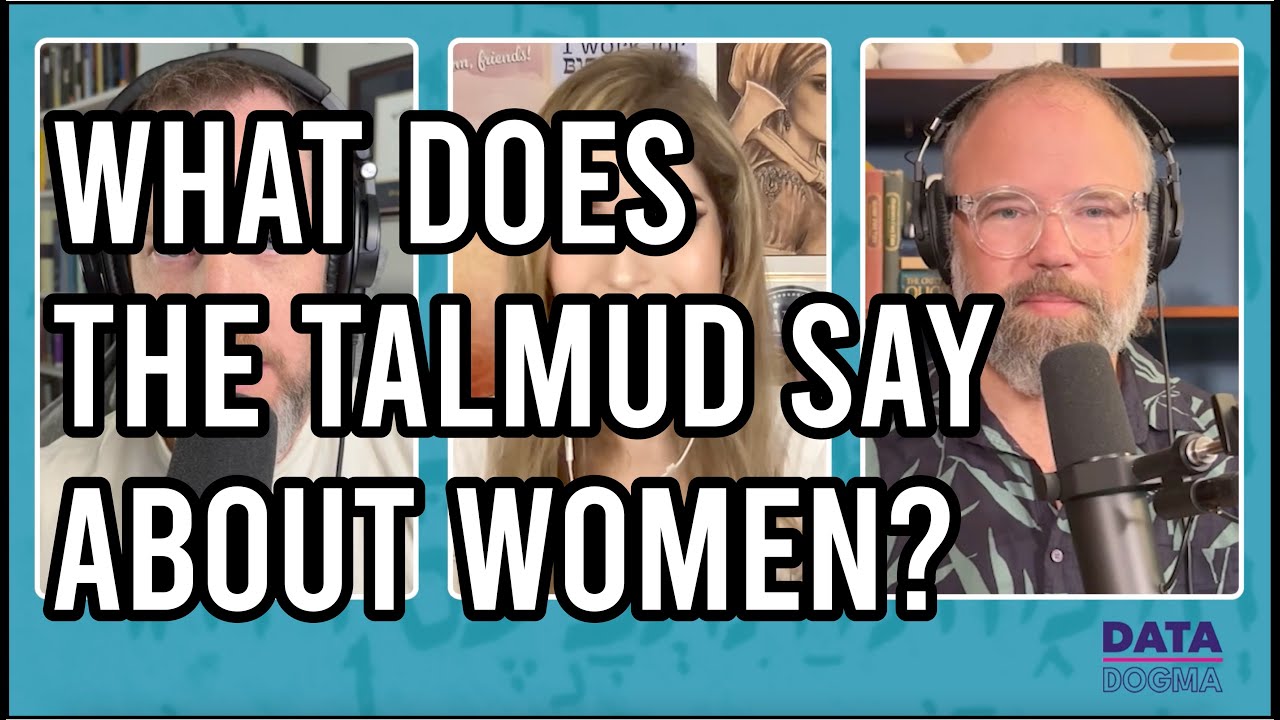
The Transcript
Rabbinic Judaism has an oral tradition of teachings, traditions, rules, laws, however you want to put it, that were transmitted, at least this is how it’s explained. Transmitted generation to generation verbally. And then what happened is the Roman Empire, unfortunately for everybody. And I don’t care that they make nice roads. I don’t care. But, you know, what about the aqueducts? I don’t care. I don’t. You know, what else have they done for us? Yeah, what have they done? They stole my. They stole our menorah. Okay? That was the least of what they did. And am I going to the Vatican to get it out of the basement? I will. For anyone who wants to join me on that highly illegal heist. Hey, Everybody, I’m Dan McClellan. And I’m Dan Beecher. And you are listening to the Data Over Dogma podcast, where we try to increase the public’s access to the academic study of the Bible and religion and combat the spread of. Of misinformation. About the same. How are things today, Dan? Man, I’m excited. We got a great guest today. I’m very. I’m very pleased. I’m going to learn a lot of words that I don’t actually know and figure out what the heck they mean because they’re not in my language. So, Dan, why don’t you introduce our guest? Happily, today we’re going to be talking with Miriam Anzovin, who is on TikTok, is on social media, is an artist, is a creator across a number of different channels and in a number of different media. I know her from her very popular Daf reaction videos on TikTok, but she does so much more than that. So welcome to the show. Miriam, how are you doing today? I am so delighted to be here. Shalom, friends. To anybody listening who might be my follower, but to everybody else who is a fan of these two wonderful Dans and Dan’s TikTok account. I am just delighted to be here as a fellow fan. So thank you so much for having me. All right, thank you. Well, thank you so much for being here. We really appreciate it. We were very excited to. To have the opportunity to talk to you a little bit today about things like the Talmud and the representation of women within the Talmud. But I think before we get into that, we want to hear a little bit more about your backstory so we can understand how you’re coming at the Talmud and its representation of women and. And your experience on social media. And you were mentioning before we got started here that you were producing, editing, hosting a podcast. For a community, a Jewish community in the Boston area before they decided to corporatize and. And kick things over to a CEO and you were left in the wind. Which then led to what? It led to me having all of this creative Jewish energy and nowhere to put it, because in addition to hosting that podcast, The Vibe of the Tribe, Rest in peace, I also did a lot of graphic design. I designed Haggadot. I did infographics about Jewish ideas and holidays. And anything that I found fascinating about Jewishness, Jewish culture, I was able to create. I also wrote a series of comedic articles, which were sort of the forebearer, if you will, of what I do now in video format, in Daf reactions, and the other funny yet heartfelt Jewish content I create for social media. But yes, so what happened was I had all this. All this energy and I had nowhere to put it, nowhere to put all these Jewish thoughts in my head. And I had been, you know, lurking on TikTok for two years over the course of the pandemic.f the pandemic. I’m talking right now about, like, December 2021, you know, about two years. And I had been doing. Learning the Talmud. I have been doing Daf Yomi since January 5th of 2020. So it again, you know, been almost two years of that. And I thought to myself, well, TikTok is a place where I learned so many incredible things about things I never knew how other people live across the world, what their faith traditions might be like, their interests, their hobbies. Incredible, incredible things that were really eye opening to me is what I found on TikTok. And I also found a lot of humor that really supported me during that dark, dark time. So I thought, okay, I’m gonna make, you know, I’ll make some reaction videos. It’ll be like a play on reaction videos, a little bit of a play on beauty influencer kind of aesthetic, which is why I locked myself into a full face of makeup every time I record now. That was my mistake. But at the beginning, I was like, no one’s gonna see this anyway. So this is just me having fun. Maybe five to 10 people who are similar to me in a lot of respects, maybe fellow millennials, fellow women who are learning the Talmud for the first time, might also be wrestling and struggling with some of the ideas I was encountering and, you know, trying to rectify that with our current modern mode of thinking. And I was like, okay, I will make. I will make some reaction videos. And, you know, those people may get it. And I remember the first one I did was a natural. A natural fit because it was a story about someone who we would define now as a Karen. And I said, oh, this is perfect. This translates beautifully to social media. Let me just take this, this very old text, this very, very, very old story. But it fits perfectly into a modern Internet paradigm, which I found as the work has progressed since that first video has been the case, quite often, it quite often lends itself, and I’m not the first person to have identified this idea. It lends itself well to being discussed online because. And I’m sure we’ll get into more about this shortly, the, the Talmud, the way I describe it to people, it’s very much like the Internet. You have the Mishnah, which is a blog post, for example, and then you have the Gemara, which is the comment section, and arguments and discussions and fights happening in there. And anyone who has had a comment section or been in one, sometimes you find comments that are brilliant and enlightening, and sometimes you find ones that are just like, I would like to block this. So it’s very akin to that. And it’s also a very hyperlinked text in a way, before there was such a thing. Before the advent of Sefaria.org where I learn Talmud. They offer the full Talmud for free, which I salute them. They can’t see me if they’re listening to this, but if they’re watching on YouTube, I salute you. And it just, it really shockingly perhaps to me at the time, because I didn’t know it was a natural fit to make videos about this. So a lot of things happened between then and now, but that’s, that’s how I first began. That was the genesis, if you will, of. Of Daf Reactions as a series. I’m gonna, I’m gonna jump in here because we’ve already gotten several of the words that I don’t actually know. I’ve looked them up. I. I do know them. But I would love to. For you to explain to our listeners who may not have your particular background. Daf Yomi. I. Absolutely. What is that? What are we talking here?g here? Okay, well, let me first start with the Mishnah, because there are two basic components of the Talmud. And you’ll understand what the Talmud is when I explain the components. So in Judaism, we have the Torah, the Five Books of Moses. One, you might know them as the Five Books of Moses. And in addition to that, however, Rabbinic Judaism has an oral tradition of teachings, traditions, rules, laws, however you want to put it, that were transmitted. At least this is how it’s explained, transmitted generation to generation verbally. And then what happened is the Roman Empire—unfortunately for everybody. And I don’t care that they make nice roads. I don’t care. But you know, what about the aqueduct? I don’t care. I don’t care. You know what, what else have they done for us? Yeah, what have they done? They stole my— They stole our menorah. Okay? That was the least of what they did. And am I going to the Vatican to get it out of the basement? I will, for anyone who wants to join me on that highly illegal heist. But… So what happened was Rome. And because of the Roman takeover and steamrolling of Judea and the subsequent destruction of Judaism as it was at the time—centered entirely on the physical land of Israel and surrounding the sacrifices in the Temple in Jerusalem—this was the sort of basis around which all of Judaism converged. Right? The rabbis of that era, the community leaders of that era, had to figure out a way to preserve Judaism and preserve these teachings. And as part of that, they wrote down these oral traditions. And that is what the Mishnah is. And I believe that ended up being compiled around the year 200 CE. I mean, this is, this is a little wiggly. I am not… I want to state right now that I am not an academic. So, Dan, if you would like to interrupt me at any point and say, “Actually, it was a little bit more like this time period,” please feel free. But then what happened after that? So we have that. But not everything in the Mishnah is entirely clear. A lot of it is not exactly comprehensible without additional context and additional discussion. And that is what we find in the Gemara, which is debate, discussion, and analysis of what is in the Mishnah. And also, you know, what is in the Torah and the Tanakh—the Hebrew Bible, I guess it’s called. Right. I only refer to it as the Tanakh. So I think that’s what the whole thing in its entirety is called. But these are multiple hundreds of rabbis called the Sages, talking over hundreds of years in multiple locations. So it starts out in the historic land of Israel, and then they move to Babylonia, where that became the center of Jewish learning in exile. And there were these academies of learning. And a lot of these discussions that we encounter in the Gemara come from all these different rabbis or houses of study. Like, it’s not only Hillel and Shammai being two very well-known names. If you are a Jewish person, you know Hillel and Shammai as two opposing schools of thought, but Beit Hillel and Beit Shammai, the schools, and their disciples as well. So the Mishnah and the Gemara, plus additional commentary added over various years, added over time, including Rashi from the medieval period— Very, very important figure in understanding a lot of this and providing context. That is the Talmud in like a little nutshell.690] Dan Beecher: Does the, okay, so the Talmud being that, does it take the, the, the Tanakh, the, the, the Torah as the jumping off point and then sort of go from there? Or, or is it its own whole thing? It is interwoven. So let me, let me say it this way. All these different sages, the rabbis, they are arguing, right? Is there agreement amongst them? Rarely, which is why it’s so fascinating because anyone who says that Judaism was a monolith, there was one way of thinking or being Jewish until the modern denominations is just simply ridiculous. If you, if you learn the Talmud, if, if that was the case, it wouldn’t take so long to learn the whole thing. And that’s what’s brilliant about it, is I can agree with somebody and absolutely abhor the thoughts of somebody else. And I’m not alone. They, they also had those sorts of feelings. But in order to prove that their interpretation or read on something was the correct quote, unquote correct one, or the accurate one, or the one that we were supposed to do, they would bring proof texts from the Tanakh. So in order to prove XYZ thing, they would bring a statement, bring a pasuk, bring a line from the Torah or the Tanakh and reference that. So in order to have their arguments have validity, they needed to bring in the written Torah in order to back up their assertions. And so when you go through the Mishnah and you go through the Gemara, you will see always a source text is being referenced. And either they are elucidating it, they are expanding upon this idea or clarifying it, or extrapolating. And this is when it gets a little sketchy, extrapolating one idea from another because of parallel words used in one place that they find in another, and thus they find a connection between the two. I will give a little example from the current tractate I’m studying, although now that I say that, I realize I haven’t explained what a tractate is. So a tractate is a volume, I guess we would say, of the Talmud, and there are different ones for different subjects. Do they stay on topic? Rarely. So the first one that I learned was Berakhot, which is ostensibly about blessings, but it’s a lot about, but it’s about a lot of other things in addition to that. So the current tractate I am learning right now is Tractate Kiddushin, which is about betrothal and marriage. And on the very first page of that, that tractate, the very first daf, that’s a page of Talmud, the discussion is how does one acquire a woman? Right. And the ways to be acquired are multiple. One is a document, one is exchanging or giving her an item of a certain amount of money or value, and the third is sex. But the way they are discussing the word acquired has also to do, in their mind, they’re connecting it to how the field was acquired in the biblical story of getting the Cave of Machpelah, the, the burial site which is now in Hebron. So they’re like, ah, you acquire a field and you acquire a woman. Because these two kinds of wording, this, this parallel wording is taking place. Does that make me feel weird? Absolutely. And I’m sure we’ll get into more of that. Why? I know why I feel weird about it. What’s difficult about that? So it’s normal. I am an object. But to get to your earlier question about Daf Yomi, let me just explain that that is a practice. It’s only been 100 years of this practice. Actually, earlier this week was the anniversary of that. But it is the practice of learning the entire Babylonian Talmud. There’s actually two. One is called the Jerusalem Talmud, it’s the earlier one.Jerusalem Talmud, it’s the earlier one. It’s, it’s not as fun in my opinion. But the Babylonian one is when it really gets good. That’s when you have all the demon content that I love so much. But it’s the practice of learning one double-sided folio page of the Babylonian Talmud every single day. It’s like a worldwide book club. And it’s a seven and a half year cycle. Seven and a half years. Oh, okay, so we’re not, we’re not talking like, you know, this is the 30 day challenge. No, this is a commitment. And this is why when I see anyone online say, well, the Talmud says blah, blah, blah, and they make up some something or they take something very out of context or they say something that is in there, but completely without the surrounding necessary information. And they say, I have read the Talmud. And I’m like, really? What year, what year are you on? Because I’m only halfway through. The halfway point is actually this coming Wednesday. I know this will probably come out after that, but this coming Wednesday to me is the half, the halfway point. Mazel tov! Thank you. The current cycle began in January 5th of 2020. So all of us who have been in this cycle began then. And that’s the thing. People do it together. Everybody dives in at the same time. So if you miss it, you got to wait seven years. That’s not entirely. No, you’re not allowed to. I know. I read about it. You’re out. People can. People. In fact, I am honored to say that some people have started doing Daf Yomi because of my videos and… which is, you know, mind blowing to me, but they will continue on, like, after the end of this current cycle. They will have to continue to catch up on the… on the tractates they missed. Right. Right before they started going. So anyone can start at any time. There’s nothing wrong with that at all. It just so happens that this… this idea of being all on the same page and being able to sort of be doing something that another Jew, completely different than me around, you know, across the world, who speaks a different language, who has a completely different life than I, but together we are meeting on this page every day for seven and a half years, and it’s sort of like this fascinating collective experience. So not to take anything away from people who study Talmud in other ways. People spend years on just one tractate. You know, there’s all types of ways to study Talmud. This is just the way that I am doing. I. Oh, go ahead, Dan. And this crosses kind of, for lack of a better word, denominational boundaries. Yes. All different types of Orthodox. Yes. Does that include, like, the Hasidic and other branches? It’s something that everyone has kind of come together and said, let’s… let’s try this out. There are some people who dislike it for… I understand the reason. It is very complex material to get through. Really, really, really hard, sometimes, sometimes easier, sometimes less so, depending on what’s being discussed and who… who is being… who is being talked about or, you know, is it a fun story? Is it really upsetting?550] Miriam Anzovin: Really depends on. Is it a complex set of laws? You know, all different types of content are within it. And I understand this reticence to devote only one day to a page because there is so much to be gotten out of out of these pages, more perhaps than one could get in a solitary day. So I understand this sort of pushback. In fact, when this practice was first introduced, it was like, no. What? No, this is wrong. This is bad. So definitely there are the anti. Anti-Daf Yomi people, but for a lot of people across different denominations, this has become an exciting thing, a unifying thing. And I say that because at the beginning, before the cycle began, when the. The previous cycle was coming to an end, and there’s this, like, massive party, the Siyum after the completion, it was just like, everyone is so hyped. And I remember so many social media groups popping up or had already existed. You know, LGBTQ Talmud groups, Daf Yomi groups, women’s Talmud groups, Orthodox women’s Talmud groups. Every single day I learn the daf because I do not speak Aramaic. I know, I know. It is a fault. I do apologize. I listen to Rabbanit Farber. She has a podcast. She is an Orthodox woman and she teaches this incredible podcast, Hadran. And I hear her in my ear speaking the Aramaic and I read along, but I can’t speak it. So I value that. But it really does cross so many different boundaries of so many different types of Jews. And for example, I myself am a secular atheist Jew and I am doing Daf Yomi. Right. You know, sorry, I just wanted to get at one thing, which is you mentioned the. The podcast with. With a woman sort of explaining, you know, expounding on it. I. When I did a bunch of research for this interview, I found a lot of people talking about Daf Yomi, and most of the ones that I found had significantly more beard than you have. I. I’ll just put it that way. They wore a different hat. And I’m wondering if you. If I just don’t think you look like the standard person, who would be. Who would be reacting to the Daf Yomi. I wonder has. How has that been being a. A young. You know, our. Our listeners can’t see you, but. But, you know, you’re. You’re very made up, you’re very put together. Is my persona now. Yeah, exactly. The tyranny of the brand. Exactly. Talk about how people have reacted to that, all of that sort of thing. Yes, indeed. Yes, indeed. Well, firstly, so when I started creating these videos and I really didn’t think anybody would see them, I never expected to be the center of any type of controversy because no one was gonna watch them except people like me. And who wouldn’t care that I was a woman or wouldn’t care, you know, anything about how I looked or that I don’t dress according to the standards of modesty that I adhered to when I was an Orthodox person, which is, you know, covered up to the neckline, elbows covered, you know, the whole. The whole thing. I am a secular person now, and I dress accordingly. So when people started first taking note of these videos, the pushback, the really, really overwhelming pushback. And it has taken me a really long time to sort of acclimate to this. If I am acclimated to it, really.n’t know if I am, having suddenly thousands of people with very strong opinions about. About me. And at first it was all negative, or not all negative, but widely negative. And there were several aspects to that negativity. The first is that I am not religious and I am an atheist. And in fact, I wrote an article on day two of doing Daf Yomi about why I felt it was important to do this, to learn Talmud, to learn Jewish texts. Even if I wasn’t believing at the time, I felt it was really, really vital. And I still do. I still do. It includes so much about how to. How to understand Jewishness, Jewish identity as a nation. And I don’t mean a state, I mean a nation in diaspora, how to understand all of these. These things that I really, deeply value about being Jewish, about being a Jewish person. So I thought it was really, really vital. So when people started to notice what I was doing, the negative responses were, she is immodest, not only in her dress, but in her. Her speech. She swears, she speaks like a millennial, because I am one. How could she do this? She is making jokes about the sages. This is ironic, considering the sages make a lot of jokes themselves about each other. And to anybody who does not believe me, please see the book Talmudic Insults and Curses. Highly recommend. I believe the author is Abba Helft. Great book. Great book. Yeah. It just really gives perspective on. On the levity that was also a factor they didn’t like. You’re making jokes, you’re being comedic. You’re not taking this seriously. This is for men to study in a yeshiva in a set setting where it’s sort of guarded. This text is guarded. It is gatekept very literally. And most people are pushed away from engaging with it. That has certainly changed before I started doing this. I don’t want to take credit for this, because so many women and people who are not men have worked very hard on opening those gates and. And doing this work. I am not. I did not pave this way. I can only walk on this path because others have gone before me. But perhaps they didn’t do it on social media in this way. With those porn elbows flying left and right. Exactly, exactly. These scandalous elbows. Certainly not with vocabulary that I happen to use in my videos. And there was this also, like, she doesn’t believe. How dare she, how dare she open the Talmud and talk about it? Which is ironic, considering people have less pushback about someone like me opening the Torah and reading it and studying it, which I have theories. I have theories about why that is, that’s familiar. I get, I get a lot of that when I talk about the Bible. People say, you don’t believe in it. Why are you even doing it? My gender has never come up. No one has ever said, I don’t have. That must be nice. Unfortunately, yeah, that’s, that’s something that, that has never come up. But yeah, some people seem to think that if you approach this as a, as a secular exercise or something, you, you have no business doing that, have no right to it. But that’s odd that the, the Talmud would be considered more sacred, more set apart than the Torah.y on that in a second. But I think the thing also that people would say to me is, women have made such progress in being Talmud scholars. How dare you come and make all their progress irrelevant? You have basically. Yeah, I know. Which is like, I’m not the Lorax. I don’t speak for all women who learn Talmud. My reactions are my own. I never claim to teach Talmud. I am merely learning. This is a learning process. It’s a project of personal learning that has become public. But it’s about my own reactions to it, not, not me telling people what to believe. So you’re wrong for doing it because you’re a woman. And you’re also wrong for doing it because you’re making the other women look bad. I’m not the right type of woman. Wow. There’s a lot, there’s a lot of hoops that you have not jumped through. Right, right. And, and yes, the, the fact that I wear makeup was indeed a thing because. Oh, she’s not serious. Oh, she’s. And I actually heard this from some people. She’s too pretty to learn with. And firstly, my terrible low self esteem for the majority of my life says, oh, really? Wow, thanks. Good to know. But I always respond to this with. In the Talmud, there is a particular sage, Rabbi Yochanan, who is notoriously the best looking human being. And he says it, the Talmud says it, everybody says it. It is a known fact. So I said, how dare you? How dare you, dare you disrespect Rabbi Yochanan that way? No, no. Okay. We can be attractive, but we have to be Rabbi Yochanan. That’s the only one and actually, historically, I will just note there is a. I forget what, what era in which she lived, but there was this female Talmud scholar, Miriam Luria, and she was supposed to be very beautiful and she taught behind a screen so that she would not. Nobody would be, you know, and I teach behind a screen too. Not teach, but I react behind a screen. But it’s a fun phone screen, which is different. So. So that is the. That about that piece of that. But to answer your question about why I think people get more irate with me about Talmud comedy versus Torah. People know the Torah, and if they know it as the Torah or the Bible or whatever it is, it is a known, known. It is out there. People know what’s in it. People have engaged with it. There has been Bible jokes since, ever since forever, literally. It seems more comfortable in a certain way because it’s already out there and you can’t take it back. With Talmud, there has been such a. A sense of protection about it. And I understand why in some ways certain things are said in the Talmud that come from a place, were written in a time when the Jews were being exiled, they were being persecuted, and they verbally, in these discussions, which no one else was supposed to see, push back. And in their minds, this is a protest against their oppressors. So there are some unflattering things said about somebody who is often believed to be that Jesus. I will say, however, that those unflattering things have also been directed at me. So it’s just gonna be me. It’s me and Jesus and Shabbetai Zevi.Zevi. What we’ve learned about you so far is that you’re very attractive and you’re Jesus. Correct. And I wonder, you know, because we always see depictions of Jesus as, you know, gorge. And I think we know who to blame in art history for this. But I am not, though. I’m not on his level. I don’t have his abs also. And I also don’t want to talk too much about Jesus because that is not my wheelhouse, not my faith. I do have to address it when it comes up in the daf. But there are things for which Jews were persecuted historically because Christians looked at the conversations in the Talmud, found some things that they found offensive and edited the Talmud or punished people directly for it. And if you still, to this day, if you go on TikTok, I did this before I first, you know, ever posted a video. I wanted to say, see, I wanted to see if anyone else is doing this. So I didn’t like step on anyone’s toes. And I’m like, put “Talmud” into search into TikTok. It is all antisemitic stuff that is the same exact antisemitic stuff as they were saying a thousand years plus ago. Like literally has not changed. Which is also another reason why I find it very important to learn it, to be able to counter these narratives. But so there’s that self-defense aspect of gatekeeping the text. If nobody knows what’s in it, we don’t have to defend these things, which I don’t have a problem with. I mean I don’t care what they said about the Romans. I really don’t, like, it’s a vent. But on the other hand, the Talmud represents a shift in power. It represents a shift of power from the Kohanim, the Kohen familial, how do we say, genetic, I guess leadership in Judea or in Israel before the destruction of the temple. And then that shifts right as the temple is destroyed. Now the sages, now the rabbis are in charge and they are in charge of defining what Judaism will be outside of the land of Israel or in the land of Israel under occupation. And therefore the power shifts to them. And by kicking at that, what people think I am doing is kicking at that bedrock of modern rabbinic Judaism, which I’m not actually doing, that is a more of a threat to some people than doing some light comedy about the Torah. It seems to me that one of the things that the Talmud is doing is kind of mediating between the Torah and communities who are trying to live these things. Because the Torah is very complex, it’s self-contradictory in many ways. It does not provide answers to all possible questions. And so although if your ox does fall in a hole, I keep telling you, you know what to do. Very oddly specific and never relevant guidance. And so you have the sages coming in and contemplating all the different ways you can take that ox, the goring ox story, and kind of extrapolate all these different principles out from it. And then that becomes kind of the locus of authority, as it is closer to the people in their living of that religion. That this is actually what we are, is kind of how we’re engaging it more so than even the Torah itself. I think the sages are looking both backwards and forwards. They’re looking backwards to a world that already was in the process of being demolished. So they’re looking back and trying to figure out how do we translate a prayer structure, for example, that at the time before them was about animal sacrifice, how do we pivot away from that and define prayer being a set of written down prayers that we recite, you know, three times a day that correspond to the times when Jews of that era would do sacrifices, but we’re not doing animal sacrifice anymore because the temple no longer exists. How do we pivot?:33:09.420] Miriam Anzovin: How do we change that when we are clearly obligated in the Torah to do these things, but we can’t, we can’t do them anymore. So it’s like figuring out what used to go on, how to sort of carry that through in a way that makes sense, if possible, to something that they could do, which was verbal prayer, and how to make, how to make this sort of jump between what they knew, what had been Jewishness at that time, or practicing Judaism and what it had to become in order to survive. So I do want to give a lot of credit. I know I make a lot of jokes, but to be able to survive that long, and I think the credit goes to Yochanan ben Zakkai. There’s a famous story where Jerusalem is being destroyed and he fakes his own death and gets smuggled out in a coffin to go speak to somebody who heads the Roman army. I think it’s Vespasian, I’m not sure, but. And he, he, he tries to convince him, you know, how do we, how do we, what do we do? And Vespasian or whoever is in that position of authority, says, well, what, what do you want? I can’t stop Jerusalem from being destroyed. It’s going to happen. That’s going to happen. And so Rabbi ben Zakkai says, okay, give me Yavneh. Yavneh is a city. And that’s where he took the sages, took the rabbis, and they reconstituted themselves there. They could continue the process of rabbinic learning and transmission of traditions that way. So in that moment, I think it was really down to him. Although obviously a lot of other things happened in that story. I don’t know about the accuracy historically of it, but the way it’s presented is this is the moment where he saved Judaism by making it portable, by making it something that while everything in our tradition is deeply connected to the agricultural cycle of the land of Israel, you know, some of our holidays that we celebrate here in North America do not make sense here in North America, but they do there. But it was that or annihilation, you gotta pick. And so he made that choice. And that’s very similar to the crisis that Judahites faced in exile in Babylon. And you have different ways of trying to, like Ezekiel, for instance, makes God’s presence portable by saying, what if his throne had wheels? Which is, yeah, I mean that’s, I. I mean it’s really cool. Very true. Trippy deity wheelchair is invented. That’s pretty cool. Yeah, I like that. But that’s a lot of what’s going on in the Torah is similarly responding to crisis and trying to figure out how we can keep our community together, increase that social cohesion and maintain our identity. And so in a lot of ways, the Talmud is simply doing that. And so I, I, I can tell that you have an appreciation for what they’re doing, a respect for the Talmud, while also, you know, having to react to and engage with a lot of rather problematic or a lot of. Rather sus aspects of it. For instance, the fact that uh, women are treated as property in some ways when it comes to, and I don’t know what the term in the Talmud is, but in the Hebrew Bible it’s lakach is what you, you do to get a wife, you take a wife. Yes. And so can you talk a little bit about the conceptualization of women within the Talmud? What kind of questions are being asked and how are women being represented? And is there agency even a question? Or is it just only the agency of the man? When I go to do workshops with people and I don’t teach them Talmud, I teach them how to react to Talmud. One of the things I recommend is asking themselves who is speaking in this portion of the text and who is being spoken about. And often the people who are being spoken about but who have very little agency.ncy. I mean, it depends on the area and the topic, but they’re women. Women are often discussed in the Talmud. In fact, there is a whole order of the Mishnah. We’re in it right now, Seder Nashim, all about women and for better or worse. And so sometimes we see huge debates over multiple pages or whole tractates that could have been easily resolved had they asked a woman, but they didn’t. So. And no women were present. Well, let me rephrase that. Let me add just a little bit about that. Some women were present. I want to mention Baruria in particular. She was a sage. I think we can fairly say that in her own right. And she famously learned 300 halachot laws in one afternoon because she could. And other people did not have her aptitude for, for learning for Talmud for, for her knowledge is incredible. Off the, off the charts. There are only a few women named in the Talmud, fewer who are actually knowledgeable about Jewish law or Torah tradition and who are, you know, pointed at as being right in their interpretations. She is definitely one person who is. Her rulings, her judgments. I mean, not her rulings. She wasn’t allowed to do that, but her judgments, her suggestions, her. Her read. Is she quoted or is she just. She is quoted. She is quoted and she is quoted. And there’s one quote. I think one. One thing I really appreciate about her is she weaponized the. What we would term now, sexism in the Talmud in her own. To her own benefit. There is a story where she is walking along a road, minding her own business, right? Doing whatever she needed to get done. And Rabbi Yossi walks up to her and says, which way to Lod? Or something like that. And she turns around and clearly she didn’t want to be bothered on her walk. And she says to him, and I’m paraphrasing because I don’t remember the actual how it is actually said. Use fewer words when speaking to women, which is something that the sages are saying. Don’t talk to women. It’s bad idea. It’s a bad idea, right? They’re going to lure you into stuff. No, don’t do it. And she’s like, speak. Speak less to women. You should have just said which way to Lod? Instead of, oh, are we on the right way? Are we on the right path? Where are you going? Am I going this way? So she was like, weaponizing. She’s like, sir, have you not heard? Speak less to women. But then we get also people like Yalta, who famously did not appreciate being disrespected openly by a sage, Ulla, who was visiting her own home. And she had requested to also have the. The kiddush. So the. The wine that is used to. As. As part of, like, Shabbat, part of a lot of Jewish rituals. And Ulla, who was not her husband, but the guy who was visiting, was like, don’t give it to her. She’s a woman. And she was like, okay, I won’t say what I would usually say. It involves swears. But she. She goes down.] Dan Beecher: And she rejected the notion. She firmly rejected it. She went and smashed 300 barrels of wine. Wow. She’s like, oh, you want. You want it in my. In my house? You’re gonna do this. Let’s go. I actually, this. If anyone’s watching on YouTube, I don’t know, but this is an image I drew of her. She is holding an ax on her shoulder and ready to smash the patriarchy. Yeah, but. And a bunch of wine, which I think is the. Is a bit of a tragedy. But sometimes. I understand, but sometimes you have to make a point. Yeah, you know, I do understand. I do, I do. And it was. If you guys had a Jesus, he could have just turned some water back into the wine. But easy now, there is a story about somebody. Okay, I won’t go into that because we’re talking about, we’re talking about the woman question. So yes, we do hear from. We do have actual quotes from a few women in the Talmud who have significant-ish parts to play or things to convey, stories about them that are relevant and important to the topics being discussed. And I appreciate that, I do. Then there’s the rest of it where, you know, not only do we usually hear about women in relation to a man, this is someone’s wife or daughter and she doesn’t get a name. In my videos. I give them names so that they can have one. But it’s the discussion as a whole, depending on what we are talking about. Women did not have rights of owning things on their own when they were married. Everything she made, like if she had a job, that’s really the ownership of that money or whatever went to her husband. She does not hold on to that. And actually the same if she’s younger and is working, her father gets that. If you know, she is sexually assaulted, the fee that the rapist pays doesn’t go to her. It’s not about her and her embarrassment that goes to her father. She’s a commodity. And now the commodity has been compromised. Exactly. And her value also goes down as a non-virgin, which is also a deeply obnoxious pattern. You know, really difficult thing to come to terms with. The value is virginity and your price lowers. Good thing nobody thinks that way anymore. Right. Thank goodness nobody has that idea since then. Yeah, I think, what was it, 1973 when women could, could have credit cards. Oh really? Or something like that. Yeah, yeah. So we’ve come a long way, right? In some ways we have come a long way. But the thing I will say is I do get very mad at a lot of things in the Talmud about women. And some of them I’m like, okay, this was 2000-ish years ago. I can’t change that. Sure, it’s disturbing to come across and to process it. Sometimes I will donate to a women’s organization or something like I have to, I’m learning this, but I’m going to change something in the present. What really gets me is times when the Talmud is discussing an issue involving women. And the problem has trickled down to this day and affects us. Now, I will use an example. We just got out of Tractate Gittin, which is about divorce. Right. Actually, until the 10th century, women didn’t have to agree to a divorce.ave to agree to a divorce. They just, bye. Couldn’t do anything about it. At the time, marriage was the only way for economic support, status, protection. And I hate that that was the case. I hate that. But a man is the only one who can grant a divorce in Judaism, and still to this day among the Orthodox community, only a man can initiate a divorce. And a man can withhold that divorce, leading the woman, the woman, the wife, even if she desperately wants to be away from him, even if he is abusive, whatever it is, she will not be free of him until he grants her that get. And women who are in that position of being chained to a dead marriage are called agunot. And there is a, a truly terrible crisis about that. Especially I will say, in the state of Israel where there is no secular marriage or divorce, it is all through the Rabbinate. So I have a friend who lives in, in Jerusalem who literally, she and her partner just very recently traveled to Cyprus to get married. A day trip out and back. Yeah. Because they didn’t want, because they couldn’t go. They’re secular even though they are of Jewish origin. Right. And they couldn’t, they, they had no way to do it otherwise. Yeah, it doesn’t actually matter what I would believe. If I went there and I wanted to get married, I would have to do it through the Rabbinate. And if I wanted to get a divorce, I would have to do the same thing. And that plays into issues of custody and things like that as well. And that is not good. That is very bad. So I hope, I, I really hope that soon Israel will have civil divorce, civil marriage, but even here in America, so I am a divorced person. I was married for nine years to a fellow Jew and we were divorced in American law. And I also made sure, even though I am not observant, I am not a believer at this time, that he went to a Beit Din, which is a Jewish court of three men, if it’s an Orthodox one or three people, if it’s not Orthodox. And I received my get. This is my document of freedom, which is not too dissimilar to a document freeing a slave. Wow. So you, you have been manumitted. I have indeed been freed. Now, did they, did they drop it for you? Yes. And you catch it. So yes. And I did a very. So I was the only woman in the room. And I was like, okay, I’m gonna make this funny. This is the last hoop I have to jump through before I am free of this person. And so they. The person who was a stand-in. Well, there was a stand-in for my husband there because I didn’t want to be in the same room with him. But at one point, the get, the document is actually dropped into the wife’s hands. She catches it and she, like, brings it into her, so she’s like, boop. And I did a very dramatic one. I did get. People did laugh. So I win. It’s so good when you kill at your get. That is a. I know. That’s a. That’s a coup. That is a coup. Right, right, right. That’s good stuff. Yeah. So I did. I did receive it. I went through the whole ritual. The thing is that they don’t. You don’t get to keep that.iriam Anzovin: You get a receipt that says, I have my get. You don’t keep it. The Beit Din keeps it. Wow. They keep it in the event because they don’t want, like, anything to happen to it, anything to be changed about it, which could invalidate what happened. They actually cut it before, you know, it’s sealed in a special way. It’s cut with a knife, and then they keep it. And I have a receipt in a security box. But. Right. So this is an example of something that we see in the Talmud that I can be mad about then and I can be mad about now, because the through line is direct. Yeah. I’m guessing a lot of people your age, especially women, really appreciate having someone having, you know, an avatar of them talking in this way, because I can’t imagine that it’s common. I can’t imagine that this is a. That this is a usual way of talking about the Talmud, about. About the. The Daf, all of that stuff. It is and it isn’t. It is and it isn’t. I will say that there are a lot of other forms of media in which this is done. For example, there are great meme pages about the Daf Yomi on Instagram that I love. Right. So it is addressed in that way for other people who also find this comedic nugget in there. But also the intense part that we are sort of making a commentary on and in meme form, in terms of short-form video. I have not found another me. If I had, I probably wouldn’t have created this series because I. I was like, oh, no, this person has it. They already, they have this down. They don’t need me. But I hadn’t found a me. That’s not to say that other women don’t have these thoughts or have these opinions and share them in, in their own groups or their own way. Or maybe there are those out there whose videos I haven’t discovered yet. But. But I think there’s a reason that people started taking note and writing about it and showing it on Israeli TV, showing my videos on Israeli TV without censoring it, which is hilarious. And why it became such a huge controversy at the beginning of when I started to do this because it was a new-ish approach. It was a fairly new approach in a, in a medium, TikTok, that had not been, it hadn’t been done before and it hadn’t been done by somebody like me. And to your point, there is a way in which I am an avatar. I am no longer just myself. Miriam Anzovin was just me. And then in January of 2022, I became more than just me when this happened. And I’m cognizant of that, deeply cognizant of that. Because people see me and they say, I didn’t think that I could learn Talmud because I am a non-religious woman. Or I didn’t think I could learn Talmud because I am, or even, I want to say, not even just women, people who aren’t men, anybody who isn’t men, a man. Or they say I used to be religious and then I stopped being religious because I shared my views, my opinions, my reactions in Yeshiva and I was kicked out and told that I could not have these opinions, that there was a set paradigm with which I was to understand this text and I was not to think too far beyond it or engage with it on a deeply personal level where I could have these thoughts. That’s interesting. Sorry, can I just. Yeah. Drill into that a little bit? Yes. What’s fascinating to me, you literally just said, you know, when you’re explaining Talmud to us, that there are these factions of discussion that are disagreeing with each other. other. There’s a tradition of disagreement. And yet things, as they so often do in human life, things people are more comfortable once something has solidified. The. The Talmud became calcified at a certain point, or I should say the discussions became calcified. It became, I think once the Shulchan Aruch came around and possibly before this, so the Shulchan Aruch. When people say you get your laws out of the Talmud, that is not necessarily true. You get your arguments out of the Talmud. Some. You have questions, a lot of questions, not all of which are answered. But the Shulchan Aruch is a book. It’s literally called the set table. It is how you should do things and it clearly articulates it. And so while there are differences in practice across, for sure, geographic locations, like diaspora communities who may have lived hither and yon and don’t have the same practices or customs, always those who, who kind of did come from this specific tradition, it’s now like, this is what you do. And if you want to consult and find out the right way, quote, unquote, the right way to prepare for Passover and, you know, go and do whatever XYZ thing, you don’t go and look in the Talmud, you look at a later compendium of law. So even though I know you would, you would think that looking in the Talmud, you’d be like, yeah, we’re, we are here to argue. And a lot of people do see that. A lot of people do see that. And they will reenact, in a way, the arguments between these, these, you know, multiple viewpoints, these sages who are well known, like people that, that you kind of grew up hearing about, that’s how, how important they are in, in Jewish tradition that, that we know their names and we know how they thought, we know a little bit about their lives and how that impacted how they thought. In a lot of ways, the fear of thinking outside of the box in a way that is a little bit too dramatic or could be detrimental to modern Jewish communities in some way. Like, oh, no, we don’t want people to think too hard because then they’re going to go off the derech. They’re going to go, they’re not going to be religious anymore. I am an OTD and off the derech too. And a lot of people don’t like that term, but it is a commonly used one. The concern is, no, you are not. You’re not. Don’t think too hard. Don’t react this way. We know the reactions that we should be having to this. And if you have a different one, why are you questioning what I am telling you? Not what the Talmud is saying necessarily, but what modern instructors, modern teachers, modern rabbis are saying about the right way to interpret and the right way to react. And sometimes I have had, I think very early on third month maybe, that I had been making these videos. I spoke about the agunah crisis and I also spoke about sexual assault because it was a daf, it was a page addressing sexual assault. Such a fun topic. Such a fun topic. And I remember while I got a lot of pushback from men who were like, you have to understand, this is actually better than it was everywhere else at the time. And I’m like, no. So many people wrote to me privately and said, I. Well, either people who had experienced a sexual assault and were giving me their stories to hold. So I, you know, have this. This responsibility now to hold these stories for people. And I’m honored they trusted me with those other people who are men wrote and said, I have learned this seven times I have learned this. However many times I have learned this page of Talmud. And I never thought about that because I never learned it with a woman.00] Dan Beecher: Yeah. So it’s. If you have the same type of person learning with you, you are going to have the same types of reactions, same types of thoughts, and you’re not going to expand beyond that. But I think what the Talmud says to me is that the more voices in Talmud, the better. And I just wish that more people now agreed with that. Well, and I think. I think TikTok is a great democratizer in a lot because it enables people to get in front of an audience and it gives you a seat at the table. And I think that’s probably what’s threatening a lot of people is they’re so used to people who experience the world in the same way as them, and they’re comfortable in their power structures and in that patriarchy, and having a seat at the table threatens those power structures, and that is threatening their worldview and threatening their experience of the world around them. And for a lot of people, that’s unacceptable. Yeah. Which I think is one of the reasons, is that it’s something that is not. It’s a good way to say this. You haven’t come across many other people doing what you’re doing from your set of experiences and perspectives, because it takes some bravery to do that, because you’re going to get pushback from those folks who don’t know any better than to just reflexively defend the patriarchy, because that’s the. The foundation of their worldview. Yeah. I do want to say before. Before anyone gets a wrong idea, that people view my videos from across the Jewish spectrum. I have people who are not religious at all, and I have people who are Orthodox. And I appreciate that. And I appreciate when somebody who is. Has existed in that structure says to me, I actually really love this. I love what you’re doing. I can’t wait to get to this page and this topic and I’m just really excited to see what you do with it. So I just wanted to express my gratitude for all the people who may not initially, perhaps have felt comfortable with what I’m doing, but have come to or always did perhaps find value in it and see what I’m trying to do. Comes from a place of deep love and appreciation. Yeah. That doesn’t mean I don’t have difficulties with it, but it comes from not a place of hate or wanting to dismantle it. It comes from a place of deep. Love and I think people who are sincerely engaging with your content can sense that. And I have similar experiences where I have people from all across the spectrum of belief and non belief who appreciate the content that I produce. And I’m also very, very humbled and grateful that, that I’m getting that feedback because it validates what I’m doing. I’m sure it validates for you what you’re doing. So congratulations that you’re. I think that’s a sign that you’re in a sweet spot that you’re doing something right. And I’m very hopeful that continues and, and increases as, as the reach of your social media content expands. And I was going to ask TikTok is, is that where you create most of your content or that’s the environment for which you create most of it? TikTok is the environment for which I create. However, I have noticed since the pandemic has, I mean, it’s still here, but, you know, things have shifted. There’s actually been a change also in TikTok where it has become a lot more strict in what I can and cannot say, which is why I have to use euphemisms all the time. But it’s become more strict and my views there are going down often, but my views on like Instagram and YouTube are going up. So like this strange shift is happening, which is a bit odd. I think what I initially love about TikTok and I still love about TikTok, even though it has experienced some changes since 2020 at its height, when everyone created a TikTok page and was like, this is my life now.age and was like, “This is my life now,” I think that some of the changes or some of the things that I really appreciate and appreciated about it still is the sense of community that I don’t necessarily find on Instagram or YouTube. There’s viewers, there’s, you know, in the comments, we’re going back and forth. But TikTok is a special kind of environment. It is a special kind of environment and I really value the community that has been built there. Without that, this wouldn’t have happened on Instagram. This wouldn’t have happened on YouTube without TikTok kicking it off first. I think that it has a very unique way of approaching interacting with content and the way people can respond and you can respond with videos in this kind of ongoing conversation, which is not too unlike Talmud in a way. But I, I think that whatever fluctuations happen on social media between the platforms and you know, depending on how earlier this year, there was that fear about TikTok going away. There’s the debacle with Twitter where now all we have all these… This diaspora of J-Twitter who are wandering around trying to find each other on like Mastodon and Bluesky and everywhere. There’s so many shifts in social media, but the general trend is that more and more people across the board are watching my stuff. And for that I am deeply, deeply grateful. And you know, I really do have to… Have to give it up for TikTok, because without that, this would not have happened. Well, so speaking of all of these places where… How do people find you? How do they track you down? You can find… Well, don’t try to track me down because I literally, I’m… I truly do believe that I will be tracked down. I truly believe that I will be assassinated by… By somebody who hates what I do. You can find me on TikTok, on Instagram, on YouTube, on Mastodon, on Bluesky, and on Threads @miriamanzovin. M-I-R-I-A-M A-N-Z-O-V-I-N. And I post videos, you know, usually everywhere, all those places. Everywhere, all those places. So if you’re not on TikTok and you’re a YouTube person, you will see the same content that I post on my TikTok and my Instagram. And it’s not just Daf reactions. You also react to other genres of Talmudic and other literature. Well, that… You know what we’re gonna have to… That is a talk, a discussion for a different episode of this show. So maybe we’ll have you back to… To talk about other things and so that I can learn. I would be delighted. I would be delighted. Well, Miriam Anzovin, thank you so much for joining us. We really appreciate it. For those of you who are patrons of our show, if you stick around, we’ll do some… Miriam has agreed to… Foolishly probably, agreed probably to… To stick around and chat with us a little bit more. We’ll… We’ll get down and dirty and personal. She might show her elbows, you never know what’s gonna happen. And, and, for those of you who aren’t patrons, but would like to be, you can always go to patreon.com/dataoverdogma to become one. And what’s the other thing? Oh, if you want to contact us, you can write to us. Contact… It’s contact@dataoverdogmapod.com. Thanks so much for joining us. We’ll talk to you again next week. Bye, everybody.