Close Encounters of the Catholic Kind
with Michael Peppard
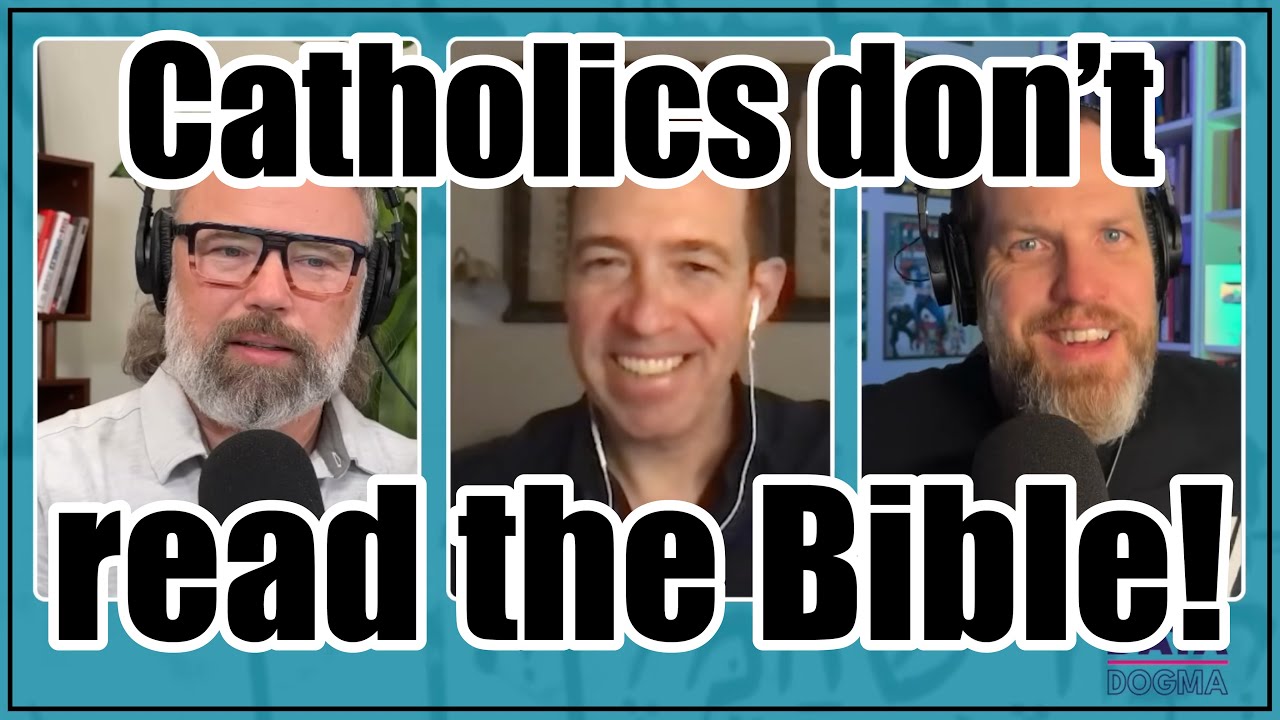
The Transcript
For those of us who don’t know, talk a bit about what that means. Oh yeah, sure. Explain yourself. You have a very educated audience. I can’t just say quasi-Marcionite and walk away. Hey everybody, I’m Dan McClellan. And I’m Dan Beecher. And you’re listening to the Data Over Dogma podcast, where we increase public access to the academic study of the Bible and religion, and we combat the spread of misinformation. About the same. How are things today, Dan? It’s a good day. It’s a good day because we get to interview somebody, and that’s always fun, having a different voice on the show. It’s always a nice time. So why don’t you introduce our lovely guest? Happy to. Today we have the pleasure and the privilege of talking with Dr. Michael Peppard, who is professor of theology at Fordham University, as well as associate director of the Curran Center for American Catholic Studies. Michael, thank you so much for being here. Welcome to the show. Thanks so much for having me. I’m excited to, uh, to talk about some data and actually a little bit of dogma maybe too. We’ll get all of it. We’ll just squeeze it all in. We’ll figure out how. And, uh, and there are actually two books that I hope we get to talk about, uh, a bit during the show today. I’m holding one up that doesn’t have the dust cover because I am I am not pro-dust cover, but this one is called The Son of God in the Roman World, which is, what, 14 years old, something like that by now? Yeah, that’s right. That’s right. 14. Yeah. Wonderful discussion of Christology in Mark, which I think does a wonderful job on some stuff we’ll get to later. But much more recently and much more topically and relevant to today’s show, How Catholics Encounter the Bible. Both of these are with Oxford, aren’t they? Yes, they’re both—. Those are with Oxford, and then the middle one, the world’s oldest church about Dura-Europos, was with Yale in between those. Oh, was it the library? No, it just would have made sense considering their role in the excavation there for Book 2. Yeah, I have missed that one somehow, but Dura-Europos is such a cool place. I’m going to have to circle back around for that one. But I think what we’re most interested in tonight is how precisely Catholics encounter the Bible, which is not how Catholics read the Bible, which is something that you actually made a point of explaining why that was the title that you chose in the book. Could you explain for those who are wondering, why would you write the title that way, Michael? What was the logic here? Sure, happy to. The way this book came together was, I mean, it in part goes all the way back to my childhood, which I also talk about with some trepidation on page 1 basically, but the more proximate cause was an email from OUP, from Oxford University Press, from Steve Wiggins, the editor for Bibles and biblical traditions, and he kind of said, “We don’t have a book about Catholics and the Bible, about Catholic biblical interpretation,” and that seems like we should, and we’ve heard that maybe you’d be a person who might write one like that. There aren’t actually that many practicing Catholic biblical scholars, even though there’s a lot more than there were 100 years ago. There still are a relatively smaller number than some other faith traditions or those with no faith tradition, so they got my name, and they said they wanted it to be called How Catholics Read the Bible, and I just kept pushing back and saying, I’m not going to write a book called that, and I might write a book about Catholics and the Bible, but they don’t read it, and Steve laughed, and he laughed, and he said, I don’t know, that can’t be true, and I said, well, it’s kind of true, Steve. I’ve been out there in the field, and I said, I’m willing to grant that 5% of Catholics globally do something like pick up a copy of the Bible, open it, and read it as an individual act, but I’m not willing to go more than 5%, and so if you want a realistic book about Catholics and the Bible, reading will be there, but it’s going to be subordinated to a lot of other modes of engagement with the text, and we settled on the word “encounter” because I thought it was capacious enough to bring in lots of different modes of engagement and different types of hermeneutics. And I also thought Pope Francis uses the word encounter a lot, and that’s kind of apropos of the Catholic moment. So that’s kind of how it got in there. I love that. You know, you open the book by sort of setting a scene, an average traditional Catholic church, and you sort of, you have us imagine this church as we sit in a pew and sort of the service is about to start and you look around and ain’t no Bible there. And then even when the service starts, a big book is trucked out, still not a Bible. What’s going on with that? Talk a bit about that and sort of set that scene for us and talk about why that’s not a Bible. Like, what are we looking at? What’s happening? Well, what are we looking at? So there’s the kind of phenomenological answer to your question of what’s happening in the room, and then there’s the historical answer to your question of, you know, how did it come to be this way? I mean, the phenomenological answer, kind of the religious experience answer to that question, is that most of the world’s Catholics don’t have any texts at all in the room. If you think about when I’m visiting in Latin America or visiting a Catholic church that doesn’t have a significant budget, there’s frequently nothing printed at all. There’s no printed materials anywhere. When you are there to pray, you listen and you look, and you kneel and you smell and you taste and you’re having a multisensory experience, but you’re hardly ever reading anything. So even the idea that there would be a pew Bible, so-called, or the idea that someone might carry their personal Bible with them is very much a Protestant framing of what happens when one worships. Traditionally Protestant framing. I also need to add for your listeners right away, because they haven’t read the book yet, that when I talk about Protestant framing and make this a book that does kind of draw into contrast Catholic encounters with the Bible and Protestant encounters with the Bible, I do so out of a position of love and a somewhat divided identity, having a very devout Protestant evangelical side of my family and a very devout Roman Catholic side of my family. So, I do have significant religious experience of both traditions that I can draw from, and also a lot of participant observation in all kinds of different Christian denominations over the years. The historical answer I go into much more in the book, but in short, three-fourths of Christian history has not had a printing press, and so if you’re going to say that you need a printed Bible to be Christian in worship, then you’re saying three-fourths of Christian history didn’t have it, and many of the worship experiences today. So, so, yeah, so kind of the combination, as you both well know, the combination of the printing press and the Reformation, they go hand in hand there in the 1500s. It does make sense, right, that the impetus for the Protestant Reformation, you know, Martin Luther takes the Bible and starts to say, hey, we need to center onto this. And so yeah, like Protestantism is basically suddenly a laser focus on the Bible itself, where traditionally, you know, for centuries before that, the church, the sort of Catholic unified church, had been something less focused on the Bible itself and more more sort of the Bible is something that props up the church, or that informs the church, but the church is the thing. Well, would you say that that’s correct? That is part of the truth for sure, that the church is the thing, and that ecclesial structures and ecclesial structures of authority have interpretive magisterium, we would say in the Latin West, have magisterium, but or and in addition to that I would say that Catholics have always been a people of the Word, and they’ve always been a people of the story, and the Word and the story are a mode of encountering, having an encounter with the person of Jesus Christ, so the Bible is a means of doing that, but the Catholic tradition has not been sola scriptura, right? So there are other means of doing that. That person of Jesus is encountered in the Eucharist, the body and blood of Christ, Lord’s Supper. That person can be encountered in mystical prayer. That person can be encountered through the visual arts. That person can be encountered in pilgrimage, that person can be encountered in all sorts of other ways besides the printed page. So, yeah, so that’s kind of where I would go with it. I’m not telling Catholics not to read the Bible. I mean, I still am a biblical scholar in the Catholic tradition at a Jesuit university who tries to get my undergraduates to read more of the Bible. It’s not that I’m pushing them away from that. Yeah, but I am - I try to be honest in a kind of lived religion approach about what actually happens in the Catholic tradition. Well, and like you said, three-quarters of Christian history has not had a printed Bible. The lived experience of Christianity is a rich tapestry that I think a lot of people do a disservice to, particularly on Twitter. When they reduce it to just get a Bible, read the Bible, that’s all that matters. Which is a misrepresentation of their own lived experiences and the way they’re engaging the Bible themselves. But you use a- you kind of take a metaphor that John Dominic Crossan came up with in the book. Can you talk a little bit about the altar, the sides of the altar, and how this informs your discussion of the different ways that one can engage the Bible in the Catholic experience? I would love to. I think John Dominic Crossan doesn’t get enough credit, honestly. I think he’s so brilliant and he’s so clever, and his turns of phrase are just amazing. So when he wrote a memoir called A Long Way from Tipperary, I went out and got myself a copy, and I wanted to see what this this man’s life was like. How does an Irish monk end up at DePaul University in Chicago and writing seemingly a book a year for many, many years filled with great insights? So, I said the origin story was kind of my parents and also OUP asking for this book, but I mean, honestly, this one line in Dom Crossan’s memoir is also another part of the origin story. When he’s talking about his experience of growing up Catholic in mid-20th century Ireland, pre-Vatican II, which is in the 1960s and did a lot of church reform, liturgical reform for the Catholic Church. So growing up pre-Vatican II, he says, “When I first heard the words epistle and gospel, they were not parts of a book but sides of an altar.” He becomes a New Testament scholar. He’s known- like, when I picked the book up, I knew of him as a New Testament scholar. So the fact that he then goes on to say he didn’t even know epistle and gospel as in book form until he went to seminary, right? He didn’t think of it that way. And so another thing I do in the book is that my- well, right before the writing of it, my father on the Catholic side passed away in 2019. And he, you know, so I was going through all of this stuff and deciding what I might bring to my house. And one thing I grabbed is this little book called Concise Catholic Dictionary. And it was clearly from his childhood. And I thought, I’ll just grab that and didn’t, you know, put it on the shelf for later with some other of those kind of items, rosaries and whatnot, and then when I was writing the book manuscript I’m like, I wonder what it says in this dictionary under the word epistle, and sure enough you go there and you look up what it says for epistle and it does not refer you to one of the 13 letters of Paul or anything like that. It refers you to the liturgy. It refers you to the reading when the reading happens during the Mass. Oh, interesting. Talk a little bit about that, because in the book you talk about- when you’re talking about that sort of epistle and gospel being sides of an altar, you go through what the Catholic Mass kind of looks like in terms of the readings of the Catholic Mass. So just give us a sense of that, because this is kind of the first way in which a Catholic does, and maybe the primary way in which a Catholic does encounter the Bible. Absolutely, absolutely right. So you’re right, I should have said more about- to close the loop on that epistle and gospel point, because in a traditional- now you need an asterisk here because there’s a lot of Catholic Church architecture that is not this way. But, if you take a kind of traditional Catholic church with a linear nave and a central altar, there were two different pulpits, two different places from which one could read and speak. And, one was for announcements and the psalm and if there is a first reading from the Hebrew Bible Old Testament, it would be there. If there’s an epistle reading, it would be there. Then the other side of the altar has a more ornate, usually taller, usually grander pulpit from which the Gospel is proclaimed, meaning a reading from Matthew, Mark, Luke, or John, and then that’s where the homily or sermon is delivered, usually about the Gospel reading. So prior to Vatican II there’s hardly any Old Testament readings at all in the Mass, hardly any, a few a year. It’s really, really limited. So there really is a big change after Vatican II about that, but that’s why the readings were called the sides of the altar: Gospel and Epistle, because those are the two main readings. So the ghost of Marcion is always with us, and there was a bit of a Marcionite liturgical expression of what was in the Word. For those of us who don’t know, talk a bit about what that means. Oh yeah, sure. Explain yourself. You have a very educated audience, I can’t just say quasi-Marcionite and walk away. You have to at least bring me back into the conversation because I’m easily lost. No, I mean, to put it simply, Marcion is known for two main things. In the 2nd century, he ends up being kind of like an arch-heretic, but he’s very popular at the time, has a lot of followers, and seems to be a very innovative and intelligent early Christian who thought that the revelation of God in what was called the Old Testament and Hebrew scriptures—the revelation of God that came there was revealing a different God than the one revealed by Jesus in his person. And so, Marcion was the first real canon maker and created an early Christian canon by eliminating what we think of as the Old Testament. So that’s what I meant by—. So talk about how that comes into play during a—in the sort of the Catholic, you know, you go to church and you hear a couple of readings and somehow this Marcionite idea comes out. So how does that play out? Sure. So I should divide kind of pre-Vatican II and post-Vatican II because they’re quite different. So before Vatican II, I would say the liturgical expression was, I don’t know, somewhat Marcionite. I mean, it really had subordinated the Old Testament so much that hardly any practicing Catholics knew the stories or knew these prophetic teachings. So part of the Vatican II liturgical reform was to provide, as they say, like a “more rich treasury of the word of God.” And they say that they want all the principal pages of the Old Testament to get their moment during the Mass. So post-Vatican II, there are three main readings and a psalm. So if you count the psalm as a reading, then you have four main readings at every Sunday Mass. Weekdays is less, but you have an Old Testament reading, a psalm, an epistle, and the Gospel. So on the face of it then you’d be like, this is great, and in fact when Protestants come to Catholic Mass with me, one of the things they often say is like, “Oh, actually there was quite a bit of scripture read. That was more than I thought there would be,” and actually a lot of the time at an evangelical church you just have one reading, and so actually you’re getting four readings. That’s pretty good, and I say, true, but they almost never preach on the non-Gospel readings still. Every once in a while you’ll get a Catholic homilist, a priest who will preach about one of the other readings, but the whole thing liturgically is designed to culminate in the proclamation of a story from the life, ministry, death, and resurrection of Jesus. So that absolutely is the framing. So in chapters 1 and 2, just to bring it back to how I structure the book, I decided to structure the book in terms of descending frequency of the modes of encounter, meaning chapter 1 is how does a Catholic encounter the Bible at a Sunday Mass? And that’s the one thing that you can pretty much guarantee if a Catholic is a practicing Catholic, they’re doing that. And you can’t guarantee much about anything else in the book, right, that they’re doing. So, it’s structured so that chapter 1 is about how what is called the lectionary is structured, which is a cycle of readings. How is the lectionary organized, and how do people then experience it? And then chapter 2 is called The Old Testament and the Gospel, and it’s about this foundational juxtaposition or pairing, text pairings, right? So a Gospel text is chosen for the lectionary, and then a text from the Old Testament, from the Law or the Prophets or the Writings, is chosen to thematically correspond in some way. And did I understand it correctly that these are actually chosen not by the priest at that parish, but by a larger organization within the church? Yeah, well, yeah, and they were chosen at the end of Vatican II and haven’t changed really too much since. So they were chosen by a group called Study Group XI, which was Study Group XI of the Second Vatican Council. And when I was researching the book, I went to a Vatican II archive at Notre Dame and photocopied—they have all the notes, all the meeting minutes from Study Group XI. We didn’t have them here in New York, so I went there, and it’s all in Neo-Latin, and the version they had actually had a lot of marginalia too, of notes in French and German and various people who were part of the meetings on these meeting minutes. So, I came away quite impressed actually with the scholarship. You know, the Bread of Life Discourse gets plugged in in part of Mark and the Samaritan woman at the well and the man born blind and Lazarus get plugged in during Lent, during the seasons of special kind of heightened attention. And so, they really did draw a lot from scholarship in the construction of the lectionary. Sorry, I could really go down a lot of rabbit holes here. So, do you want to bring me back to your question? Well, you did. I just wanted to briefly, because I’ve got it pulled up here in the book, you did talk about what Old Testament books they drew from for their Old Testament readings. Yeah. And, and, and it’s like, it’s all Isaiah. Like, it is so much Isaiah. And then also Deutero-Isaiah, even Deutero-Isaiah. Deutero. That’s right. It’s Deutero-Isaiah. And then a little Genesis, a little Exodus. And then the rest is like, yeah, it’s some paltry things here and there from, from, and some from some books that I didn’t grow up with because I didn’t Yeah, it was very late in my life when I learned that Catholics had a different Bible than I had. That was surprisingly late in my life. But yeah, that’s interesting. One gets the impression from this, you talk with respect, if not reverence, for this process, but at the same time are kind of, to some degree, critical of the way this is a very carefully curated experience through carefully curated lenses designed to present the biblical texts in a rather limited and narrow way. And do you find this as a— obviously, if only 5% of Catholics are regularly reading the Bible, their biblical engagement is already— could be called a bit of a liability. But do you think that this in some way kind of is a bit of a hermeneutical straitjacket when it comes to the way Catholics, if they do get into the Bible, are going to— where they’re going to go, what they’re going to read, how they’re going to interpret it? Does this kind of pigeonhole the Bible for Catholics? It’s a good question. Yes. So I’m going to answer in a few different ways. Well, the first is to say that Catholic knowledge of the Gospels is pretty solid if you’re looking at practicing Catholics because of how the liturgy is structured and how the year is structured and how Holy Week is structured. And one thing I say about talking about my dad in the book is, and when I’m kind of comparing him to his wife who reads the Bible every day and my dad never did, and I say, you know, as a teenager, like, well, how do you know what’s in it Dad, if you don’t ever read it. And his answer is, I know the stories. And he didn’t— he was telling— he thought he was telling the truth. He’s like, I know these stories. I went to Catholic school my whole life. He went to Catholic Mass every week. He’s like, I know the stories. I don’t need to read it. And I think about the Gospels, he was telling the truth. Yeah. But if you ask my dad to tell him, say, tell me the story of Esther, he literally would be like, what? Well, that is one of the blind spots. He literally would not know what you’re talking about. You point out that one of the big blind spots is that women are not centered in this. So I tried to choose my spots very carefully, as we do when we are being critical scholars about a living tradition, and a tradition that I don’t have an interest in it being less alive. I don’t have an interest in it being— I don’t have an interest in it being harmed. I really don’t. I have an interest. It’s like patriotism, like you want your country to be better and call it back to its ideals. You want your church to be better and call it back to its ideals. So, I try to choose my spots very carefully, and what I chose was in one of the lectionary chapters, I choose its presentation of Jews and Judaism, and the way in which the presentation of Jews and Judaism falls short, even falls short of the ideals of Catholic theology as articulated by official Vatican documents. So, I go through in some detail. It’s not like I’m the first to do this. I mean, I’m standing on shoulders of giants here. But I kind of go through and say, here are the patterns of omission of women in the Sunday readings, and often even in the weekday readings. And you look, it’s just very hard not to see it as— it’s hard not to see it as intentional, Dan. It’s very hard. I mean, I would love to believe some of it’s subconscious, but some of it just feels very, very intentional. The exclusion of Phoebe from the whole lectionary just feels like too close for comfort. We don’t want it in there. We don’t want—. Never mind Junia. Never mind Junia, right? Yeah. But, but yeah, but just because of the living office of deacon and the, and the questions about ordination of women to the diaconate. That one is really hard not to see as an intentional omission, but there’s also in that chapter something I didn’t even notice till I wrote this book, and I was teaching Proverbs 31
, is it, about the eshet hayil? Yes, exactly. So when I was teaching that text, it was a similar time to when that text appeared in the lectionary, and I actually had the experience just as a churchgoer where I was like, wait, what did they leave out? They left out some pretty interesting stuff. Sorry, can you elucidate what the stuff that was left out is? I know Dan would be able to figure it out. No, no, that’s fine. So there’s this section in Proverbs. I think in my Catholic Study Bible the subtitle is “The Ideal Wife” or something like that. I mean, that’s the kind of heading you get. And this is a pretty amazing person as it exists in Proverbs, right? This is someone who is organizing domestic life. This is someone who is, I would say, running a business. I think of the Cake song. She is touring the facilities and picking up slack. But yeah, she’s she’s managing the household, she’s going off, she’s making business deals, she’s buying property, she’s doing all this kind of stuff. And she’s doing all the works of mercy too, and she’s bringing good name to her husband at the city gates. I mean, this is amazing stuff. And when you go to look at the part they excerpted in the lectionary, she’s not a global business leader, she’s not buying property, you know, she’s not making international land deals. She’s not bringing that kind of honor, and it really made me mad. It made me mad because this is not necessary. You don’t have to omit this to make— what, it makes the reading 20 seconds shorter? It’s really not a big deal, and there’s nothing doctrinally challenging about these sentences. It just gives a really full picture of biblical femininity, that in the lectionary version is a shadow or a sketch of that, and it really bothers me. Is it focused primarily on domestic responsibilities? That’s where the reading is? Yes. So, it kind of makes that figure seem like she is in the home, and not fussy and doing nice things. Fair enough. And so, you know, I came into it more mad about Phoebe and also the Hebrew midwives vanished. I mean, that one really got me mad. So when I started doing more research into like Regina Boisclair as a scholar who’s written a lot about this, and when I was doing research into her writings and kind of going through it all myself, I decide, all right, these are my two spots where I’m going to take this on. I’m going to let it— I have a lot of other things I could criticize, but I’m going to choose these two. But what was the other question, Dan? Or you had a different way of asking that that I’ve now forgotten. Oh, if you’ve forgotten it, trust me, we’ve forgotten. I need to take notes here. I’ll come back to it. It’s fine. We’re just jamming, man. We’re just jamming. We’re just having a good time. Now, I wanted to— you talk about some things that I think Dan and I both appreciate. I want to share the first time I ever visited St. Peter’s in the Vatican. Yeah. I remember I walked through the door after waiting in line for a very long time, walked through the door, and I was just kind of like, where to go? And I turned to my right and there’s the Pieta. Yeah. And I was floored. I was like, it’s right there. It’s right there. And went over and the lighting was all— was very dramatic, which I appreciated very much. It kind of heightened the experience. But Catholicism and art, obviously, this is something that a lot of Protestants are very unhappy about. But not just art, statuary, reliquary, all this kind of stuff is a central part of the Catholic experience as well. How is the Bible translated through artwork and presented to a Catholic worshiper? Well, I start with— I’m glad you had that experience, by the way, of the Pieta. It is pretty exciting, especially if you don’t know it’s going to be right there. I had no clue. It sneaks up on you. It’s got you, yeah. Well, I start with the Pieta in the book because I would argue it is the most viewed work of biblical art in history. I think if you kind of run the numbers on who’s seen it in person, on how many visitors to the Vatican there are each year, and then you kind of run the numbers on how many photos and reproductions of this there are. I think it probably, apart from the cross itself, I think it is probably the number one. Probably Our Lady of Guadalupe is one below that. But anyway, getting lost there. So I start with the Pieta because it is that, and it captures the two figures that are most emphasized in the Catholic biblical tradition of Jesus and His mother Mary. It also captures the two sides of the Catholic imagination, meaning grace and suffering, and those who study the Catholic imagination in the arts, in literature, in film often note that Catholics have a— they kind of can’t let one exist without the other. They have to have these as two sides of the same coin, two sides of the same human experience. And you’re never just going to have grace. You’re never just going to have suffering. And so this— Let me just jump in and just say, sorry, that the Pieta, for those who don’t know, yes, is an image of Mary holding Jesus after his death. Yes. His dead body is laid across her lap and she’s holding him. Thank you. And it is— So Michelangelo was a 22-year-old when he made the— carved the Pieta. So don’t feel bad about yourself. I’m a musical person, but I’m not a visual or arts person, so it truly boggles my mind that any human can do these things. But right, so this type of image is a devotional prayer image. It has a forerunner usually called the Vesperbild in German, and you can see medieval versions of the Vesperbild in medieval collections from the 1300s or so. But Michelangelo’s is of course the most famous and the most beautiful. What he does is he manipulates the ages— well, he manipulates the age of Mary by making her face very, very young so that when you’re looking at the— it’s not intended to be a historically representative image. It’s an image that invites the viewer into a prayer experience that oscillates between two periods of time where you’re feeling this is a mother and child when he is a baby, and this is a mother and child when he is an adult who has just been crucified. And you kind of can’t stay just in one. You’re flickering back and forth. But if you ask anyone who’s Catholic, who doesn’t read their Bible, they would assume this scene happens in the text. And so the reason I start with it is that it’s the most famous example of Catholic biblical art, but it’s literally not in the Bible. And so how do you reckon with that? How do you reckon with that fact that Catholics traditionally imagine things between the lines? And this is where I joked about the data and the dogma part of your podcast title, because there’s no textual data of Mary holding Jesus’ body off the cross, right? The body comes off the cross and goes to Joseph of Arimathea in the text, and Mary is there in the Gospel of John
right near the cross, but it’s not narrated that she holds him. But this imaginative filling in the gaps is happening all throughout the history of biblical hermeneutics. And so if the mother’s there, of course she would hold him. Of course she would. What mother wouldn’t? I mean, that’s— of course it’s not in the text, but yes, that is part of the story. And it becomes part of the story through the visual arts. So, so I decided to, well, when I started, I was going to have one chapter on the visual arts. It ended up being two chapters. They’re also very long chapters. So it’s about 30,000 words. It’s about a third of the, maybe more than 30,000 words. It’s a lot of the book and a lot of image permissions, Dan. Don’t write books with pictures. Oh, I was once in charge of getting image permissions for an illustrated Bible guide. So I know how much of a headache it is. And also, I do— I do— that’s why I do my own artwork. Yeah, because I don’t have to go get any permission. And now I’ve got friends. I’ve done artwork for Francesca Stavrakopoulou. I’ve done it for Candida Moss. I, I do artwork for lots of folks. So yes, I know, I know how much— well, I’m, I’m not cheap. Um, but now it’s all ChatGPT, man. It’s all, it’s, it’s all the robots that’ll do the art for me. Well, I just wanted to kind of close, kind of wrap up that answer because you asked me why the visual arts, and I talked about the Pieta for a long time, but the real answer of why the visual arts is it gets back to an earlier part of our conversation that I think it’s honest. I think it’s honest and authentic about how Catholics encounter the Bible and how they experience it, and what I wanted to try to figure out was during the formative periods of Catholic biblical art, what kind of a Bible are they seeing? What is the biblical canon and the kind of hermeneutic that’s suggested by the visual canon? And so I worked with Robin Jensen, I worked with Felicity Harley McGowan, I worked with a few other colleagues who are early Christian art nerds like me. And I said, this is what I’m putting together is kind of the visual canon of late antiquity. And they helped us. They said, “Oh, you take this one out, add this one.” And I feel pretty confident that we’re being representative of what was there. And so, I kind of trace it up from late antiquity into medieval iconography and even into liturgical drama to try to get the pre-Reformation sense of things. So, that’s why—. Before it all got chucked. It didn’t get chucked. It’s still there, but it’s—. Well, it’s still there, but there were an awful lot of folks who said this, this isn’t for us anymore. Which I think is— I’m fond of, and I don’t know if you think this rings true, I’m fond of saying that prior to the Reformation, the main focus, not the only focus, but the main focus of Christianity was how genuine is your love of God. And then the Reformation turned the main focus into how true are your propositions. And the Reformation, I think you lose so much of the experience of the lived experience of Christianity when you turn it into just about propositions and texts. And that’s one of the things that I love so much about visiting places where Catholicism is a dominant tradition or some kind of orthodoxy is. I can still remember the first time I visited Athens, I got up in the morning to go for a run and went up Philopappou, which is I think the best view in Athens. But I was running around the Acropolis, and there was this little, like, half-submerged-in-the-road church just tucked up on the side of the northern side of the Acropolis. And I saw— and there was smoke coming out of the door, and I heard, like, chanting. And I just sat down and smelled the smell of this incense and listened to these people singing. And it was an incredible experience. And I got up and kept running like, man, why can’t our church do this? But I think it’s, it’s more of an all-encompassing experience of, of Christianity. It’s something that touches a lot more of the senses and I think resonates with a lot more of, of the human when, when it comes to trying to make this, you know, trying to deeply entangle this within the, the human psyche and the human experience. I think I think it’s the Catholic and Orthodox traditions are way out ahead, which is, I think, one of the reasons they don’t have to always be arguing about, you know, interpretations of the Bible and who’s not reading the Bible enough and all this kind of stuff. So it’s a frustration of mine that that is a source of criticism for a lot of folks when it comes to Catholicism. Sure, sure. Well, I appreciate that you have that sense of its beauty and of the power of ritual to form human lives and form human culture. You bring up the Eastern Orthodox. I mean, this book, you have to draw your boundaries somewhere. I’m already writing about how the world’s largest human organization deals with the world’s most famous book. So, it was already a pretty daunting task, but my Greek Orthodox colleagues that I work with, they’ve read it and they agree. There’s many, many similarities. You could kind of write a companion book about Orthodox traditions that would be quite similar. Honestly, there’s a lot of comparisons to Judaism as well, not the visual arts piece, but there are quite a few similarities in terms of the hermeneutics of encounter that my Jewish colleagues and I have discussed. Can I— sorry, there’s a question that’s been sort of needling me that I wanted to get to. As we were talking about the arts and about, you know, you say in the book that Catholics are a people of the imagination. Yeah. And, you know, these artistic representations, you know, the Pieta, is sort of, as you said, reading between the lines of the book and imaginatively filling in scenes that should have been there. Like, why wasn’t that there sort of thing? But I also think about ways that that could go off the rails because imagination is obviously boundless. And, you know, I think about— there’s a comfort in the sort of the Protestant idea of like, let’s nail some stuff down, let’s keep it tight, let’s keep it uniform. And so there’s the beauty of the Catholic imagination. But then what happens when my imagination clashes with your imagination? Or, you know, you look at art and this imagining is sort of one thing, and then there’s, you know, Hieronymus Bosch just goes completely off the charts and gets crazy about things. So is there a downside to this imaginative encountering of the Bible? Sure. I mean, in terms of conflict, you could say something like Martin Scorsese’s version of Last Temptation of Christ in the 1980s, one of the most controversial films in the history of Hollywood. And so, an imagination also that comes out of Kazantzakis’ novel, right? So, we have a Greek and an Italian combining there in their imagination, but an imagination of the person of Jesus, the person of Mary Magdalene, Holy Week, the cross that is so different definitely leads to a great amount of conflict even as there’s a lot of philosophical and theological depth to that story and that film. But Dan, I guess, you know, just the Catholic side of me would say that there is way more positives than negatives in terms of the imaginative process. And I would also say that Protestants are also doing it. They’re not willing to admit it because then it feels like eisegesis or reading into the text. An example that I think I give in the book, I actually can’t remember, but one that I use a lot is about the Annunciation. And I think I do say this because I close the book with the Annunciation. And I say, so the Annunciation is, sorry, in the Gospel of Luke
chapter 1 when Angel Gabriel announces miraculous pregnancy to Mary. And only narrated there, It’s a one-woman, one-minute story that has an outsized influence in global history. Okay, so why do I bring it up here? If I take a room full of Christians of different denominations, fundamentalist textual Protestants included, and I say to them, “You know the story of the Annunciation. Imagine it in your mind. Where is she?” Where’s the story happen? And I’ll tell you what, very few people will say, “I don’t know.” If they’re devout Christians, they will tell you where it happens. The text does not tell you where it happens. Well, and this is an inevitability. Anytime you want to try to represent it artistically in film and in song, anytime you want to try to figure out motivations, what’s going on, how to reconcile stuff. Like, just, you know, asking a Protestant to reconcile the nativity accounts of Matthew and Luke, you have to be very imaginative. You have to fill in lots of gaps. And so when, you know, The Chosen is a television series that is doing an awful lot of that, and it seems to me that it is aimed at a primarily Protestant audience. And so I think there’s It’s an inevitability. You can’t get around this and still actually make the Bible something that’s informing your life and your experience. And so I think there’s some picking and choosing going on here when it comes to when it’s a problem and when it’s not. Yeah. I love The Prince of Egypt. I, you know, when it opens up, I’m like, well, those buildings are on the wrong side of the Nile. Like, you know, I can be critical of that. But at the same time, you know, you have to fill in the gaps. And there’s a point at which you go from seeing a bunch of pictures to seeing live animation. And you just have to get to the other side of that. And so, yeah, I think that’s kind of a silly complaint or criticism. But at the same time, I think there is value in recognizing, hey, just so you’re aware, this is the product of Michelangelo’s imagination. This is not actually something narrated in the text. And far too many people talk about, you know, the story of the Exodus, and really they’re just recalling The Prince of Egypt. And sure, and it’s hard to imagine, it’s hard to imagine even a Protestant whose idea of hell isn’t informed by Dante, you know what I mean? Like, no, like, these imaginative sort of speculations or elaborations seem to be just sort of a thing of humanity. Or anybody really talking about Genesis 6:2-4
without filling in the gaps with 1 Enoch, which an awful lot of them don’t think is real. And with the Annunciation, Dan, so most people say at home. If you say, “Where is she?” they imagine at home. And I say, “Well, you’re saying that because you’ve been to an art museum. That’s likely why you’re saying that. And you didn’t realize that that’s getting in your head.” But if you go through the history of Annunciation art prior to the medieval period, she’s at a water well for a lot of it because of the Protevangelium of James. And she’s at the temple, or she’s weaving because of the Protevangelium of James, which is a non-canonical text about the life of Mary, which is extremely widely distributed in early Christianity. And so you have water well, weaving, temple. Eventually, much, much later, you get to her at home. Yeah. And, you know, so there’s even a kind of visual—or maybe not a competition, but a kind of different traditions of hagiography about Mary that are informing people’s imagination, even when they’re looking at the text in their New Testament. And yeah, even Protestants today will have been so influenced that when they think of Mary, they think of her riding on a donkey. Right. Protevangelium of James. They might think of them being in a cave. Protevangelium of James. Very few of them think of the midwife pulling back a hand that’s on fire. But surely there are some out there that do. I don’t know that that comes from the Protevangelium of James. But yeah, that’s how the discourse about the story becomes the story. And it can be influenced by all kinds of different things. The notion that, and one of my favorites is the notion that Mary delivered Jesus in a stable, which is based on an interpretation of a word in in Luke that probably just means guest room, but we interpret it very differently. Sure. That becomes the way we fill in the gaps in our mind. Yeah. Fascinating, fascinating story. I wanted to—we don’t have a ton of time left, but I wanted to briefly get to The Son of God and the Roman Empire just because that was a book I really enjoyed as I was going through graduate school, particularly because Christology and the conceptualization of deity, that was something so central to what I was working on. But do you mind just giving the 30,000-foot view of what you were doing in that book? I was looking for a dissertation topic, Dan. New Testament’s a pretty small book, you know. Yeah, per word, it’s maybe the most interpreted thing out there. No, but honestly, the origin story of that book was I was sitting in one of my required doctoral seminars, and one of my professors was forcing us to read the Lives of the Caesars and other aspects of Roman imperial ideology to kind of get the social setting of early Christianity. And I had not realized how many of these powerful Romans were adopted. I just knew that Augustus was, but I didn’t realize it was such a dominant part of the succession of Roman emperors, and I started asking that same professor. I said, well, if that’s true, and if this is one of the only other people called Son of God in the world, doesn’t that seem relevant? That’s how it started. And the professor said, I think that is relevant and you should look into that. So I did. And then the next thing I found was an old—well, these are all old books now, but Gregg and Groh, we called it. Robert Gregg and Dennis Groh wrote a book about Arianism in the 1970s, I think. Then you have to go make sure nobody actually already stumbled across that footnote. Sure. Yeah. And there are people who, I mean, nothing’s totally new under the sun. There are people who had kind of sketched some interest in this, but I thought there was enough to make a book-length argument out of it. So, what I wanted to do then in the dissertation was really two things. I wanted to take as seriously as possible the fact that the term Son of God, whether in Greek or in Latin, without a named god, right? Not Son of Hercules, not Son of Apollo, but just Son of God was used for the emperor and for Jesus and for hardly anyone else. I wanted to just zoom in on that and say, this has to matter because this is the most known person in the world. And if you are walking along a Roman road, you know, in Crete or in Cyprus or in the middle of whatever, every mile you’re seeing Roman milestones that have this on it, right, that say like the titulature of the emperor, which includes the son of God. So I’m like, this just has to be part of, of the visual, oral, ideological landscape that everyone’s encountering. So how can I understand how that matters? The second thing that I wanted to do was to get deeper into the tension between begotten sons and adoptive sons, natural sons and adoptive sons. And then I realized that at the upper echelons of society, in elite father-son relationships, not only in the imperial family but also in other wealthy families, that this tension is very strong. And often adoptive sons have higher status, that they are, they are often seen to be right. If like the problem of dynastic succession is that not everyone has a good son, right? So you have problems. It doesn’t always work. And so, the Romans, they know this, and also there’s a lot of, of course, mortality, but they kind of can get around this problem of dynastic grammar by the adoptive succession model. So, you get some classic tensions between the two. And so, I basically said, look, if the Roman imperial divine sonship is as well known as I think it is, and if the adoptive mode of sonship is the primary mode of gaining power and status in the Roman Empire, then let’s read the New Testament with that in mind and see what happens, and I focus on the Gospel of Mark
for one long exegetical chapter, and then I also talk about Paul, and I talk about the kind of road to Nicaea in the last chapter and try to, try to bring it up, up to that point. I love it. That sounds really interesting, Dan. Thanks for cluing me in that we were going to be talking about that so that I could be boned up by the time we got to it. But yeah, that’s a really interesting topic. We might have to bring you back. Yeah, it’s, you know, there’s Mark and Christology, I argue about it a lot on social media. So it’s, it’s for— I mean, it’s like you said, 14 years ago, but it was, you know, one’s dissertation and is always dear, dear to the heart, you know. So yeah, yeah. If it’s not loathed, I mean, an awful lot of— I know an awful lot of people who are like, I never want to touch my dissertation topic ever in my life. But yeah, I feel, I feel grateful that I that I ended up with that one. There were, there were many roads not taken before that one, so yeah, grateful for it. Well, if— I’m sorry, go ahead. I was going to say it led to some— I mean, it led to some significant arguments, uh, Dan, that you may or may not know about. But, uh, Larry Hurtado, of blessed memory, uh, really hated the book. Um, well, and you bring, you bring Larry up a bit, and you know, he, he was always incredibly generous and nice to me, even though most of the time I was arguing with him as well. Yeah, he really didn’t appreciate my tone. And my own advisor, who is Harold Attridge, Harry said, when it was all said and done, he said something like, “Oh, you might have had too much fun with that couple pages there.” I think a lot of that needed to be said. I think you brought up some stuff about the influence of Platonic philosophy on the conceptualization of deity. I think, you know, you pointed to Clifford Ando and the idea of more of a spectrum of humanity and deity. That was something that was not being talked about. But I was working on prototype theory and conceptualizations of deity in the Hebrew Bible, which is exactly how, you know, that relationship is just naturally conceptualized. So that was— I thought that was very—. Weren’t you like a Psalms 82
guy? I’m a Psalms 82
guy. Yeah, yeah, I’ve published on that as well. I’m working my way towards a book. There’s an editor I’ve promised a book on Christology, and I’ve become very focused on Johannine Christology right now, just because of how much out there I think is missing the mark because of the the retrojection of much later philosophical frameworks into the first century where they didn’t really exist. So, but that stuff we can talk about in the afterparty. Yes, yes, we have a little more time. Yeah, let’s take this conversation over there. But before we do that, before we do that, The World’s Oldest Church and The Son of God in the Roman World, two phenomenal books from Michael Peppard. Go out and they’re both Oxford University Press. So wherever you get your Oxford University Press material, you can find these two books. And the newer one is very— is priced to sell. They’re very reasonably priced. Well, and I do want to say, Michael, that it’s written in a way that I could understand. So I’m sure our listeners could also understand it. It is not mired in academia so much so that that it becomes impenetrable. So I really appreciated that. Yes. And not nearly as polemical as the first one, evidently. Right. All right. Well, we’re going to end this. As you say, there’s going to be more conversation in the afterparty for our patrons. You’re going to want to be there because Michael has promised to take Dan to task for something he did in one of his videos. So we’re going to get all of that action. So you might want to become a patron. Now’s a good time to do it. Go over to patreon.com/dataoverdogma. Sign up at the— I think it’s the $10 a month level to get the, to get the afterparty every week. That’s bonus content. Helps us keep this thing on the air. It’s, it’s absolutely necessary for us. And we thank all of our patrons so much. And Michael, we thank you so much for joining us today. Happy to be here. We, we, we covered some of the main topics, and the rest of it you can find in here. Go get that book, everybody. Uh, thanks so much to Reid Gowdy for editing the show, and thanks to all of you for tuning in. We’ll talk to you again next week. Bye, everybody.