John!
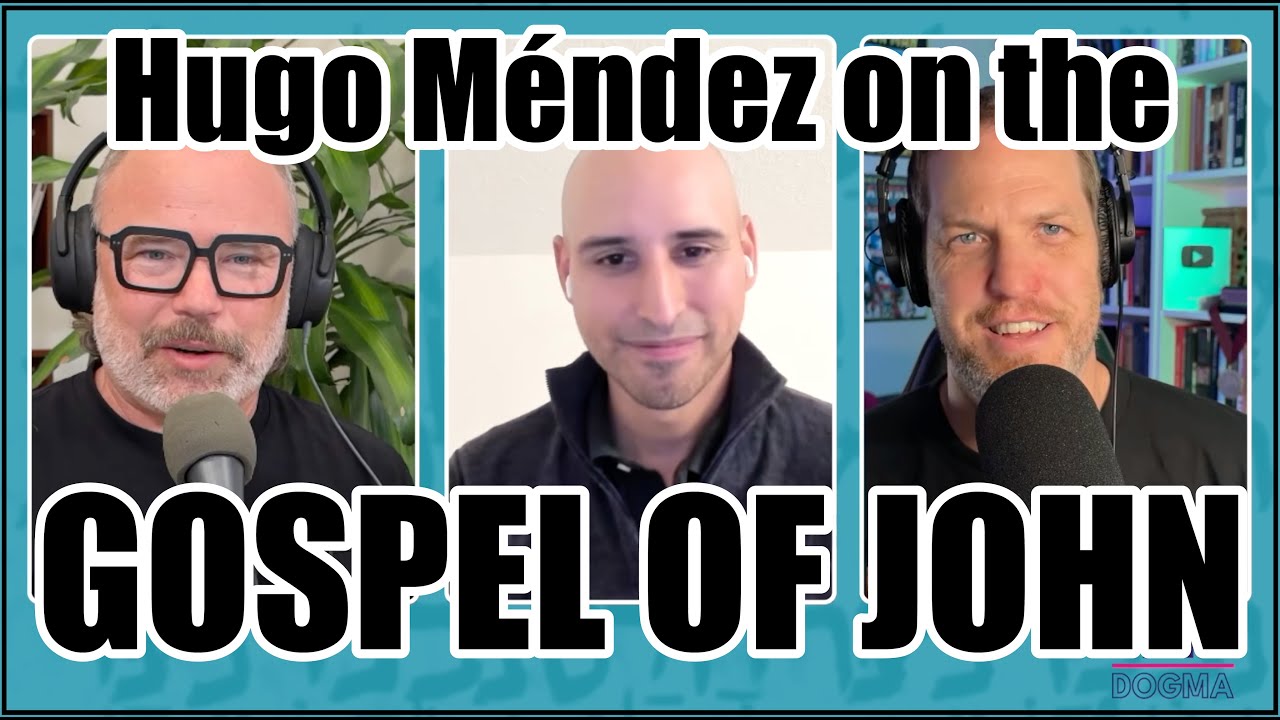
with Hugo Méndez
The Transcript
One thing I set out to do in this book was to really press the question: if John knows the Synoptics, which I argue he did, then why does he want to change them in the way that he does? What does he add to them that’s different? Something new that I do is I put together a very different theological vision of the Gospel of John
than I think has really existed in any other book that’s out there right now on the market. Hey, everybody. Hey everybody, I’m Dan McClellan. And I’m Dan Beecher. And you’re listening to the Data Over Dogma podcast, where we increase public access to the academic study of the Bible and religion, and we combat the spread of misinformation about the same. Again, in those pleasing baritone voices. Mine a little more so than usual. Your voice is a little nasally baritone today because you’re—. It’s pleasant. Alas, you’re sick. Yes. I’m just, I’m sympathizing with you. I brought home from Dragon Con in Atlanta, I brought home a number of comic books, a number of t-shirts, and a head cold. Yeah. Which I’m not happy about, but—. Apparently you’re allergic to dragons. Anyway, we should introduce our guest. We have a guest this week on the show. Please say hello everybody to Hugo Mendez, who is associate professor of religious studies at the University of North Carolina at Chapel Hill, in case you were wondering. Thanks so much for being here, Hugo. We appreciate your time. Thank you all so much for having me on.
But you can say Septuagint studies if you want.
I said nothing of the sort. But I will say that John is a really interesting, like, there’s a lot going on with the ideas surrounding this gospel and subsequent epistles and who all knows what else is also attributed to the name John. And so I’m looking forward to getting into this. Should we just dive right in here?
Well, I wanted to bring something up real quick. You mentioned the epistles of John, what is frequently referred to as the Johannine Community. But you’ve published a handful of things in recent years. You have a problem with the notion of a Johannine Community. What is your beef with the Johannine Community?
Whoa, whoa, whoa. Before we get into what is the beef, let’s not define, because Dan will yell at me if I say define, but let’s understand what we mean when we talk about a Johannine Community. And then move from there.
Yeah. Yes.
Take it away.
Yeah, that’s perfect. No. So in the New Testament, we have 4 books that historically were attributed to a figure named John. Really 5 if you add Revelation. But the 4 that we’re really interested in as scholars— okay. Yeah. The 4 that we’re interested in as scholars today are the Gospel of John and the letters that are called 1st John, 2nd John, and 3rd John. John is one of the big gospels. 1st, 2nd, and 3rd John, they’re tucked away in the back of your New Testament, right before you hit the Book of Revelation . Take a left at Jude and you’re there. Yeah. So these books are really interesting because they share a number of similarities between them. I mean, the moment you open up the Gospel of John and the moment you open up 1st John, it just smacks you in the face that these texts have some sort of relationship. You’ll hear a lot of keywords: beginning, word, life. It talks about this word, this logos, which is somehow communicated truth.
And the authors of each of these texts present themselves as people who have seen this word in this world somehow become flesh, in the words of John. And so the consistencies between these texts, the similar language, the similar themes, the similar ideas, have been for 2000 years, nearly a real source of interest for Christians in antiquity and in the Middle Ages. The explanation that was given for the profound similarities between these texts was that they must have shared a single author, that they must have been written by a single hand. And that author, not surprisingly, from the titles that later scribes put on these texts, was thought to be John, the son of Zebedee, one of the 12 disciples of Jesus, one of the closest disciples of Jesus.
Right.
What happened in the 20th century is that scholars thought, you know, examining these texts more closely, in fact, there are subtle differences in the language. There are subtle differences in the themes and ideas. And so instead of just imagining one author, they imagined multiple authors. But you have to explain, why are these texts so similar? Why the same language? Why the same ideas? And what scholars developed was the idea of a Johannine community, the idea that even if we’re looking at multiple authors, these must have been authors that were somehow connected to one another, that were all in the same community or something.
Yeah, one of the things that I wanted to ask, or to clarify here, is that when these texts first appeared, they didn’t have any names attached to them. Is that right?
Yeah, no, so for various reasons, I think the majority of scholars think it’s very likely that, you know, the biblical texts as we have them simply didn’t have titles at the beginning. It’s not hard to understand this in most cases, right? Usually at the top of a letter you write to someone, you don’t write, Second Hugo at the top, right? I mean, this is very clearly the kinds of titles that later scribes would affix for the letters and then also for the gospels, we think, as well.
Right. Okay. So that explains why there is some question as to who wrote these things. So sorry, I just wanted to get that out there. Go on with what you were saying about this community.
Now, if I may jump in real quick, do you think this community concept was a way to maintain the unity while also acknowledging the diversity, or do you think it has other origins?
Yeah, totally. It— on the one hand, it rested on an assumption that a lot of people had in the mid-20th century, scholars had in the mid-20th century, that the Gospels as we have them must have been transmitted, that the traditions within them in oral forms, perhaps in written forms. And if you’re going to talk about tradition and handing things down, you kind of need people to do that. You need a community. But even more so in the case of the community we’re talking about here, this Johannine community, there was a real need to explain why the gospel and epistles look so similar to one another. And so the common language, common ideas led people to suggest a common community. The way that I explain this to my students is, You know, if you hear two people say they’re going to mass, I can promise you they’re not Southern Baptists, probably. Right. You know, it’s the kind of language that is very closely associated with a particular religious group.
The reality is that different religious groups develop their own social dialects, right? Their own kind of ways of speaking as a group that represents something of their distinctive vision, distinctive outlook. And so when scholars looked at the Gospel of John and the letters of John, which are texts that are very similar to one another, but somewhat dissimilar, sometimes very dissimilar from other texts in the New Testament. They imagine that somewhere on the landscape of first century Christianity, there was some group that spoke this way. The common expressions are things like word and life, abiding in Jesus, themes like doing the truth, etc. These are very distinctive of these texts. And so the idea was these must come from some Christian movement that articulated their faith in this way, a Johannine community, a community that is John-like. That’s really what that adjective means.
Okay.
So, but where I take it from your book that you’re moving away from that idea, from the idea of the community writers.
Yeah. So in the year 2020, I published an article called Did the Johannine Community Exist? You can find it online. It’s open access. So anybody who’s listening to this can easily pull up that academic article. And the abstract for that probably should have just been one word: no, I don’t think that the Johannine community existed. And the reason is that when I’m looking at the Gospel and Letters of John, it strikes me that the similarities between them are not simply a matter of coincidence, of the idea that maybe these authors had a common extraction. The best way to understand these similarities is that one author is very clearly— each author really is copying from other authors. So in antiquity, you know, there are— and we can find instances of this in the New Testament, in the Bible, right, where individuals have access to earlier texts. And what they decide to do is to imitate the style of those earlier texts often in an attempt to try to look as if they are writing texts written by the same author as some other work.
So this is the phenomenon we call pseudepigraphy in ancient Christianity and beyond, right? Classics, other fields. So pseudepigraphy, you know, kind of, you know, my colleague Bart Ehrman prefers the vocabulary of forgery, but something where an author is using another person’s name for some reason. Forgery tends to be a little negatively loaded, so we don’t tend to use that as as a field. Um, but that’s basically what I see happening in 1st, 2nd, and 3rd John. I think the authors of 1st, 2nd, and 3rd John knew the gospel. I think they loved the gospel. I think they also saw how attractive and popular the gospel was. And I think they also in some ways saw what the Gospel of John didn’t do when it was first published. And so they wrote letters that present themselves as if they’re works, supplemental works by that original author, but addressing new sorts of challenges, exploring new sorts of directions. And we would have plenty of analogs for this in ancient Christianity.
You know, Paul wrote letters and we know that other people wrote letters in the name of Paul, some letters that probably made it into the Bible and some letters that definitely did not. And I think that’s likely what’s happening with these texts. They’re not necessarily from a single community. Instead, they’re from authors who read one another’s work, who might have been located in actually very different communities, geographies, settings.
Now, real briefly, uh, Robin, uh, Walsh has written a bit on the origins of, of early Christian literature, and she contends that we’re— we should be talking more about literary communities rather than communities of faith anyway. I’m curious where you stand on what social level the authors of these texts are operating.
Yeah, so I’m very sympathetic towards the work of Robin Faith Walsh and before her, right, her doctoral advisor Stanley Stowers in suggesting that when we think about where a lot of early Christian literature comes from, the go-to historically in scholarship has been to think of ancient Christian churches as being a very formative place. And, and I don’t want to detract from the idea that, you know, oral and written traditions about Jesus did flow through these communities. But the writers that we see working in the New Testament are individuals who had higher than the Christian average, higher levels of literacy. Uh, there are people who had been trained to be literate. They had read, uh, really kind of gulped down large amounts of ancient literature just as part of even their training in writing. And they formed networks of people who interacted, engaged with one another, if not personally sharing writings, sharing drafts, improving one another’s work, then at the very least they were definitely at least reading the work of others.
Reading the work of famous writers from the past, reading the works of contemporary writers. And these two are important and powerful influences for the texts that became part of the Bible.
Let’s talk a little bit about the Gospel of John . You know, since we’re, since we’re on this track, let’s talk a little bit about the authorship of that, because, you know, we’ve been talking about authorship You mentioned in the book that the character of John in the other Gospels or in the New Testament was a fisherman who was very unlikely to be literate at all. So the attribution of this book to that character remains unlikely also. Yeah. But that’s not the only reason to believe that he’s not the author, right? Talk a little bit about why we don’t believe that the character of the disciple John would’ve written this.
Yeah. So right from the start, when you read the Gospel of John , you’ll see in chapter 1, verse 14, that the author seems to present himself as someone who has seen Jesus in his lifetime. He says that the Word became flesh and dwelled among us, and he’s talking about Jesus becoming a human being. And he says, and we have seen his glory. He positions himself as someone who’s seen this figure. If you keep reading the book, you start to see this character show up, this disciple whom Jesus loved, who seems to be Jesus’s closest disciple. On the night of the Last Supper, this disciple is leaning on Jesus himself. He’s the very first person to essentially be at the empty tomb. He stands under Jesus’s cross when everyone else abandons Jesus. He’s everywhere. Everywhere in the book, by the end of the book. And then at the end, very end of the book, in chapter 21, verse 24, you hear the text say that this disciple, this disciple whom Jesus loved, is the one who has written this book, the one who has written these things.
So the question is, who is this disciple? Now, there are great reasons for thinking historically that maybe it could have been someone like John the son of Zebedee, one of the apostles of Jesus. If you turn to Mark, Matthew, and Luke, he is one of the three closest disciples to Jesus. Well, you know, this disciple whom Jesus loved is very close to Jesus. He would make sense as, you know, potentially being John. They could be related that way. But that is kind of almost as far as it goes. There are lots of other attributes of this disciple that don’t fit, pardon, quite neatly with John the son of Zebedee, as presented in the Bible. So one of them, as you mentioned, is the fact that, well, for one thing, John is presented to us in Acts chapter 4 as someone who is illiterate, someone who didn’t know how to write, someone who was never trained to write a gospel. So the idea that John would be the author of an entire complicated work, let alone a work that’s as theologically sophisticated, as philosophically sophisticated as John, you know, kind of seems a little different.
Other details about this disciple don’t seem to match up either. In chapter 18, it seems that this disciple, who in that chapter is called the other disciple, is someone who is supposed to be a friend of the high priest who has special access to the high priest’s home. The John we know from Matthew, Mark, and Luke is a simple fisherman living in Galilee, working on the Sea of Galilee. He lives nowhere near Jerusalem, let alone is he involved with the highest echelon of Jerusalem society. For various reasons, you know, by the 20th century, scholars looked at the traditional attribution of the gospel to John the son of Zebedee and thought that this isn’t quite the fit we want for authorship. We need to be looking for another author.
Now, something that, that I’ve frequently said when I’m talking about at least the compositional unity of John is you’ve got some weird, what I’ve called perhaps editorial seams. And in the past, I’ve pointed out you’ve got things like Jesus is sermonizing in Jerusalem, and then the next verse says, “And then they crossed over to the other side of the Sea of Galilee,” which is at quite a distance from Jerusalem. Or Jesus says, “All right, let’s go,” and then he sermonizes for 3 more chapters, and then the next verse says, “So they went.” And and I think there are some scholars who would say that maybe the Logos hymn at the beginning of John also is indicative of some disunity. But you are arguing in this book that there’s one main author for John, but you do mention a few places where you think there has been addition to the Gospel of John . Can you talk a little bit about the unity of John, but also these places where people have added to the gospel?
Yeah. So for all the reasons you mentioned, right, there has been this notion for a very long time, for decades in scholarship, that John might have been a work that might have been assembled by different authors sequentially expanding a gospel, editing, re-editing a gospel, and that in the process of all that, they introduced all of these weird skips, right? They, like you mentioned, like in chapter 5, Jesus is in Jerusalem, and then in chapter 6, suddenly he goes to the other side of the Sea of Galilee, which is nowhere near Jerusalem. It’s the equivalent of saying Jesus is in North Carolina, and then he went to the other side of Lake Michigan, which really makes no sense geographically. Right. And so scholars thought this is an explanation that could work. I would say that the trend now over the last several years of Johannine scholarship has been to say that instead—and this has been something even the last few decades—there’s just so much unity beyond those little skips, though.
You know, if you look at John across, you know, so many chapters of the book, you’re going to see a very similar language and style. You’re going to see very simple patterns of Greek and very predictably you know, Johannine patterns, you’re going to see an impressive unity in the terminology that’s used, an impressive unity of thought. You know, another example you gave where Jesus in chapter 14 says, you know, I can’t talk much longer, and then he talks for another 3 chapters, you know, is kind of odd. But if you look at what he’s talking about on both sides of that verse, it’s actually a really cohesive, coherent, rich continuous, basically, speech. So the way that most scholars, I think, today think about it and the way that I argue in the book, I think it happened is that we’re probably instead looking at really one author, one author that had a very clear vision of what he wanted to accomplish in the gospel, one author who had a very distinctive style that is impressed all across the gospel, but an author who developed his gospel gradually.
You see, one thing we don’t quite understand sometimes is, you know, modern readers of these texts is that ancient authors developed these gospels, these very large books in stages and steps, and they worked and they reworked manuscripts. An excellent book that’s just been recently published on this is James Barker’s Writing the Gospels. And in chapter 1, James notes that, you know, oftentimes what we should imagine gospels as in terms of how they were written is that authors were sketching out potentially particular stories on one tablet, maybe another tablet, maybe reworking them before they ever actually hit their final scroll. And so we can imagine an author who, over the course of developing a manuscript, worked, reworked, put his drafts together, reworked even those drafts, and gradually compiled something that, yeah, ended up having a skip or seam or two.
I mean, my book has a skip or seam or two if you look very closely, and the occasional typo that missed the press, and all the kinds of things that modern books have. Ancient authors were just as prone to those sorts of things in antiquity.
I mean, they didn’t even have the advantages of Clippy, let alone all the things that we had. So yeah, it makes sense that editing might have been a little more cumbersome of a process back then.
Yeah, and so that can lead to these kinds of issues. Yeah. Yeah.
But you— but, um, and I, and I, uh, like bringing this up in videos from time to time as well. You mentioned earlier toward the end of John 21 , this is the disciple who wrote these things, but you skipped over the very next clause because it wasn’t relevant to the point you were making. But the very next thing that the author says is, “And we know his testimony is true.” And who’s we? Now, you bring up that you think the entirety of John chapter 21, and many other scholars think this as well, is a secondary addition to the Gospel of John , that it originally would have ended at the end of chapter 20, ties it off with a nice little rhetorical bow, that gets repeated again at the end of chapter 21. But what about these additions to John? What can you say about those?
Yeah. So, so in the book, I identify two passages as additions to John. So even though I think one individual is responsible for most of this gospel, which of course is what tradition says and again, what a lot of scholars today would say, there are two passages that are problematic. The first is it begins in chapter 7, verse 53, and goes on into chapter 8. It’s the story of the adulteress, the pericope adulterae. This is a story where Jesus is presented with a woman who apparently has been caught in the act of adultery. She’s dragged before Jesus, and Jesus is presented with this test of whether or not we should stone this woman. It’s a kind of test that reminds you a lot of the Gospels of Mark, Matthew, and Luke, where Jesus is put on the spot and then he comes up with a brilliant one-liner that gets him out of the situation. And that’s exactly how it works in John. The problem with this passage is that we don’t find it in any manuscript before the 5th century.
And so it’s just, you know, we have lots of manuscripts of John. We can date many of these earlier than the 5th century. And this story doesn’t appear in there. It seems to be a later addition that someone added to the text. It doesn’t help that one early reference to probably this story places it in a different gospel altogether, the Gospel of the Hebrews, supposedly. But there’s another passage, right? Chapter 21. It’s the final passage of the book, the final chapter of the book, where you’ve— if you’ve read the Gospel of John and you’ve gotten to the end of chapter 20, the disciple who’s narrating this book, or the author of the book anyways, the narrator of the book, goes ahead and tells you that there are actually lots of other things that Jesus did that I didn’t have time to talk about in the book, but I wrote these things so that you may believe that Jesus is the Christ, the Son of God. He kind of puts this beautiful bow on everything he’s done in 20 chapters. It’s an appropriate ending for a book. We know this because we see other ancient books that have this kind of ending in antiquity.
But another reason why we know it’s a good ending for a book, it is literally the ending of the book. A chapter later, what happens is after chapter 20, after the author has told you there are lots of other things that Jesus did, he starts confusingly narrating something else that Jesus did, right when you don’t expect it. And then, you know, the chapter wraps up with yet another one of these, oh, you know, there’s so much more that we could talk about, but not all the books in the world could contain all these things.
So, so Dan’s bringing up how in chapter 21, verse 24, right at the end of this extra chapter of the gospel, in that very same verse where the narrator explains who’s actually writing this, the narrator says, this is the disciple, this disciple whom Jesus loved. This is the disciple who is testifying to these things and has written them. And then the narrator says, and we know that his testimony is true. And one of these, you know, big kind of questions is, well, what’s going on in this verse? You know, the author has just said supposedly that this one disciple has written these things, that there’s one author to the book, and here he is, the disciple whom Jesus loved. But then suddenly we get this we language at the end of the verse, and we know that his testimony is true. And I know many scholars who think that that verse probably means that there might have been an author of something like a core of the gospel, but that there’s like a we, some maybe group of people who have completed the gospel or who are editing the gospel or who are doing something here to compile all this material.
And that’s certainly one way that we can understand this we. But one of the things that I argue at length in the book in chapter 4 is that there actually is, I think, a simpler explanation for this. If you look closely, that verse, for one thing, is very clearly modeled on a few other verses in the Gospel of John . And one of them is 1:14, where the author of this gospel, who seems to be closely identified with his disciple, has also used we language. He says, you know, we have seen his glory. And what I do is I kind of break down this verse and show that actually it answers to a few different verses in the Gospel of John linguistically. I think what the author has done is he’s smushed together language from different parts of a gospel, some language coming from parts where the author is used to referring to himself in the third person, some where he’s used the first person plural, we. And in this case, it’s kind of jarring that he skips from a third person he reference to a first person plural we reference.
And then the very next line, verse 25, he skips to a first person singular I way of talking about himself. But we actually see this a lot in antiquity. We see this in Polybius. We see this in Josephus. We see writers who kind of moved between he, we, I language, they language, when speaking just about themselves as narrators, sometimes in really tight spaces. And so I think the traditional interpretation that suggested there’s just one author for this entire book, we language be damned, I think is actually close to the truth.
Okay. Now, and that brings up the chapter 1, verse 14 part of the Logos hymn. Which I see— I don’t know if some people have said this is a pre-Johannine hymn that was just picked up, other people think it’s secondary. What are your thoughts on the Logos hymn, which is another indicator that, you know, the fisherman John is not like, “Well, I was reading in Philo, and you know how Philo likes this Logos theology, and this is the Logos Prophorikos that we’re talking about here like this. This is not the language of a fisherman.” But what are your thoughts on the Logos hymn and Johannine or the singular authorship?
Yeah. So in chapter 1, if you read the Gospel of John , chapter 1 has a little bit of a different style than other chapters of the book. It honestly feels more poetic than the rest of the book. And, you know, those words very famously that begin the book, In the beginning was the Word, and the Word was with God, and the Word was God. He was in the beginning with God. It’s very beautiful, kind of repetitive, and again, kind of poetic. And scholars have looked at that chapter and thought, well, you know, it’s different in style a little bit. It feels a little more elevated in style than the rest of the book. They’ve also noticed that in that first chapter, the author talks about Jesus as the Word, as the Logos. And this is a concept from Greek philosophy that becomes important in Hellenistic Jewish philosophy, right? Like the writings of Philo. What they note, though, is that this word logos, word, doesn’t really seem to be distributed across the entire gospel.
It’s pretty much just there that Jesus is described as the logos or word. And so some scholars have thought, okay, so this is yet another sort of seam in the gospel where maybe this part in the KitKat bar of the Gospel of John can break off neatly and you can treat this as maybe something that was added later because it’s poetic in style. People have thought, okay, so maybe this is like some early Christian hymn or something like that that was added to the text in the book. What I argue is, and not even actually really an argument in the book, this is really something that I think a lot of other scholars are really talking about right now is, you know, those arguments are interesting. But the reality is, when you read the Gospel of John , that prologue, that introduction is really critical for how the gospel develops all sorts of themes and ideas. It’s often considered even something like a hermeneutical key to the rest of the gospel.
Scholars like Adele Reinhartz bring this out. To the point where if the hymn wasn’t originally there, it doesn’t quite feel like the Gospel of John would be as complete as it is in its current form. Another thing that, you know, numerous scholars have noted, and I really try to bring this out in the book, is that it’s true that Jesus is only called the Word or Logos directly right at the beginning of the text. He’s also, by the way, only called God really right there at the beginning of the text. But you would be hard pressed to read all kinds of verses in John without the knowledge that Jesus is divine and that Jesus is on some level the Word of God, the Logos of God, and at least the words that Jesus speaks, the logos that Jesus speaks in Greek, are actually a really critical theme in the rest of the gospel. So I’m one of those people who has been persuaded that we want to keep chapter 1 with the rest of the book. You know, the fun of scholarship is the debate, is the fact that we can have these different opinions.
But yeah, that’s where I stand.
Well, and that’s one of the things that I’ve, I’ve always wondered about that because it feels so different. But in my own work on John 10 and what Jesus’s argument is, why is he bringing up Psalms 82 where he— and I’ve argued in print that, that what’s going on here is he’s appealing to a specific interpretation of Psalms 82 . This is the Israelites at Sinai, and he says, “To whom the word of God came,” and he’s, you know, the Word made flesh standing in front of them. It does kind of bring out the full import of his argument if we use that as an interpretive lens. So that’s always been a challenge for me. It’s like, it doesn’t feel like the rest of John, but at the same time, it is so important to John. And you talk a bit in the book about theosis, divinization, deification as part of what’s going on in Johannine soteriology.
And that’s John 1:12 , where he gives them power to become the children of God. And these are some of the themes that I’ve talked about a lot. And, you know, of all the things that I say that infuriate the public, or at least the people who are unlucky enough to stumble across my videos, my interpretation of John 1:1 is probably the thing that infuriates them the most. And I’m sorry, Dan Beecher, to be bogarting.
Yeah, quit hogging the guest, Dan. No, no, go for it though.
I think these are such fun discussions.
Yeah.
Tell me about your thoughts on John 1 :1c, kai theos en ho logos.
Yeah, and the Word was God. Yeah.
So, and particularly the anarthrous nature of John 1 :1c. I’m just using technical language to make Dan feel uncomfortable. Uncomfortable. But no, I’m sorry, I’m just—.
No, no, you’re doing it to make our, our whole audience feel uncomfortable. They all— we all thank you, Dan.
That’s right. So there is no question that the Gospel of John understands Jesus as higher on the ladder of life than certainly the average human being who’s here below on Earth. Um, there is no question that John even understands Jesus fundamentally as divine. The question that’s kind of coming up is in John 1:1 , you have the words, in the beginning was the Word, and the Word was with God, and the Word was God. And in that instance, what you have at the very end of that verse is, and the Word was God, without a definite article in Greek. Greek. That’s what we mean by anarthrous. It doesn’t have a definite article. Now, what does that mean? So if you go to the writings of Philo, who is a Hellenistic Jewish philosopher of the early 1st century, Philo seems to have a concept of the Logos, of a word of God who is with God, the same kind of thing we’re finding in John.
Who else has it before him? We don’t know. We definitely know at least Philo has it. Aristobulus clearly had a logos idea, but we don’t know much of the particulars of that, etc. But for Philo, what he does in his writings in one place is make a distinction between the transcendent ultimate God of Judaism, which he uses a definite article for, if you will, the God, and then the logos, the word of God, which he conceptualizes as something like the mind, the rationality, the, the thought of God as an entity that, like anyone’s mind or rationality or thought, is with the person who’s thinking, but is also on some level abstractly distinct from that person. And this entity, the word, he doesn’t use a definite article for. He distinguishes the two based on his exegesis of a particular verse in the Old Testament that he—a Hebrew Bible that he thinks works really well for this.
I think that John is building on the exact same foundation. I think that John is swimming in the same streams of Hellenistic Jewish philosophy that understand that there is the God of Judaism, the ultimate God of the universe, but that this God interacts with his created universe through all sorts of intermediary beings. And the highest of these beings is his own abstractified mind, reason, or thought. His word, his logos. And so it’s not surprising to me that at the beginning of the Gospel of John , we have a reference to this word. We have a reference to how this word is with God. And at this crucial moment, there’s a reference to how this word was God. But the definite article isn’t there. This word is not, I think, in the Gospel of John ’s conception, the ultimate God of the universe. But this is a divine being, an entity, a being who has, I think, in John’s conception, a subordinate participatory divinity.
It’s divine because of its oneness with God, in its oneness with God. And Christian theology has tried to work out that relationship for centuries. Perhaps not arriving at the same sort of synthesis. That’s what I see happening.
So, so it’s, it’s not quite Nicene in—.
Yeah, I always tell my students. Yeah, I always tell my students, you know, Nicene theology is the cake. The ingredients are eggs and flour and sugar, and they look nothing like cake, but you absolutely need them for cake. I think John’s theology wasn’t quite that of of Nicaea and First Constantinople and these sorts of ecumenical councils. But yeah, they’re going to play a role one way or the other, but in synthesis.
Let’s dive a little bit into the theological innovations of John, because one thing that we hear— when I do this show, I don’t know anything, but Dan talks a lot about the synoptic gospels, meaning the gospels of Matthew, Mark, and Luke. And then distinct from those, and the fact is that John is not included in those synoptic gospels because it is such a different entity.
Yeah.
Uh, even though like we think of gospel, when you think of the gospels, you think Matthew, Mark, Luke, and John, like you just rattle those off as a thing. But like, what, what are the, what are ideas that Christians now take to be gospel that would be lost if we didn’t have the Gospel of John ?
Oh, that’s a great question.
Is that a fair way of wording that?
Yeah, that’s great. If you didn’t have the Gospel of John , you would possibly not have a Christianity that viewed Jesus as much divine as Christianity will eventually do it. I mean, I mean, when it comes down to the councils that define the Trinity, they’re reading John, they’re reading John intensely and closely. The church fathers like Athanasius, who are developing Trinitarian doctrine, the Cappadocian Fathers, they’re intense readers of John because John is the book that blows the whole cosmic cover off Jesus. If you read Matthew, Mark, and Luke, you have the idea that Jesus is a human being. In different parts, it looks like Jesus is a very special human being. Perhaps even a supernatural human being, perhaps something greater than a human being. And the Transfiguration scene, for instance, in Matthew, Mark, and Luke, Jesus suddenly appears as light in front of his disciples.
And if you’re a casual reader of that text, you’re wondering, well, heck, I can’t do that. He’s got something going on supernaturally that I do not have. But it’s only the Gospel of John that will tell you straightforwardly Jesus is—and I agree with Dan again, the best translation is divine—that associates him frankly with a preexistence at all, where right at the beginning of the book it tells you in the beginning, in the beginning of this whole world, echoing Genesis, there’s Jesus at the very beginning.
Different concepts like that flow out of this gospel. At the very least, the terminology we use flows out of the gospel.
I think it’s very interesting to hear, to look at John as its own distinct thing and see—one of the things that you talk about a lot in the book is the symbolism of John and how John, other books, use symbolism, but not to the extent that this book grabs onto it and carries it away. Do you want to talk a little bit about the symbols that John uses to explicate the theology?
Yeah. So let me just start by saying John is my absolute favorite gospel, and that should not surprise anybody who has to pick up a book with my name on it. No, but it’s, it’s such a brilliant, incredibly fun text to play with. So the Gospel of John knows the Gospels of Mark, Matthew, and Luke. I think, I think it’s read some of these earlier accounts of the life of Jesus, which is in part why it looks kind of so similar to them. It starts with the baptism, ends with an empty tomb. You know, there’s something that feels like earlier Gospels about that. John also knows some of the literary techniques that earlier Gospels have used. If you read good books on Mark, you’ll learn that Mark has occasional places where he plays with symbolism, where just like the parables of Jesus, the stories Jesus tells symbolize ideas. Mark also weaves in a story or two where Jesus does something that seems to symbolize something in his teachings. He flips over the tables of the temple right about the time he’s also telling you how the whole temple is going to be destroyed.
And it seems one thing symbolizes the other, you know, things like that. In the Gospel of John , whoever wrote the Gospel of John , that author took this literary device and decided to run with it across the gospel and did it in, I think, such a rich and creative way where, as I argue in the book, nearly every story in the Gospel of John , the miraculous ones and the non-miraculous ones, the very memorable ones and some of those weird transitional sort of things that you just think is just continuous story have been turned into symbols. John is not simply interested in telling you that this happened or that happened in Jesus’s life. He’s not here to necessarily say Jesus did this miracle, then Jesus did that miracle, then Jesus did this interesting thing. John wants you to dwell on each of these stories, to reflect on them, and to see that inside these stories is something that represents a big idea in Jesus’s teaching.
Jesus talks across the Gospel of John , and he uses these really important keywords, right? Believe, hour, you know, life is a key word in the gospel. Dwell or abide is a key word. When you turn to the stories in the gospel, these stories are replete with these words. You’ll see that these stories of Jesus’ miracles weave in these key words in ways that turn the miracles themselves into, if you will, sort of parables of sorts. There are ways in which Jesus, by his gestures, by his actions, actually represents ideas in his teachings. And this comes out all the time in the text because Jesus will do something in the, in the gospel, and it says that his disciples didn’t understand what he was doing. For instance, he washes their feet in chapter 13, and it says that the disciples—get it? Well, the reason, if you can look closely at the language of the text, is that Jesus is doing things in ways that are evoking the key words of his teaching.
So in the book, in what is my favorite chapter of the book, Chapter 3, I go story by story in the Gospel of John , ones that scholars talk about, ones that scholars haven’t even considered yet, ones that pass the average reader over. And I show how everything we think about, know about the theology of John is actually expressed through the gestures of Jesus.
Now, you—indeed, the, the subtitle here is A New History. You have some new things to contribute to this, and obviously not just a survey of, of the events of, of the Gospel of John . What is the takeaway from this book when we’re thinking about the Gospel of John , where it comes from, what it’s trying to do?
Yeah. This book was a ton of fun to write. It was a ton of fun to write because it broke the most essential rule that I always tell my grad students, which is you should offend the fewest persons possible. You should, you know, and usually as a scholar, you know, I always kind of tell people you got to, you got to get from point A to point B while trying to rock as few boats as possible. Do something like that. And this book doesn’t do that. It’s a new history of John. Insofar as it takes a lot of decades of scholarship and it tries to instead really voice a lot of the latest trends in the study of the Gospel of John . But in the midst of that, it also cuts against even some still very popular ideas in the field. It, it gets into just about every issue and it puts together, I think, a vision of John that hasn’t existed in all of its parts in any previous book. And even some parts of it are things you haven’t seen before.
So in terms of what it does, I think on the first— in the first place, it starts by saying John knew the Synoptics. This is something that a lot of previous generations of scholars were skeptical of. There have been great books that have just been published. James Barker’s book has argued that John knew the Synoptics. Mark Goodacre’s book is coming out probably by the time this is aired, The Fourth Gospel and the Synoptics, that will make this argument. What I’m trying to do, you know, both of those scholars are really great at talking about, you know, the fact that John used the Synoptics and demonstrating that. One thing I set out to do in this book was to really press the question, if John knows the Synoptics, which I argue he did, then why does he want to change them in the way that he does? What does he add to them that’s different? And that’s where it takes me. Chapter 2 of the book, something new that I do is I put together a very different theological vision of the Gospel of John than I think has really existed in any other book that’s out there right now on the market.
I—.
It’s a book that I think tries to get people who have never understood John to understand John and to get excited about a theology that feels very different from many of the ways that we tend as, for instance, Christians. I position myself as a Christian. The ways that we read this text, I think, don’t capture all of the complexity of it. I argue in Chapter 3 that the symbolism is so much more pervasive than we think in the book. That’s something that I think goes beyond some current scholarship that has recognized the symbolism but hasn’t seen it in various places. As I argue in that chapter, you have to understand all of John’s theology to then understand all of John’s symbolism. And then chapters 4, 5, and 6 are really doing this really important work of saying that John isn’t just a gospel in the ways that I think traditionally Christians have thought of it, as scholars have thought of it in recent decades, that it’s, you know, potentially one author sitting down recording a history of the life of Jesus, or it’s an entire community gathering traditions.
What I argue is that this is fundamentally a pseudepigraphal work. Work, right? It’s a, it’s a work by an author who presented himself as something he was not, as an eyewitness to the life of Jesus. But that’s only part of the story. What’s interesting about this gospel is that the author did this, and he also drew in other devices, techniques that we find in apocryphal, non-canonical gospels. I argue in the book that the Gospel of John is much more like the Gospel of Thomas, the Gospel of Mary, some of these so-called Gnostic gospels than it is like the other gospels of the New Testament. And the Gospel of John had an impact on Christian literature where it would spawn all kinds of pseudepigraphal literature in its wake. I argue that 1st, 2nd, and 3rd John reflect the Gospel of John as pseudepigraphal literature. I argue that perhaps Revelation is a part of this, other non-canonical works. So it’s really from cover to cover chock full of really new ideas that I’m excited to frankly debate with people.
Yeah, that’s one of the most exciting things about publishing something is licking your chops, waiting for somebody to come at you about something that you get to debate. Well, I hope you get an opportunity to debate an awful lot of folks about this. And one final question. Are you— I think you said that you prefer a date in the early 2nd century, late 1st or early 2nd.
Yeah. As my last spiel kind of pointed out, I’m non-conventional on a ton of issues in John. I am extremely conventional on this one. I think it’s somewhere between 90 to 110. I think if you lined up 10 John scholars, they would probably tell you just about 90 to 110.
Okay. And so you’re putting—.
Exception—.
Are you, are you putting Luke, uh, so you’re putting Luke prior to that, or including the, uh, the first 2 chapters of Luke? You think those are, are late 1st century?
Oh, that’s a different question. Yeah, I’m actually very, very amenable to the idea that Luke originally did not have chapters 1 and 2. Now, is that a factor? I mean, did Luke with chapters 1 and 2 predate John? I would say that if they weren’t originally part of Luke, then the answer would be no. I think they would have come later than the Gospel of John .
Okay, awesome. Well, just a little minutia there, Dan. I just wanted to get out of the way.
- I like it. I like it. It’s fun. It’s fun to hear about. And, and I think, I think a lot of people are going to want to check out the book. Again, it is called The Gospel of John
- A New History. Hugo Mendez, thank you so much for joining us.
Thank you all for having me. This is really fun.
And friends at home, if you would like to become a part of making this show happen and potentially hear Hugo— are you going to stick around? We do an after-party. We do some bonus content for our, for our top patrons. Uh, will you stick around for that?
Yeah, I’m game for that.
All right, so if you want to hear some more Hugo, and I know you do, uh, go to patreon.com/dataoverdogma where you can become a part of the community that helps keep us going.
And, and this community exists, by the way.
Yes, this community. You’ll hear rumors flying around about this just not being real, but the Johannine community is real. So we’re going to—.
I thought we were the Danites or the— We are the Danites.
The tribe of Dan.
Tribe of Dan. But yes, that’s a real community and you can join and help become a part of making the show go. And you get ad-free version of every show. It’s early. It’s great. So head on over to that. Thanks so much to Roger Gowdy for editing the show. Uh, that’s it for this week. Hugo, thanks once more, and we’ll talk to y’all next week.
Bye everybody.